Cleaning Guides · 5 min read · 2 April 2026
How to Declutter Your Home: The Method Clearance Teams Use
Most declutters collapse at the halfway point, when everything is out of the cupboard and nothing has anywhere to go. Here is the sequence professional clearance crews use, adapted for a normal UK house.
By the Nims Casa editorial team — written from professional cleaning experience and checked against our editorial standards.
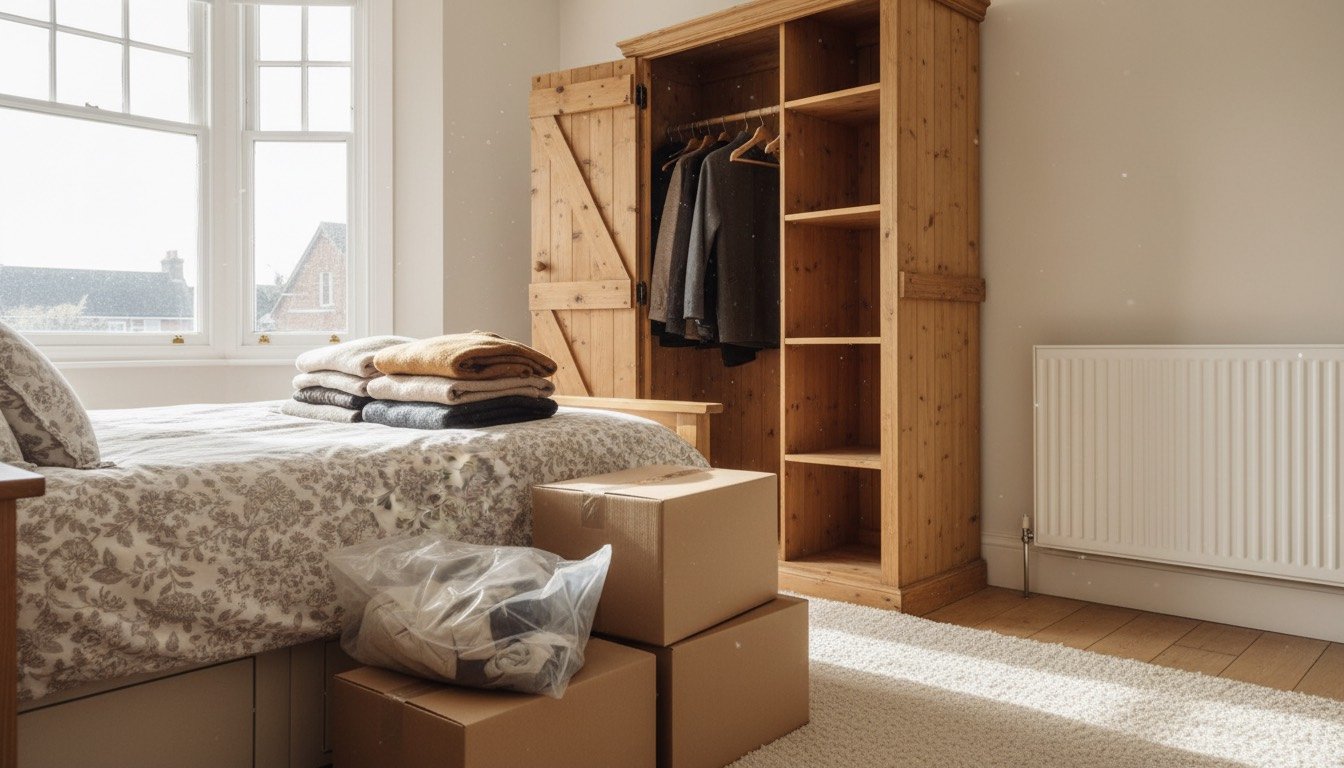
Most declutters fail in the same place: the middle. Everything is out of the cupboard, the living room floor has vanished under carrier bags, and nobody has decided where any of it actually goes. Clearance crews never allow that stage to exist. They agree the exit routes first — charity, resale, recycling centre, waste — and only then open the first door.
What follows is that sequence, scaled to a three-bed semi and a normal weekend. It assumes limited time, nowhere obvious to put things, and possibly a landlord who will inspect at check-out.
Safety first: the parts that genuinely go wrong
Decluttering injures people more often than it should, almost always in the loft or the garage.
Loft floors in most UK houses built before the 1990s are not floors. The joists are typically 75–100mm deep and were sized for plasterboard and insulation, not you plus forty years of paperwork. Stand on the joists, never between them, and if you board out, use raised loft legs so you do not crush the insulation flat and create a cold spot.
- •Asbestos: textured coatings, old garage roof sheets and some airing-cupboard panels pre-2000 may contain it. Never saw, drill or snap these — get a sample tested for £40–£70.
- •Lifting: two people for anything over 25kg, and empty the drawers before you move the chest. Most bad backs come from a fully loaded wardrobe.
- •Dust: an FFP2 mask costs about £1 and saves a two-day cough.
- •Old chemicals: paint, thinners, weedkiller and aerosols go to the recycling centre's hazardous bay, not the wheelie bin.
- •Electricals: anything with a plug or a battery is WEEE waste — recycling centre or retailer take-back.
Tools and materials you actually need
This is a low-kit job. Resist buying storage before you have decluttered: you will buy the wrong sizes and simply relocate the problem.
- •Four sturdy containers per zone — keep, relocate, sell or donate, bin. Boxes are fine; 60-litre crates (£9–£14) are better if the job runs over weeks.
- •Heavy-duty rubble sacks rather than kitchen bin bags. They survive being dragged downstairs.
- •Masking tape and a marker. Unlabelled boxes become permanent boxes.
- •A tape measure — take internal cupboard dimensions before buying a single basket.
Realistic time and cost
Skill level: beginner. The difficulty is decision fatigue, not technique, so budget 30–90 minutes per zone and stop there. Decision quality falls off a cliff after about two hours.
Real timings: one kitchen cupboard 20 minutes; a full double wardrobe 90 minutes; a garden shed 3–4 hours; a boarded loft a full day with two people. A whole three-bed house, done properly, is 25–40 hours across six to eight weekends.
Costs are mostly disposal. Charity collection is free — British Heart Foundation and Sue Ryder collect furniture, though upholstered items must carry the fire-safety label. Council bulky waste is typically £25–£60 for three items, a man-and-van clearance £120–£350, a 6-yard skip £180–£320. Doing it yourself with a hire van and tip trips: £60–£90.
The method: eight steps, one zone at a time
Work zones, not rooms: one cupboard, one wardrobe rail, one drawer bank — something finishable in a single sitting.
- •1. Set the exits first: which charity collects, the recycling centre slot booked, Vinted or Marketplace decided. No exit, no declutter.
- •2. Clear a staging area — one empty bed or dining table. Everything lands there, not across three rooms.
- •3. Empty the zone completely. Half-measures mean sorting the same shelf twice.
- •4. Clean the empty space while you can reach it.
- •5. Sort into the four containers on a hard rule: unused for twelve months and not seasonal, sentimental or genuinely irreplaceable means it leaves. Eight seconds per item, maximum.
- •6. Put the keepers back by frequency, not category. Daily items at chest height, weekly at knee height, annual up high or under the bed. This is what makes tidy stick.
- •7. Get the outgoing containers out of the house the same day. Bags left in the hall get unpacked again within a fortnight.
- •8. Only now measure and buy storage, when you know exactly what is staying.
The renter-safe version: no drilling, no deposit risk
Tenants are routinely told to fit shelving and hooks, which is exactly how deposits get docked. Everything below is reversible and needs no screws; our guide to rental-friendly decor covers the finishing touches afterwards.
Two rules matter most: never dispose of anything belonging to the landlord, and photograph fixtures before you touch them. If a landlord's chest of drawers is in the way, move it on a blanket and note it in writing — do not sell it, however tempting.
- •Freestanding beats fixed: tension rods in alcoves, shelf towers and stacking crates do the job of built-ins with none of the risk.
- •Adhesive hooks rated to weight — most take 2–3kg. Avoid wallpaper and any wall painted in the last four weeks, and remove by pulling the tab straight down, never outwards.
- •Over-door hooks and back-of-door organisers on wardrobe and bathroom doors: free vertical space nobody uses.
- •Under-bed drawers and vacuum bags, sized to the 15–20cm clearance under a standard UK divan.
- •Bag and label every original fitting — curtain hooks, shelf pegs, blind brackets — for check-out day.
- •Genuinely short of space? Small-space storage ideas for narrow UK hallways and box rooms will get you further than self storage at £25–£45 a week.
Troubleshooting: where it stalls
Five failure modes account for nearly every abandoned declutter, and each has a practical fix rather than a motivational one.
- •Nothing leaves. You are alone in a room full of memories. Fix: one sealed, dated 'decide later' box, revisited in six months — and only one.
- •It all comes back. The homes you assigned are too high, too deep or behind a door. Re-home the five items that keep migrating, at the height you use them.
- •The wardrobe refills within a month. Fix: seasonal rotation, as set out in our wardrobe organisation guide, plus one-in-one-out on the rail.
- •The kitchen looks identical. Worktops are the symptom, cupboards the cause — zone the cupboards first, as kitchen cupboard organisation explains, then clear surfaces.
- •The garage swallows everything, because it is the overflow room by default. Get things off the floor and onto walls; garage and shed storage is the highest-value hour here.
When to stop and call someone in
Use a licensed waste carrier rather than a skip if you have no off-street parking — a skip on the highway needs a council permit (£30–£90) and lights. Always check a clearance firm's waste carrier licence on the Environment Agency register: if they fly-tip your things, the fine follows you, not them.
Stop entirely and get specialist help for suspected asbestos, an unboarded loft where you cannot judge the joists, a hoarding situation, or a bereavement clearance you are not ready for. Hoarding disorder is a recognised mental health condition and a weekend blitz makes it worse; a GP can refer to proper support.
Once the volume is down, keep it down with routine rather than another blitz. A simple weekly cleaning schedule does more for a tidy house over a year than any amount of sorting.
Found this useful?
There's plenty more — hundreds of guides and honestly-tested product reviews for every corner of your home.
Browse All Guides