Home Decor · 6 min read · 5 May 2026
How to Fix Peeling Paint (So It Doesn't Come Back Next Winter)
In a solid-walled Victorian house, paint almost never fails because the paint was bad. Work out what is behind the flakes first, then strip, stabilise and recoat so the repair holds past next winter.
By the Nims Casa editorial team — written from professional cleaning experience and checked against our editorial standards.
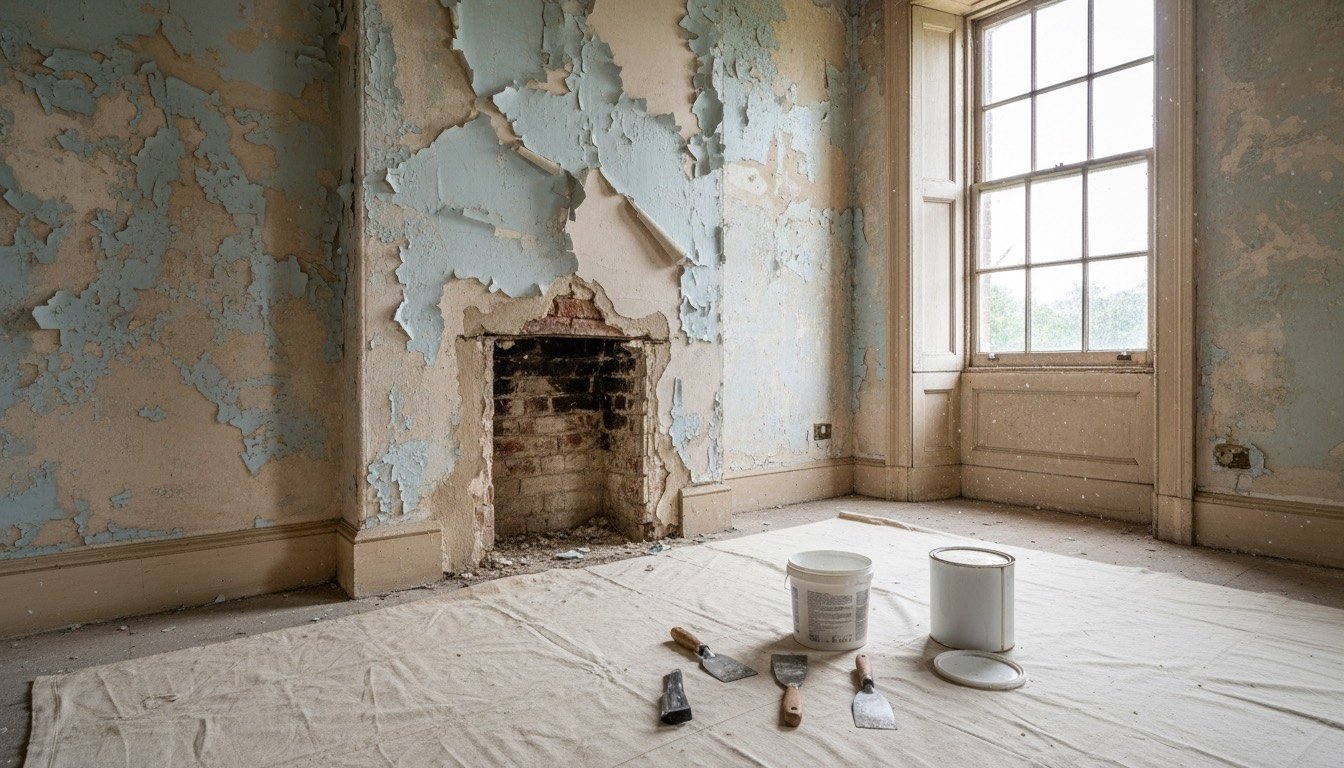
Paint rarely fails on its own. In a 1900s terrace it fails because the surface beneath it moved, got wet, or was never something a coating could grip. Repaint without asking why and you will be back at the same corner by February.
Older stock behaves differently. Solid nine-inch brick has no cavity, so the inner face of an exposed wall can sit 3-4C below room temperature and collect condensation behind an impermeable coating. Lime plaster on riven lath is soft and needs to breathe. Add distemper, chimney salts and a century of patch repairs, and shortcuts get punished. If the plaster itself sounds hollow, start with our guide to repairing old plaster walls.
Diagnose it before you pick up a scraper
Lift a flake with your thumbnail and look at the underside. What is stuck to the back tells you the cause, and the cause dictates everything else.
- •Chalky buff powder on the back, and a damp cloth wipes the wall to bare colour: soft distemper, common on pre-1930s ceilings. Nothing modern bonds to it.
- •Stiff plates several coats thick lifting off sound plaster: an impermeable coating, usually vinyl silk, over a wall getting wet from behind.
- •Bubbling 300-900mm above the skirting: rising or penetrating damp. Look outside for a bridged damp-proof course, a raised path or a blocked Victorian gulley.
- •White crystals around a blocked-up fireplace: hygroscopic chimney salts, which pull moisture from the air above roughly 65% humidity.
- •Black spotting on a bathroom ceiling: condensation, not paint failure. Fix the extraction and read our guide to damp and mould first.
- •Sashes peeling on the bottom rail and cill with cracked putty: water is getting behind the glazing line. Same story behind a leaking cast-iron hopper.
Safety first: assume lead until you prove otherwise
Lead was not banned from UK domestic decorative paint until 1992, and pre-1970s coatings on joinery can run to 40% lead by weight. On a Victorian house that is every original skirting, architrave, sash and door. A £10 swab kit answers the question in 30 seconds.
Never dry-sand it, and never burn it off with a hot air gun, which fumes lead above about 400C. Use a chemical stripper or an infrared plate at 200-250C, wet-sand with 180 grit, wear an FFP3 mask and vacuum with an M-class filter. Our lead paint safety guide has the full protocol.
Two hazards are specific to old houses. Heat guns near lath and plaster can leave horsehair and dust smouldering in the void for hours, and steam strippers near perished pre-1970s rubber-insulated wiring are a live risk. Isolate the circuit before soaking plaster near a switch or ceiling rose.
Tools and materials
Primer choice is where these repairs are won or lost; a self-priming emulsion will not stabilise a chalking Victorian ceiling. We have compared paint and primer in one against a separate primer on UK wall types.
- •Stiff 50mm scraper, flexible 100mm filling knife (£12-18 the pair) and a shave hook for sash beads
- •FFP3 masks, goggles, nitrile gloves and an M-class vacuum (hire around £30 a day)
- •Abrasive mesh in 120 and 180 grit with a rubber block, sugar soap and two buckets
- •Stabilising sealer such as Zinsser Gardz, £20-25 a litre, plus a shellac stain block for tannin and water marks
- •Powder filler (Toupret Interior or Easi-Fill 45) rather than tub filler on anything deeper than 3mm
- •A breathable clay or mineral topcoat for lime plaster, such as Earthborn Claypaint, 2.5L for £35-45
Realistic time and cost
A 300 x 300mm patch is 20 minutes of work spread over two days, because drying sets the pace. A 12m2 wall taken back and rebuilt is 6-9 hours across three or four days. Our interior painting cost guide covers the wider job.
- •Small patch: £15-25 in materials; one wall of 10-14m2, stripped and repainted, £60-110
- •Whole room including woodwork: £150-260 in materials
- •Decorator's day rate: £180-260, London and the South East at the top
- •Plasterer for a lime or salt-retardant re-skim: £250-380 a day; lead-safe stripping of joinery £45-70 per linear metre
The repair, step by step
On lime plaster, keep the whole build-up breathable: mineral primer, mineral or clay topcoat. Matt also hides wavy old plaster far better than any sheen, as our paint sheens guide explains.
- •1. Fix the water first: gutter, hopper, putty, extractor fan. Everything below this is wasted otherwise.
- •2. Let it dry. A wall that has been genuinely wet needs 4-8 weeks of heat and airflow, so start in spring, not November.
- •3. Scrape back to a firm edge, blade at about 30 degrees, until it stops lifting material.
- •4. Test for distemper with a damp cloth. If it comes away chalky, wash the whole surface off with warm water and leave it 48 hours.
- •5. Feather the edges wet with 120 grit and a damp block until you cannot feel the ridge through kitchen roll. Any ridge you can feel will telegraph through.
- •6. Sugar soap and rinse with clean water; residue is a common cause of second-time failure.
- •7. Stabilise with one full coat of sealing primer over bare and feathered areas. Allow 3 hours minimum, overnight in an unheated room.
- •8. Fill in two thin passes proud by 1mm, sand flat once set, and build anything over 8mm in layers.
- •9. Spot-prime the filler; it is far more porous than the wall and will flash through.
- •10. Two topcoats, with a 70:30 emulsion-to-water mist coat on fresh plaster. Recoat at 4 hours minimum, and never below 8-10C or above 80% humidity, which an unheated back bedroom fails in February.
Troubleshooting when the repair fails
- •Bubbles within hours: the surface was still damp, or stripper residue was never neutralised. Strip, dry, re-prime.
- •The patch still shows: the filler was not spot-primed, or you stopped mid-wall. Carry the finish coat to a corner or picture rail.
- •Peeling returns in the same band every winter: check the wall with an infrared thermometer on a cold morning. Below about 12C at 55% humidity you get condensation behind any coating.
- •Crystals push through within weeks: salt contamination, which no emulsion will hold. That plaster needs rebuilding in lime.
- •Sash paint lifts after one season: the glazing line was never sealed. Paint must lap 2mm onto the glass, and linseed putty needs 7-14 days to skin before it takes a coat.
When to stop and call someone
Call an independent damp and timber surveyor, not a free survey from a firm selling injection cream, if peeling comes with a musty smell, spongy skirting or hollow-sounding plaster. In old houses the cause is usually cement render, a bridged damp-proof course or a blocked gulley.
Call a plasterer if the plaster crumbles to dust, if lath has pulled away from the joists, or if a ceiling has dropped even 5mm. Lath and plaster fails suddenly and heavily.
Call a lead-trained decorator if the swab is positive over more than a couple of square metres, or if a young child or pregnant woman lives in the house. And judge the scale honestly: one weekend and £200 of materials to save £600 is a fair trade; three weekends is not.
Found this useful?
There's plenty more — hundreds of guides and honestly-tested product reviews for every corner of your home.
Browse All Guides