Garden & Outdoor · 6 min read · 3 June 2026
Mulch vs Rock Landscaping in UK Gardens: Bark, Gravel, Costs and Which Actually Lasts
Bark rots down and needs topping up; gravel is permanent until you change your mind. Here is what each really costs in the UK over ten years, and which one belongs in your beds.
By the Nims Casa editorial team — written from professional cleaning experience and checked against our editorial standards.
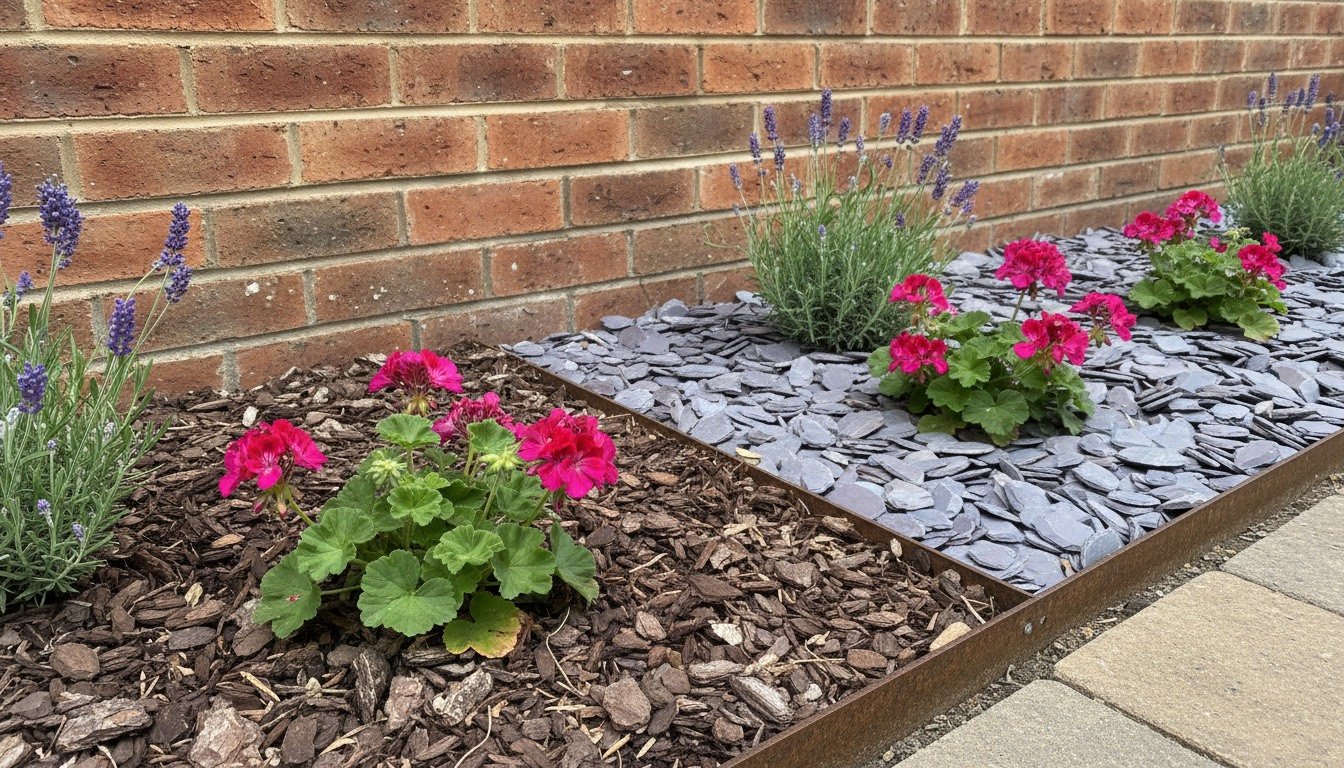
Every spring the same call: two quotes for the front garden, one for bark, one for slate chippings, and the gravel one is three times the money. They are not the same job. Spreading bark is an afternoon with a barrow. Laying stone properly means excavating, membrane, edging and a tonne bag on the drive that somebody has to shift.
Both work. Both fail badly in the wrong place — nobody enjoys hand-picking 40mm granite out of a border they now want to plant. Here are the real UK prices, the labour split, and the parts of a quote worth arguing about.
Side by side: the short version
Figures below are for a typical suburban bed, not a driveway. Depth matters: too shallow and weeds win, too deep and you are wading.
- •Lifespan: bark needs topping up every 2-3 years; gravel lasts 8-15 years before it silts up and needs lifting or washing.
- •Laid depth: bark 50-75mm; gravel 40-50mm over permeable geotextile. Deeper than 50mm, gravel walks like sand underfoot.
- •Weight: 1m2 of gravel at 50mm is about 80kg against 15kg of bark — which is why labour costs diverge.
- •Soil effect: bark feeds the soil as it rots and holds moisture; gravel adds nothing but keeps plant crowns dry.
- •Weeds: both suppress annuals for two years. Neither stops bindweed, couch grass or ground elder — dig those out first.
- •Reversibility: bark vanishes into the border by itself; gravel has to be shovelled out, and some always stays behind.
- •Supplied and laid: bark £12-£22 per m2; gravel £35-£60 per m2 on small areas, £25-£40 above roughly 50m2.
How each performs through a British year
Bark earns its keep from May to September. A 75mm layer of composted bark cuts summer evaporation noticeably — watering on established shrub borders drops by about a third — and it buffers the freeze-thaw that lifts newly planted perennials in February. Against that: it is a slug hotel, it mats and greens in deep shade by the second winter, and in exposed gardens it blows about — fine grades worst, while 10-35mm chipped pine stays put. Our guide to mulch types and quantities covers the grades in detail.
Gravel does the opposite. It is a heat sink, so soil beneath pale chippings runs warmer and drier — ideal for lavender and salvias that rot at the neck in a wet winter, poor for hydrangeas, ferns and hostas. It is permeable, which matters at the front: in England a front garden surfaced in impermeable material over 5m2 needs planning permission or somewhere for the water to go. Gravel sidesteps that only if the ground below actually drains, so fix any standing water and drainage problems before you order stone.
One UK warning: cocoa shell mulch, still sold in garden centres, contains theobromine and is dangerous to dogs — use composted bark or gravel instead.
What it costs: materials, labour and the honest split
Buy loose or in bulk bags, never 70-litre sacks. Composted landscape-grade bark is £45-£75 per cubic metre tipped loose, or £70-£110 for a bulk bag delivered — and most builders' bags hold 0.7-0.9m3, not a full cubic metre. Garden centre sacks work out at £90-£130 per m3 equivalent, a 60% premium for car-boot convenience.
Stone is sold by weight. An 850kg bag of 20mm limestone or granite is £60-£95 delivered and covers 12-14m2 at 50mm; Welsh slate is £90-£140. Add woven geotextile at £0.80-£2.00 per m2 — 100gsm or heavier, because £0.40 fleece tears on the first barrow run — and edging at £4-£8 a metre in timber, £12-£25 in steel. Our notes on garden edging that survives a strimmer will save you doing it twice.
The labour split is the giveaway. Bark runs roughly 70% materials, 30% labour — one operative at £180-£280 a day covers 60-80m2. Gravel flips to about 45% materials, 55% labour: excavating 60-80mm of soil, disposing of it, lapping membrane, fitting edging, barrowing 1.6 tonnes per 20m2. A 4-yard skip for the spoil is £180-£320 in most of England, more inside the M25.
The ten-year figure, worked through
Take a 20m2 border, DIY labour, over a decade. Bark: 1.5m3 at 75mm to start, about £120. It loses 25-40% of its volume a year, so it wants a half-depth top-up every second year — 0.7m3 at £55-£70, four or five times. Ten-year materials £340-£440, plus two hours of your time per top-up.
Gravel over the same border: two bulk bags at £130-£190, membrane £30, edging £120, plus six hours of digging and barrowing. Ten-year materials £280-£340, including a small top-up near year six. But budget for a reckoning between years eight and twelve, when leaf litter and silt have built enough growing medium on top for weeds to seed straight into the stone. Lifting, washing and relaying is £400-£900 with a contractor, or a miserable weekend.
So the ten-year spend lands closer together than the first quote suggests. Gravel front-loads the cost and buys quiet years; bark spreads it thinly and asks for attention. Budgeting a whole garden? Our UK landscaping cost breakdown sets these numbers next to paving, turf and fencing.
Reading a quote: reasonable versus suspect
A sound gravel quote states three things unprompted: finished stone depth, membrane weight in gsm, and how spoil is removed. Missing any, the price is guesswork. Be wary of anything quoted per 'load' rather than per tonne, and of a supplied-and-laid rate under about £22 per m2 on a small job — at that money something is skipped, almost always the excavation, which is why the gravel finishes level with the lawn and ends up in it by August.
On bark, the red flag is the opposite: membrane under bark on a planted border makes no sense. Bark is meant to break down into the soil, and plastic stops that while making future planting a nuisance.
Price the materials yourself from a local aggregate supplier and see what is left. If the remaining labour exceeds about £45 an hour for one person on an accessible garden, ask what it covers. Difficult access justifies more, but it should be said out loud.
Who each suits, and the verdict
Choose bark where the bed is planted and will stay planted: mixed shrub borders, woodland-edge schemes, ferns and hydrangeas, new hedging, hungry sandy soil. Choose gravel for Mediterranean planting, hot dry strips along a south-facing wall, and front gardens or bin stores that need a hard-wearing permeable surface.
For most UK gardens: bark in the back borders, gravel at the front. Bark is the better material for plants and the cheaper mistake; gravel is the better surface to walk on and the dearer mistake to undo. Undecided? Settle the planting first — work out the layout and plant list before ordering a tonne bag, because the plants dictate the topping. If the real goal is fewer lost Sundays, read our low-maintenance planting ideas too: good ground cover beats both on ten-year cost.
Next: measure the bed, then divide the square metres by 13 for bulk bags of gravel at 50mm, or by 20 for cubic metres of bark. Take that to two suppliers before you take it to a landscaper.
Found this useful?
There's plenty more — hundreds of guides and honestly-tested product reviews for every corner of your home.
Browse All Guides