Cleaning Guides · 6 min read · 13 July 2026
Pantry Organisation Ideas for Real UK Kitchens and Real Budgets
Almost nobody in Britain has a walk-in pantry. Here is what actually works in a 600mm larder unit or an understairs cupboard, what it costs, and where the drill should stay in the box.
By the Nims Casa editorial team — written from professional cleaning experience and checked against our editorial standards.
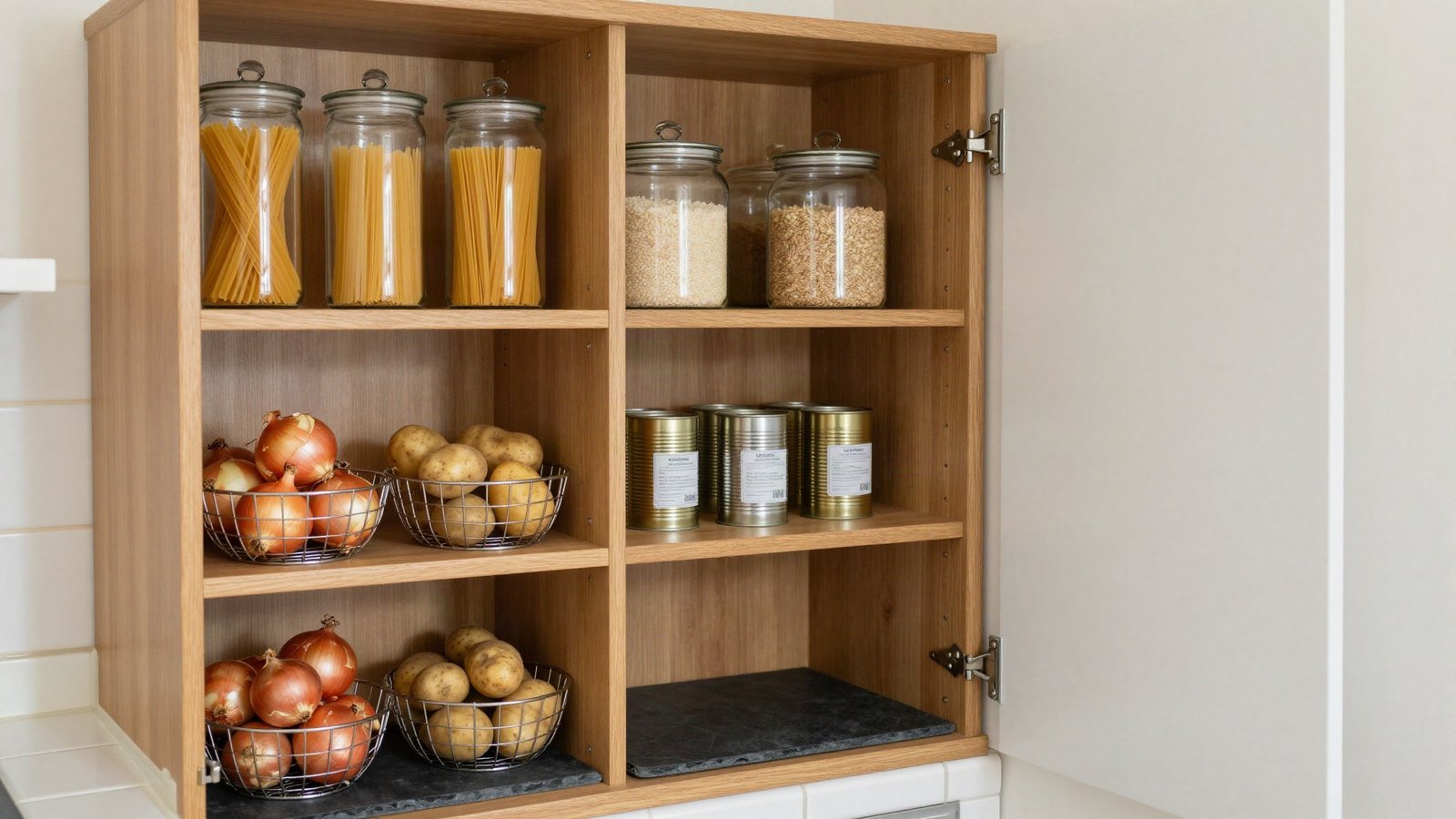
Almost no UK home has a walk-in pantry. What we have is a 600mm larder unit, or an understairs cupboard with a staircase slope eating half of it. The glossy pantry galleries — wall-to-wall open shelving, forty matching canisters — do not survive contact with a Victorian terrace.
So here is the working version: fittings that hold up in British kitchens, 2026 prices, and the part most guides skip — where the job stops being a Saturday with a drill and starts needing a joiner or a registered electrician. Cull first, though. A pantry reorganised around food you will never eat is just tidier waste, and decluttering room by room is the cheaper move.
First, Work Out Which Pantry You Actually Have
Four layouts cover most British homes, and each fails differently. Identify yours before spending anything.
- •Tall larder unit, 600mm wide and 2m high. Shelves are usually 500mm deep, about 200mm deeper than useful, so the back row goes stale unseen.
- •Understairs cupboard: great volume, awful shape. Headroom drops from 2m at the newel to 500mm, and it often houses the consumer unit, gas meter or stopcock — all of which must stay accessible.
- •A repurposed run of units: one base unit plus the wall unit above. Cheapest to improve, because you buy fittings rather than carcasses.
- •A genuine old larder — north-facing, air brick, sometimes a slate thrall. These sit 4-6°C below the kitchen, so use them for root veg, eggs and cheese, and never block the air brick.
Ideas That Earn Their Space
Every item has to earn its shelf. The logic behind good kitchen cupboard organisation applies harder in a pantry, because this is where bulk buying goes to hide.
- •Zone by frequency, not category: daily things at 900-1,500mm, heavy bulk buys low, baking tins and the slow cooker up top.
- •Cap usable depth at 300mm. A 300mm shelf shows everything at a glance; a 500mm shelf hides a back row that quietly expires. Where the depth is fixed, use front-to-back baskets at £6-12 each, ordered 20mm shallower than the shelf.
- •Turntables on deep shelves and tiered risers for tins, £8-12 each, are the best value here by a distance — three hidden rows become a shop display and the duplicate buying stops.
- •Decant flour, rice and pasta into airtight containers so pantry moths cannot spread from one bag to the whole cupboard. Freeze new flour, rice and dried fruit for 72 hours at -18°C first: that kills the eggs that arrived in the packet, which is why infestations return weeks after a clear-out.
- •Keep dry goods at 10-18°C. The cupboard beside the boiler or above the oven is the worst spot for oils, chocolate and flour.
Budget Tiers: £60, £300 or £1,500
Prices are 2026 UK retail for materials, labour excluded. Only go built-in if the space is odd enough that off-the-shelf units waste a third of it; our custom built-in shelving cost guide shows how those quotes break down.
- •Under £60, fittings only: two turntables, a tin riser, four baskets, six 2-litre containers and labels. One evening, no drill, and it fixes perhaps 70% of a bad pantry.
- •£150-£350, the reconfiguration: twin-slot uprights at £10-14 and brackets at £3-4 make every shelf height adjustable. Add boards, a door rack and a rechargeable LED strip with a motion sensor at £15-25.
- •£600-£1,500, the built-in: a full-height larder cabinet with pull-outs is £450-£1,100 supplied, and a joiner will fit and scribe it for £180-£280 a day. A bespoke understairs pantry lands at £900-£2,500.
Small UK Kitchens: Depth, Doors and the Slope
In a galley kitchen under 8m², tall and shallow beats short and deep. A 300mm-deep unit at 2m high holds more usable food than a 600mm-deep one at 1m and keeps the walkway wide enough to open an oven door — the vertical-first thinking behind our small-space storage ideas.
- •Understairs, stand full-height items at the newel end and slide trays, baking sheets and the ironing board into the low slope.
- •Leave 40-50mm between shelving and an external wall. Shelves pressed against a cold north wall are how condensation and mould start.
- •Measure door swing and shelf-front clearance before buying a door-back rack; it needs 80-100mm and people lose that gap constantly.
- •Keep the bottom 200mm clear of loose packets if you have ever seen droppings. Mice find dry goods fast and cardboard is no barrier.
Materials, Loads and Where the Money Goes
Sagging shelves are the commonest pantry failure, and it is a materials problem rather than bad luck. A 900mm shelf of tins weighs 15-20kg; in a bulk-buying household it can reach 30kg.
- •18mm melamine-faced chipboard, £15-20 a 2.4m board, is fine at 600mm spans and visibly bows at 900mm. A 25mm timber lip along the front edge roughly doubles its stiffness.
- •18mm birch ply at £75-95 a sheet stays flat at 800mm and takes hardwax oil well. This is where the money goes on a smart-looking pantry.
- •Fix into masonry or timber studs, never plasterboard alone — metal self-drill anchors are rated in single-figure kilos for pull-out. Studs sit at 400 or 600mm centres in modern builds and nowhere predictable in lath and plaster.
- •Use a cable and pipe detector every time: never drill directly above, below or beside a socket, or within 150mm of a ceiling or internal corner.
What You Can Safely Do Yourself
A competent DIYer with a cordless drill, a cable and stud detector and a spirit level can do most of a pantry refit. This is what sits comfortably inside that line.
- •All fittings work: baskets, turntables, risers, containers, labelling and a rack screwed to a solid door.
- •Twin-slot uprights or brackets fixed into masonry or located studs, using correct plugs and 60-80mm screws.
- •Cutting and finishing your own shelves, including scribing to a wonky wall with a scribing block and a block plane.
- •Painting the interior in a washable satin; pale shades make the back of a deep shelf readable.
- •Battery or USB-rechargeable LED strip lighting with a motion sensor: no wiring, nothing notifiable, £15-25.
Where DIY Stops and a Professional Starts
Everything below is a genuine stop-and-call-someone — not because the work is hard, but because getting it wrong is expensive, uninsurable or dangerous.
Two questions we get constantly. Does fitting a pantry need approval? No, cupboards and non-structural joinery are exempt. Is an understairs pantry safe? In a two-storey house yes, provided meters stay accessible and you store no petrol, thinners or gas canisters there.
Start at the fittings tier, live with it a month, then decide whether the built-in is worth it. Most people find it isn't. For the rest of the house, work through the Organisation & Storage hub.
- •Any new socket or fused spur. In England, adding a socket to an existing kitchen circuit is no longer notifiable under Part P, but a new circuit or consumer unit work is — and in Wales kitchen work remains notifiable. Use an NICEIC, NAPIT or ELECSA electrician and keep the certificate; £180-£300 for a half-day.
- •Anything that cuts into the staircase. Strings, treads and the trimmer around an understairs opening are structural, so enlarging it means a structural engineer at £350-£700 plus building control.
- •Moving or boxing in a gas meter or pipework: Gas Safe registered engineer only, and meters need ventilation and access.
- •Removing part of a wall for a walk-in — load-bearing or not, that needs an engineer's sign-off.
- •Textured coatings or unidentified soft boards in pre-2000 homes. Do not sand or drill them; a UKAS lab sample costs £30-£50 and settles it.
- •Persistent damp on the external wall. Shelve over it and you seal the problem in — diagnose the cause first.
Found this useful?
There's plenty more — hundreds of guides and honestly-tested product reviews for every corner of your home.
Browse All Guides