Garden & Outdoor · 6 min read · 14 August 2026
Paving Over Your Garden: The Rules on Permission, Drainage and Flood Risk
Pave more than 5 square metres of front garden with the wrong surface and you need planning permission. Here is what counts as permeable, what each option costs, and exactly where the DIY line sits.
By the Nims Casa editorial team — written from professional cleaning experience and checked against our editorial standards.
Every serious summer downpour now brings footage of water sheeting off paved front gardens into someone's hallway. The rules are older than most people realise: England and Wales have restricted impermeable front-garden paving since October 2008, and councils have grown keener on enforcement as surface water flooding has climbed the political agenda.
The rules are cheap to satisfy once you understand the logic — a compliant driveway often costs barely more than a rogue one. This guide covers when you need permission, which surfaces are exempt, honest per-square-metre costs, and which parts of the work you can safely do yourself.
The Rule in Plain English
Since 1 October 2008, covering more than 5 square metres of front garden with a traditional impermeable surface — poured concrete, standard block paving on a fines sub-base, non-porous asphalt — requires planning permission in England and Wales, unless the rainwater drains to a permeable area within your own boundary. The front garden, for this purpose, is the land between the principal elevation of the house and the highway.
That gives you three compliant routes with no application needed: use a permeable surface; keep the impermeable area under 5 square metres; or lay impermeable paving falling towards a lawn, border, rain garden or soakaway on your own land. Back gardens are exempt from this rule but not from drainage law generally — no part of your plot may discharge run-off onto a neighbour's land or the highway. In conservation areas or with a listed building, tighter restrictions can apply — check with the council first.
Why a Paved Garden Floods Someone Else's Kitchen
The arithmetic is stark. One millimetre of rain on one square metre is one litre of water, so a fully paved 40 square metre front garden in a 20 mm cloudburst sheds 800 litres into the road gully. A street of thirty similar houses is 24,000 litres hitting what is often a Victorian combined sewer never designed for it. When it surcharges, the overflow comes up through gullies into ground floors — the Environment Agency now puts more than four million properties in England at risk from surface water flooding.
Long dry spells make it worse: baked clay sheds water almost as fast as concrete for the first half hour of rain, which is why flash floods so often follow droughts. The 2008 rule is sustainable drainage (SuDS) thinking — deal with rain where it lands, rather than exporting it to the lowest house on the street.
Surfaces That Pass Without Permission
Any of these is compliant at any size, provided it sits on a free-draining base rather than being glued over existing concrete.
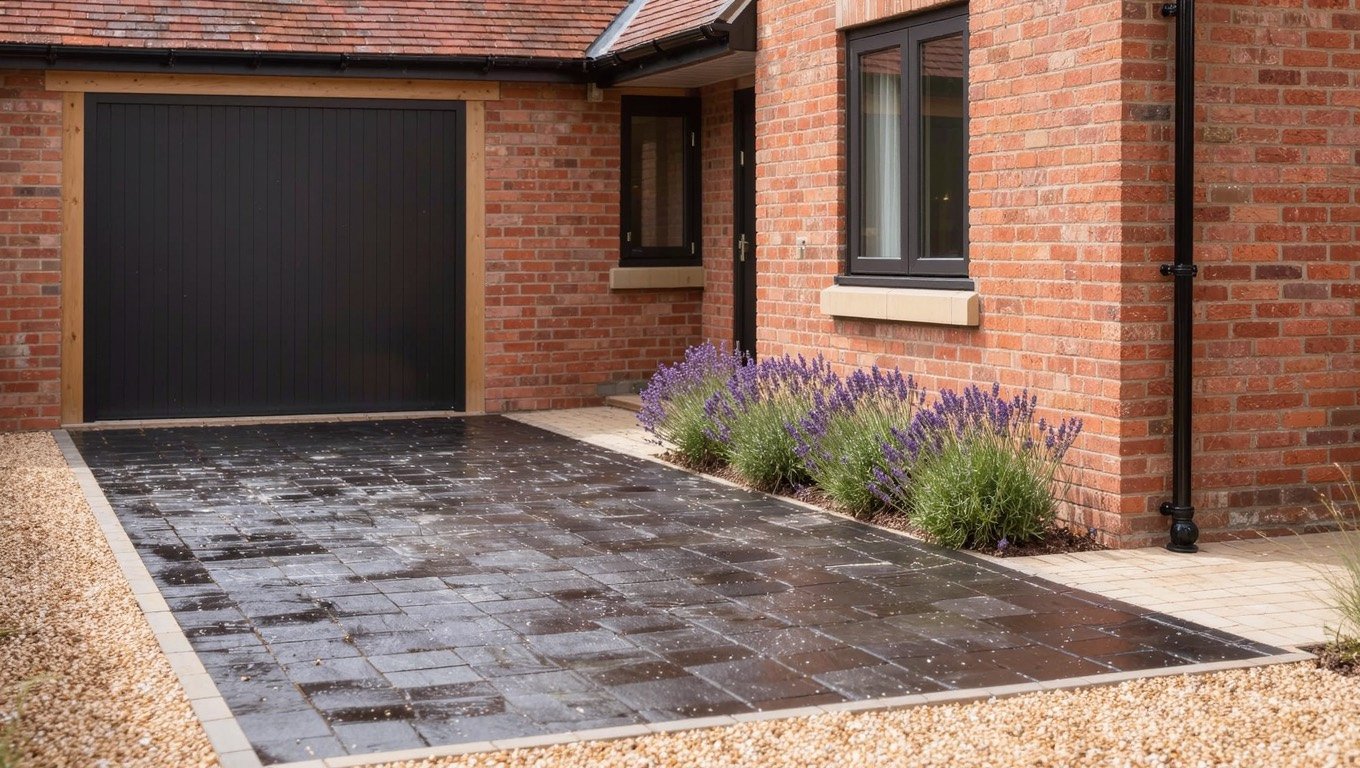
- •Permeable block paving: purpose-made blocks with widened joints on open-graded crushed stone containing no fines, so rain drains through the joints into the stone reservoir below. The best all-round driveway choice.
- •Loose gravel on a membrane: the cheapest compliant surface. Fine for parking if properly edged.
- •Resin-bound gravel: permeable when laid over an open-textured base. Beware the similar-sounding resin-bonded finish — a scatter coat on solid tarmac, not permeable.
- •Grass or gravel grids: plastic or concrete matrices that let you park on a green or gravelled surface without rutting it.
- •Impermeable paving falling to a rain garden, border or soakaway inside your boundary: still fully compliant, and often the practical answer for a smooth, level surface.
What It Costs
Supplied and laid, expect roughly £25 to £45 per square metre for edged gravel, £70 to £120 for permeable block paving, and £80 to £130 for resin-bound; grass grids run £20 to £40 in materials. Permeable block typically prices £10 to £15 per square metre above standard block, almost all of it in the deeper open-graded sub-base rather than the blocks. A soakaway adds £700 to £1,500 including the dig and needs a percolation test first — on heavy clay it may simply not work.
So a typical 30 square metre front garden in permeable block lands between £2,400 and £3,600. For fuller regional figures see our patio cost guide, and if you are weighing block against a poured slab, the trade-offs are covered in pavers versus concrete — poured concrete being the option most likely to force a planning application.
DIY or Professional: Where the Line Sits
A competent DIYer can do more of this than the trade admits, but the boundary is real.
Sensible DIY territory: gravel over a membrane with timber or metal edging; grass and gravel grids; any path or pad under 5 square metres; setting falls towards your own border; and re-jointing permeable paving with proper jointing grit rather than sand. If you are laying blocks yourself, the base preparation in our paver patio guide applies — with the crucial difference that a permeable job uses clean open-graded stone, never fines or building sand.
Professional territory, no arguments: sub-base design for any permeable driveway that will carry a car, because depth and stone grading do the actual drainage work; soakaway sizing and percolation testing; anything raising ground levels within 150 mm of your damp-proof course; and every dropped kerb. Lowering the kerb needs a Section 184 licence from the council's highways department — approved contractor only, typically £1,500 to £3,000, plus planning permission on classified roads. Digging up a footway yourself is an offence, and there are services six inches under it.
Enforcement, Selling Up and the Neighbour Problem
Councils rarely patrol for rogue paving, but they respond to complaints — usually from a flooded neighbour — and can require a retrospective application or full reinstatement. Unauthorised work also surfaces when you sell: a buyer's solicitor who spots a post-2008 concrete front garden with no consent can stall the sale or demand indemnity insurance. And run-off that repeatedly floods next door is a private nuisance — a civil claim against you personally, entirely separate from planning.
Compliance also needs maintaining. Permeable paving silts up if the joints fill with detritus, so sweep it seasonally and clean it as described in our patio cleaning guide — never re-sand joints with builder's sand, which seals them. Check your downpipes too: roof water dumped across paving defeats the design, so keep gutters clear with regular gutter maintenance and discharging to a drain or water butt.
FAQs
The questions we hear most, answered briefly.
- •Does a back garden patio need planning permission? Not for the surface itself, but keep the run-off on your own land — fall it towards a border or soakaway, not the fence line.
- •Does gravel count as permeable? Yes, if it is loose gravel on a free-draining base. Gravel resin-bonded over tarmac or concrete does not.
- •What about artificial grass? Most products are perforated and count as permeable, provided the base is free-draining sharp sand and stone rather than compacted hardcore with fines.
- •My drive was paved before 2008 — am I in trouble? No, the rules are not retrospective. But replace more than 5 square metres of it and the current rules apply to the new surface.
- •Can I park over the footway without a dropped kerb? No. Driving across a full-height kerb is an offence and cracks the footway. Get the Section 184 licence first.
Found this useful?
There's plenty more — hundreds of guides and honestly-tested product reviews for every corner of your home.
Browse All Guides