Energy & Insulation · 6 min read · 19 June 2026
Reclaimed Wood vs New Wood: UK Costs, Pros, Cons and Where DIY Must Stop
A salvage yard will sell you century-old Baltic pine for less per square metre than new oak. Here is what the price ticket hides, and which jobs you must hand to a professional.
By the Nims Casa editorial team — written from professional cleaning experience and checked against our editorial standards.
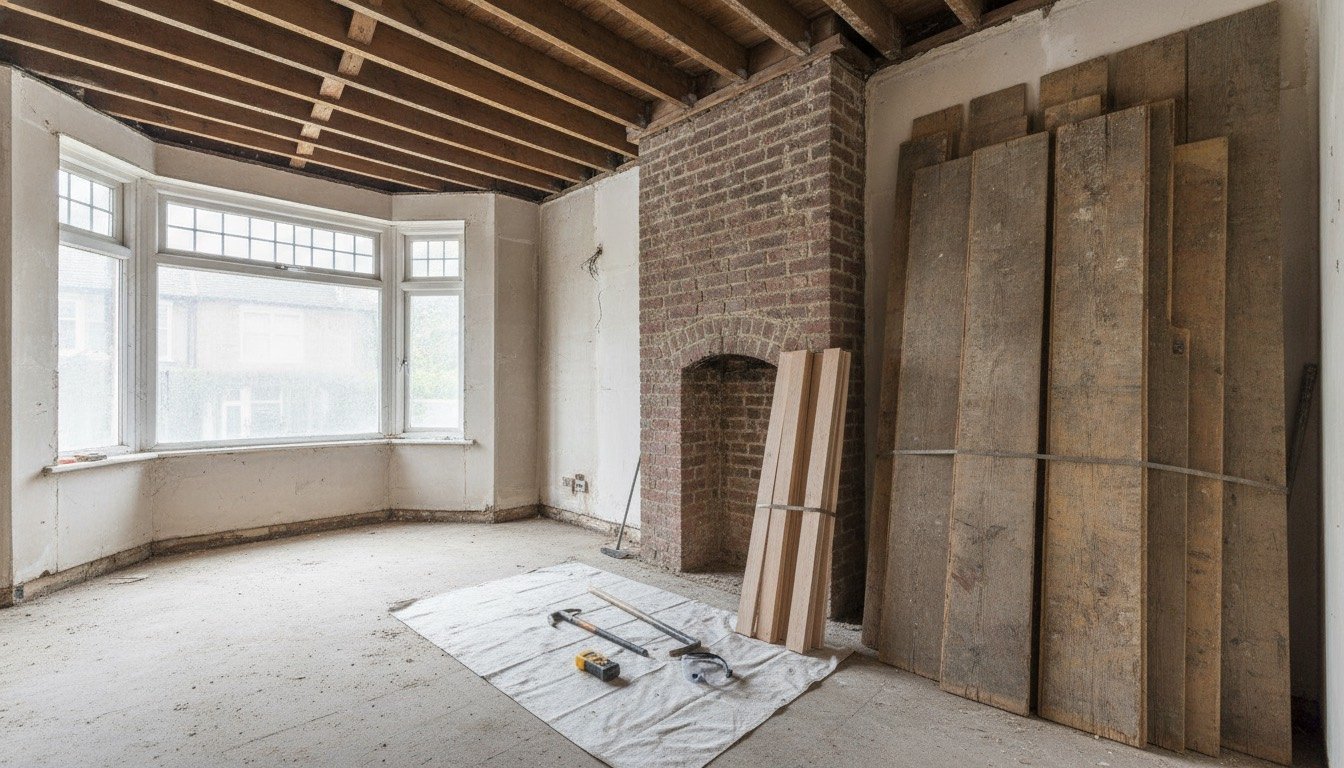
A reclamation yard will sell you hundred-year-old Baltic pine for less per square metre than new European oak, and it will look better on the day it goes down. What the ticket hides is the day and a half pulling cut nails, the quarter of the pack that goes in the skip, and the buried screw that takes £70 of thicknesser blades.
The useful comparison is not old-good, new-bad. It is where each earns its keep, what each costs across a decade, and which parts of the job you are competent and legally allowed to do yourself. That last question matters more here than on almost any other sustainable home improvement job, because salvaged wood carries a history you cannot see.
Reclaimed wood vs new wood: the side-by-side
Strip out the romance and five differences matter, each with a cost or risk attached.
- •Grain: Victorian pine shows 15-25 growth rings per inch against 4-8 in fast-grown modern softwood, so it dents far less under a dining chair.
- •Movement: reclaimed timber did its shrinking a century ago. New kiln-dried stock arrives at 12-16% moisture and keeps moving until it settles to the 8-11% of a heated UK room.
- •Certification: new stock comes FSC or PEFC certified and strength-graded C16 or C24 to BS EN 14081. Reclaimed carries no grading mark, which is the single biggest constraint on its use.
- •Hidden problems: cut nails, coach bolts, common furniture beetle, lead paint on anything decorated before 1992, and creosote or CCA preservative on sleepers and old fencing.
- •Embodied carbon: reuse skips felling, kilning and haulage, avoiding roughly 400-600kg of CO2e per tonne of softwood — the biggest single saving in a domestic timber project.
How each performs once it is in the house
In service, reclaimed softwood usually beats new. Tight-grained Victorian pine takes a screw without splitting, holds a crisp chamfer and resists denting about as well as engineered oak. New timber wins on predictability and lead time: order it to length on Tuesday, collect it Wednesday, square at both ends. Salvaged joists are often bowed 5-10mm over 3m, and thicknessing them straight costs 4-6mm you may not be able to spare.
Whatever you buy, acclimatise it: stack reclaimed boards indoors on 25mm battens for a fortnight, in the room they will live in rather than the garage. Meter them before fitting — anything above 12% will shrink and open 2-3mm gaps once the heating comes on in October.
What it actually costs over ten years
Rates below are 2026 UK averages: joiner £190-£280 a day outside London, £280-£380 inside; floor fitter £18-£30 per m². Reclaimed supply prices swing far more by region.
- •20m² sitting-room floor in reclaimed Victorian pine: boards at £55/m² with 25% wastage, £1,375. Denailing and sorting, 1.5 days, £330. Fitting at £26/m², £520. Sanding and hardwax oil, £440. Year one £2,665, plus a refinish around year eight at £480 — ten-year total roughly £3,145.
- •The same floor in new solid European oak: boards at £78/m² with 10% wastage, £1,716. Fitting at £28/m², £560. Finishing, £400. Year one £2,676, plus the same £480 refinish — ten-year total roughly £3,156, within 1% of the reclaimed option but with none of the sourcing risk.
- •3.6m of scaffold-board shelving: three used boards at £14, brackets £65, abrasives and oil £23 — £130 total. In new planed redwood it is £129. Identical money, three extra hours, far better result.
Installation: where salvaged timber eats your day
Budget an extra 30-50% on labour for anything reclaimed. Check every board with a timber metal detector (£25-£40) before it meets a blade — one missed nail chips a carbide tooth and costs more than the detector. Denail from the face outwards with pincers and a pin punch; hammering nails through blows the underside out. Plan on losing 20-30% of a pack to nail damage, rot at the joist bearings and splits, against 8-10% on new stock.
For a first project, start small. Salvaged scaffold boards make excellent floating shelves precisely because the scuffs are the point. Outdoors, reclaimed timber weathers unevenly and rarely lasts, which is why the composite versus wood decking maths seldom favours it.
Maintenance and finishes
Reclaimed softwood floors want hardwax oil, not polyurethane lacquer. Oil sits in the surface, spot-repairs with a cloth and a scuff pad, and does not craze at the board edges as old timber moves. Expect a maintenance coat every 3-5 years in a hallway and 6-8 in a bedroom, at £4-£7 per m² in materials. New oak usually arrives pre-finished with factory lacquer good for 10-15 years, but when that fails you face a full sand-back rather than a patch — the same job as refinishing any hardwood floor.
There is little sense saving embodied carbon then coating the wood in solvent-heavy varnish, so learn the difference between low-VOC and zero-VOC products before buying 5 litres of anything.
The DIY line: what you can do, and what needs a professional
With new stock the DIY boundary is mostly about skill. With reclaimed it is about contamination and structural grading, and getting it wrong has consequences a bad mitre does not.
- •DIY: sourcing and inspecting at a yard. Live woodworm shows as clean, pale flight holes with fresh gritty frass; old holes are dark and dusty.
- •DIY: denailing, cutting, planing and sanding untreated, unpainted timber in FFP3 protection with on-tool extraction. Old pine dust is a genuine respiratory irritant.
- •DIY: shelving, furniture, cladding and headboards; laying reclaimed floorboards onto sound existing joists; acclimatising, metering, oiling and long-term maintenance.
- •PROFESSIONAL: any structural use — beams, joists, lintels, roof timbers, loft conversions. Ungraded reclaimed timber has no strength class, and Building Regulations Approved Document A requires graded structural timber: a certified grader or a structural engineer's sign-off, plus Building Control approval. The same goes for notching joists or anything disturbing cables and pipework in a floor void.
- •PROFESSIONAL: anything decorated before 1992. Sanding or heat-stripping releases lead dust, which is why lead paint in older houses means a dip-stripping firm rather than an orbital sander.
- •PROFESSIONAL: active woodworm, which needs kiln or heat treatment to a 56°C core for 30 minutes — not a tin of fluid from a DIY shed. Use a Property Care Association member.
- •REFUSE OUTRIGHT: sleepers, telegraph poles and old fence posts treated with creosote or CCA. Creosote-treated timber cannot be sold for domestic use, must never go indoors or be burned, and needs licensed hazardous-waste disposal.
Who each suits, and the verdict
Choose reclaimed for period properties where new timber looks wrong beside original features, when you have the time and tools for prep, and when the job is non-structural and demonstrably free of lead, creosote and live beetle. Salvaged pine floorboards are one of very few upgrades that look better after ten years than on day one.
Choose new when you need matched sections, guaranteed grading, a fixed timeline, or anything holding the house up. Buy FSC or PEFC certified and you keep most of the sustainability argument without importing someone else's problems. On cost the two land close enough that money should not decide it — and if a yard cannot tell you what a piece of timber came out of, walk away.
Found this useful?
There's plenty more — hundreds of guides and honestly-tested product reviews for every corner of your home.
Browse All Guides