Pest Control · 6 min read · 7 June 2026
Signs of Termites in a UK Home (And What It Almost Always Turns Out to Be)
Britain has no established termite population, yet the signs that send people searching are real. Here is how to identify what is actually chewing your timbers, and what each one costs to put right.
By the Nims Casa editorial team — written from professional cleaning experience and checked against our editorial standards.
Nine times in ten these calls end the same way: no termites, but a genuine timber problem that has been running quietly for three or four years. Britain has no established termite population. The only confirmed colony ever found here, a subterranean Reticulitermes nest found at Saunton in North Devon in 1994, was eradicated under a long government programme and monitoring was stood down after nearly three decades.
Every sign that sent you searching is real, though: the pinholes, the powder on the floor, the discarded wings on the sill, the skirting that gives under a thumbnail. They simply belong to something else, several of those somethings do genuine structural damage, and each is treated differently. Work out which you have before spending a penny.
The five-minute diagnosis
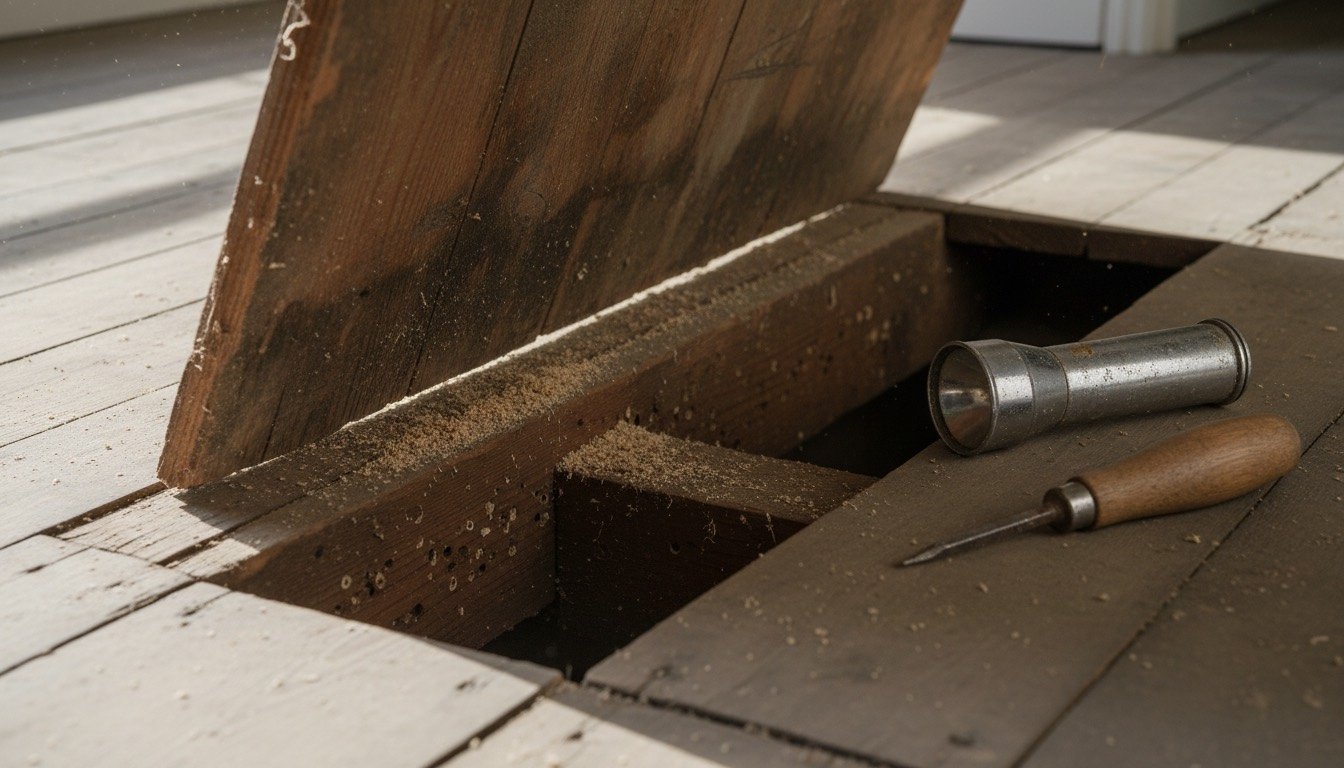
A torch, a bradawl and a sheet of white paper. Raking light is the whole trick: holes and frass are nearly invisible under a ceiling bulb and obvious when the beam skims the surface at 10 degrees.
- •Measure a hole. Under 2 mm and round means common furniture beetle. Around 3 mm with bun-shaped pellets means deathwatch beetle. Oval at 6-10 mm means house longhorn. Ragged at about 1 mm means wood-boring weevil, which only attacks timber already damp and decayed.
- •Check whether the holes are fresh. Old ones are grey inside and dust-filled; active ones are pale, sharp-edged and shedding clean bore dust. Vacuum, lay paper underneath and come back a fortnight later between May and August.
- •Press the timber with a bradawl. If it sinks more than 3 mm under light thumb pressure, you have decay, not just insects.
- •Take a moisture reading; a pin meter costs about £25. Timber below 18 per cent moisture content will not support wet rot or weevil, and furniture beetle struggles below 12 per cent.
- •Look at the wings on the sill. Ants have elbowed antennae, a pinched waist and forewings clearly longer than the hind pair. Termites have straight beaded antennae, a straight waist and four wings of equal length.
Symptom to cause: reading the evidence
Timber species narrows it fast: powderpost beetle takes only hardwood sapwood such as oak and ash, and house longhorn only softwood.
- •Small round holes and gritty, lemon-shaped frass in a loft or under floorboards: common furniture beetle, the insect nearly everyone means by woodworm.
- •Larger holes in a 200-year-old oak beam plus a faint spring tapping: deathwatch beetle, usually where a beam end sits in damp masonry.
- •Blistered paint, a springy floor and a hollow sound near a bathroom or external wall: wet rot from a live leak, with insects as a symptom rather than the cause. The signs of subfloor damage follow the same pattern.
- •Grey-white strands running across brickwork like tree roots, with a mushroomy smell: dry rot, Serpula lacrymans, and the thing most often mistaken online for termite mud tubes.
- •Discarded wings heaped on sills on one hot afternoon in late July: black garden ants swarming. Structurally harmless, and covered in how to get rid of ants in the house.
Ranked by likelihood in UK housing stock
Ordered by how often each is the real answer in British housing stock.
- •Historic, inactive furniture beetle damage: roughly half of all cases. The holes are decades old, the beetles long gone, and nothing needs doing.
- •Active furniture beetle in damp, unventilated timber: about one in five. Loft joists over a bathroom, ground-floor boards above a stagnant void.
- •Wet rot traced to one water source: another one in five. Overflow pipes, failed sealant, a new patio laid above the damp-proof course.
- •Dry rot: perhaps one in twenty, but the one that runs to thousands.
- •Deathwatch or house longhorn beetle: uncommon and geographically clustered.
- •Actual termites: effectively zero, and only ever as an isolated import in pallets or packing timber.
Fixes, lowest risk first
Work upwards from the cheapest, driest intervention. Treatment sprayed onto wet timber is money burned: the moisture is what invited the problem in.
- •Fix the water first: clear the gutter, unblock the air bricks, renew the bath sealant, lower the bed that has buried the damp-proof course. £0 to £250.
- •Ventilate and dry. Get the timber below 18 per cent and hold it there through a full heating season. Airflow plus a dehumidifier does more than any spray, as our guide to damp and mould sets out.
- •Spot-treat confirmed active furniture beetle. Amateur permethrin-based fluid runs £30 to £45 for 5 litres and covers 15 to 20 square metres. Two coats, brushed rather than misted, onto clean bare wood.
- •Cut out and splice decayed timber: £300 to £800 per joist end.
- •Full professional treatment: £8 to £15 per square metre, so £400 to £900 for a loft or single room, £1,200 to £2,500 for a whole terrace.
The UK rules that catch people out
This is where DIY timber work goes wrong legally rather than technically. Every UK bat species is protected under the Wildlife and Countryside Act 1981 and the Conservation of Habitats and Species Regulations 2017. If bats are roosting in your loft, spraying insecticide on the timbers is an offence, and ignorance is no defence. Ring the Bat Conservation Trust helpline or Natural England before any loft treatment and get the survey in writing.
Building Regulations Approved Document A also requires softwood roof timbers to be preservative-treated against house longhorn beetle in named districts around north-west Surrey and east Berkshire, the only place a wood-boring beetle appears in British building law. Replacing structural timber, whether joists, rafters or a beam, is notifiable work that building control must inspect before it is covered up.
- •Landlords: damp, decay and infestation are hazards under the Housing Health and Safety Rating System, and the Homes (Fitness for Human Habitation) Act 2018 makes them tenant-actionable.
- •Social landlords now work to fixed investigation and repair timescales for damp and mould under Awaab's Law, so report in writing and keep the date.
- •Use only products approved for amateur use; anything stronger needs a qualified operator working under COSHH. Check membership before booking: BPCA or NPTA for pest control, the Property Care Association for timber and damp.
- •If you genuinely think you have found termites in imported pallets or reclaimed timber, contact the Animal and Plant Health Agency. It is a plant health notification, not a domestic pest job.
Where DIY has to stop
Stop the moment you find dry rot mycelium, a deflecting floor, decay where a beam bears into a wall, or an infestation in a listed or timber-framed building. Those are structural and conservation questions rather than pest ones, and the wrong first move makes them worse. A structural engineer's report at £400 to £700 beats guessing.
A PCA-registered timber and damp survey runs £150 to £350, often refunded against the work. Insist on a written schedule naming the species, quoting moisture readings and defining the extent: a quote that says treat throughout is one you cannot compare. Our figures for timber and termite treatment costs and UK exterminator pricing give you the benchmarks, and the pest-proofing checklist covers the sealing and ventilation that stops the next round.
Found this useful?
There's plenty more — hundreds of guides and honestly-tested product reviews for every corner of your home.
Browse All Guides