Kitchens & Bathrooms · 5 min read · 20 April 2026
Single Vanity vs Double Vanity: Space, Costs and the Honest Verdict for UK Bathrooms
Two basins look like the obvious fix for a crowded morning. More often the real bottleneck is worktop, storage or hot water flow — here is how to tell before you spend £1,500.
By the Nims Casa editorial team — written from professional cleaning experience and checked against our editorial standards.
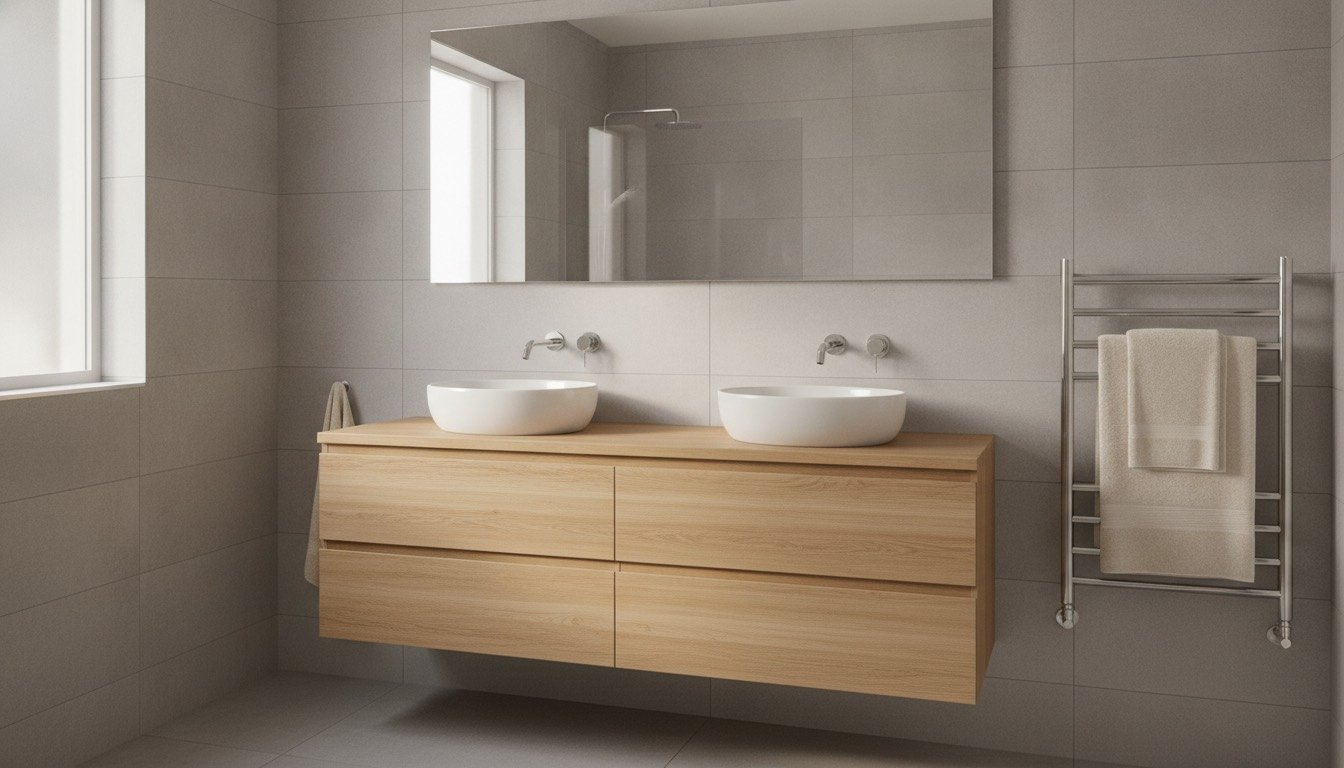
Most people asking this have already held a tape measure against the wall and confirmed that two basins will physically fit. Fitting is rarely the issue. The issue is that dropping a 1,500mm twin-basin unit into a typical 2.4m by 2m British family bathroom takes the storage, the hot water and the elbow room of one good vanity and splits it into two mediocre halves — and that only becomes obvious once the plumber has the floor up.
So before any comparison, work out which problem you are actually solving. A good half of the people who ask us for a second basin have a worktop problem, a storage problem or a hot water problem, and a second bowl makes two of those three worse. Below: the diagnostic, the side-by-side numbers, and honest UK costs with labour included.
Start here: which problem are you actually solving?
Stand in the bathroom at the moment it feels worst — usually 7.30am on a weekday — and note what is genuinely stopping you. Then match it to the list below. Costs are fitted, in a mid-sized UK town; add 25-40% inside the M25.
- •Two adults are truly at the basin at the same time, five mornings a week: a second basin helps, provided the hot water supply can serve both. Budget £700-£1,900 fitted.
- •One of you is at the basin while the other needs the WC or the shower: a second basin changes nothing. That is a layout problem. A shower screen, a repositioned door or a small cloakroom basin elsewhere in the house solves it for £0-£900.
- •There is nowhere to set down a razor, contact lenses and two cleansers: that is worktop, not basins. A 1,000mm unit with a single bowl offset to one side leaves roughly 550mm of dry surface — more than any 1,200mm double will ever give you.
- •The cupboard is jammed with towels, bleach and half-empty shampoo: a storage problem, and doubles are demonstrably worse at it. Two traps and two sets of supply pipes eat the middle of the carcass.
- •It looks cluttered even when it is clean: that is visual, not spatial. A wall-hung unit, a mirrored cabinet and one uninterrupted worktop line will do more for you than a second bowl.
Single vanity vs double vanity: the side-by-side
These are the numbers that settle the argument in a British bathroom, where the average family bathroom is around 4.4 square metres and the average en-suite closer to 2.5. Anything that works in a 12-square-metre American master bath is irrelevant here.
- •Minimum wall run — single: 450mm in a cloakroom, 600mm comfortable, 800-1,000mm ideal. Double: 1,200mm is the absolute floor and it will feel tight; 1,500-1,800mm is where it genuinely starts to work.
- •Bowl spacing — two basins need 700mm centre to centre as a hard minimum and 900mm to stop your elbows meeting. Below 700mm you have bought an ornament.
- •Usable cupboard space — a 1,200mm double typically gives 30-40% less usable interior than a 1,200mm single-bowl unit, because both ends of the carcass are full of pipework.
- •Unit price — single 600mm: £120 for budget flat-pack (B&Q, Wickes, IKEA Enhet) up to £600 mid-range (Roper Rhodes, VitrA). Double 1,200-1,600mm: £450 to £2,200, and £3,000-plus for bespoke with a solid surface top.
- •Fitting time — single onto existing services: three to four hours. Double with a new waste branch and a second supply: one to one and a half days, plus tiling and making good.
- •Clearance in front — you need 700mm of clear floor to use a basin properly, and 750mm if anyone in the household uses a stick or a frame.
- •Resale — in UK houses under four bedrooms, agents rarely price a second basin at all. It reads as a nice-to-have, not a value driver.
Performance: what actually happens when both taps run
This is the part the brochure ignores. What decides it is your heat source, not the vanity. A 30kW combi delivers roughly 12 litres a minute at a 35°C temperature rise, and a basin mixer draws 4-6 l/min, so two basins together are just about within budget. Add the shower and it is not: the boiler modulates, flow splits three ways, and whoever is under the shower gets a cold shoulder at the worst possible moment.
Gravity-fed systems — cold tank in the loft, hot cylinder in the airing cupboard — are the other common UK arrangement and they behave differently again. Pressure at a first-floor basin is often only 0.1-0.2 bar, so running two basins at once simply gives you two slow taps instead of one usable one. If you are on gravity and set on twin bowls, price a pump or an unvented cylinder into the job now; that belongs in your overall bathroom plan rather than turning up as a surprise in week two.
The 10-year cost, honestly
Ten years is the fair window, because it is roughly how long a mid-range vanity, its taps and its sealant last before something needs redoing. All figures below include labour at typical 2026 regional rates.
- •Single, budget route — 600mm unit £180, basin mixer £45, half a day's fitting £150, one re-seal at year five £15. Ten-year total: about £390.
- •Single, mid-range — 1,000mm unit with offset bowl and stone top £700, mixer £120, fitting £220, one tap cartridge £25, two re-seals £30. Ten-year total: about £1,095.
- •Double, mid-range — 1,500mm unit £1,100, two mixers £240, new waste branch and second supply £420, one and a half days' fitting £480, tiling and making good £180, two cartridges £50, re-seals £30. Ten-year total: about £2,500.
- •Running costs — two basins add roughly 3-6% to a metered water bill in a two-adult household, not the 50% people fear, because each basin is used for less time.
Installation: what a second basin really adds
The double costs about two and a half times the mid-range single across a decade, and most of that gap is labour rather than the unit itself. To sanity-check the plumbing line on a quote, our plumber rates guide sets out what a day should genuinely cost, and the wider job sits inside the bathroom remodel cost guide. Here is where that extra labour actually goes.
- •Waste — each basin needs its own trap. Under Part H a 32mm basin waste may only run 1.7m to the stack; beyond that you step up to 40mm and reduce at the trap. On a double it is always the far basin that breaks the rule, and a slow-draining second bowl is almost always this.
- •Falls — 32mm waste wants 18-45mm of fall per metre. Boxed-in runs that look level to the eye are why second basins gurgle.
- •Supply — a second hot and cold tee off the existing 15mm, with isolating valves on both so one basin can be serviced without draining the other.
- •Fixing — a 1,600mm wall-hung double with a stone top can exceed 90kg loaded. Brackets go into 100 x 50 noggins set between the studs, never into plasterboard plugs; on solid masonry use resin anchors rather than brown plugs.
- •Electrics — an illuminated mirror or shaver socket in zone 2 must be IP44-rated, and any new bathroom circuit is notifiable under Part P. That is an electrician's job, not a Sunday afternoon.
Living with each: maintenance and cleaning
Two of everything means two of every chore: two spouts and two waste flanges to descale, two sealant lines to watch, two traps to strip when a contact lens disappears. Across most of southern and eastern England the water is hard — 200-350 ppm calcium carbonate is routine in the Thames Valley and East Anglia — so scale on chrome becomes a fortnightly job rather than an annual one, and the limescale removal method we use works identically on both.
One honest point for the double: two people with separate bowls stop arguing about toothpaste residue and stray beard trimmings. One against: the bottle traps most vanity units use to free up carcass space hold debris more readily than a standard P-trap, and want clearing roughly twice a year. Neither of these is decisive, but they are the daily reality rather than the showroom pitch. If you are fitting it yourself, the list of common bathroom plumbing mistakes is where the avoidable failures cluster.
Who each suits — and the verdict
Match yourself to one of these three before you order anything.
- •Choose a single if your wall run is under 1,400mm, if this is the only bathroom in the house, if you are on gravity-fed hot water without a pump, or if storage is your real complaint.
- •Choose a double if you have 1,500mm or more of clear wall, two adults on the same weekday schedule, mains-pressure hot water from a combi or unvented cylinder, and a second WC elsewhere so the basins really are the bottleneck.
- •Choose neither if the underlying problem is one bathroom serving four people. A downstairs cloakroom basin costs less than a double vanity and removes far more queuing.
The verdict
For most UK homes it is the single — and specifically a wide single: a 900-1,200mm unit with the bowl offset to one side. That layout hands you the worktop, the storage and the uninterrupted hot water that people believe they are buying when they order two basins, at roughly half the ten-year cost and with none of the waste-run headaches. Reserve the double for a genuine master en-suite with the wall length to do it properly, where 1,500mm-plus is available and both people are actually there at the same time.
If the footprint is tight and you are trying to squeeze more out of a small room rather than more basins into it, the trade-offs are covered in more depth in our small bathroom ideas. Measure the wall, check the hot water, then decide — in that order.
Found this useful?
There's plenty more — hundreds of guides and honestly-tested product reviews for every corner of your home.
Browse All Guides