DIY & Maintenance · 6 min read · 22 May 2026
Spackle vs Joint Compound: The UK Equivalents Compared (Filler vs Jointing Compound)
One American product splits into two very different British ones. Choose wrong and you either spend three evenings on a picture-hook hole or watch a patch shrink into a visible dish.
By the Nims Casa editorial team — written from professional cleaning experience and checked against our editorial standards.
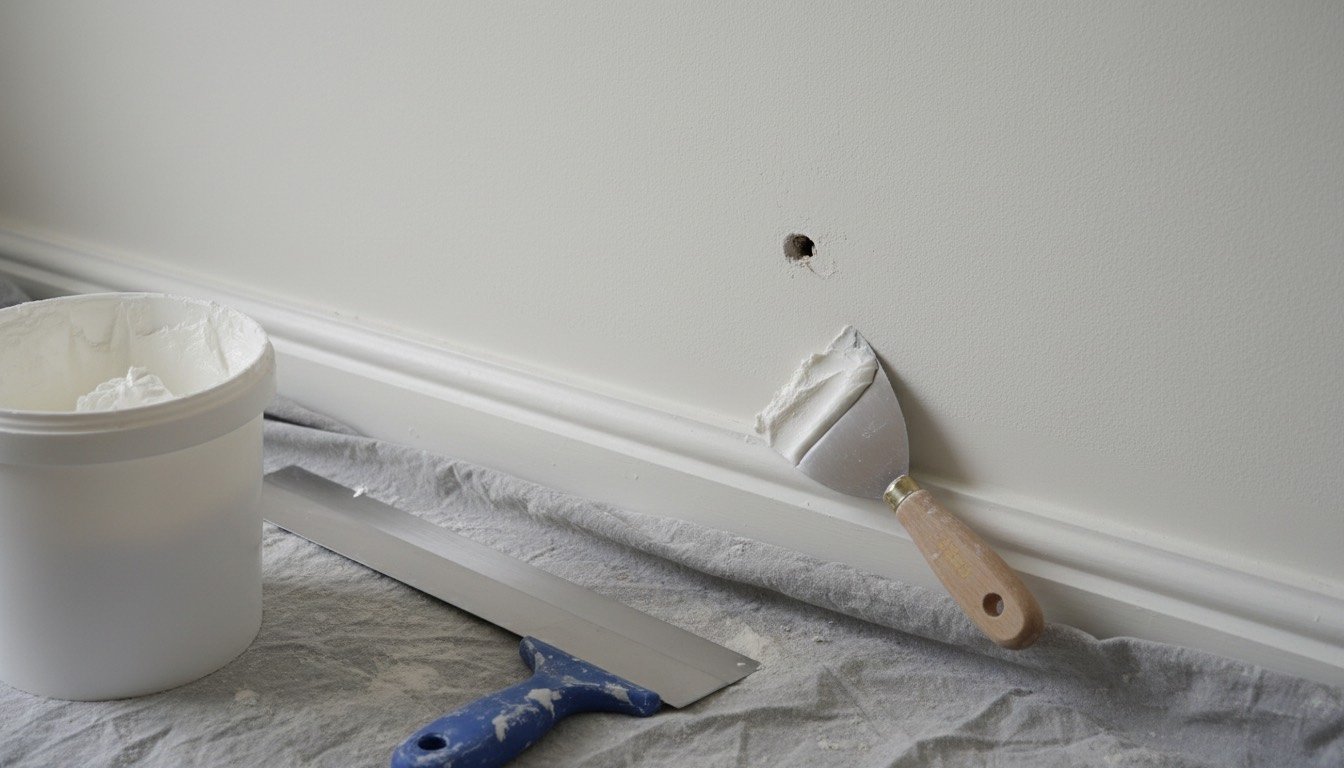
Walk into a UK builders' merchant and ask for spackle and you will get a polite blank look. The American product splits over here into two things that behave completely differently: ready-mixed filler in a 600g tub, and jointing compound in a 10kg bag.
Most British walls are not finished the American way. Only newer builds and dry-lined extensions have taped plasterboard joints; the majority carry a 2-3mm skim of gypsum plaster over board, or lime plaster on timber lath if the house predates the 1940s. That fact decides which tub you should be holding at the till.
What Britain sells instead of spackle and mud
Spackle's nearest UK relative is interior filler: Polyfilla Multi-Purpose, Toupret Interior, Ronseal Smooth Finish. It is a stiff, high-solids paste made to sit in a hole and dry hard. Joint compound's relative is jointing compound: Gyproc ProMix Lite, Easi-Fill 45, Knauf Uni-Finish. It is looser, made to spread thin across 250mm and to bed paper or scrim tape.
A third product confuses everyone. Finishing plaster, usually Thistle Multi-Finish, is not a filler; it is the skim coat itself. Our guide to plasterboard versus plaster walls explains how to tell what you have: knuckle-rap it, and board sounds hollow between studs while plaster on brick sounds dead.
Side by side: filler vs jointing compound
Compare them on the four things that decide a repair: build depth, drying time, hardness, and whether they hold tape.
- •Price: filler is £4-£9 a tub; jointing compound £16-£30 for a 10kg setting-type bag or a 12-20 litre bucket.
- •Build depth: filler takes 5-10mm per pass. Jointing compound goes on at 1-3mm and feathers out; build depth with it and it cracks.
- •Drying: filler is touch dry in 30-60 minutes at 2mm. Ready-mixed jointing compound wants 12-24 hours between coats in an unheated February room.
- •Hardness: filler takes a knock, suiting external corners, skirting junctions and socket edges. Jointing compound sands beautifully at 150 grit but dents under a ladder.
- •Tape: filler grabs too fast and drags tape as you draw the knife. Jointing compound is the only sensible choice over a board joint or a patch bigger than 100mm.
- •Setting types: Easi-Fill 45 goes off in 45 minutes, barely shrinks and paints the same day, but cures rock hard, so get it flat first.
Performance: shrinkage and repairs that flash through paint
Shrinkage loses most DIY repairs. Lightweight ready-mixed filler carries a lot of water and air, so 10mm in a hole loses 1-2mm as it dries and reads as a shadow under matt emulsion. Two thin passes beat one deep one. Jointing compound shrinks similarly, but at 1-3mm the loss is invisible.
The second failure is flashing: the repair showing through two coats as a duller patch. Both products are far more porous than aged emulsion and drink the binder out of your topcoat. Spot-prime every repair, and on a whole-wall job prime the whole wall, or you will see the map of your patches in low sun.
- •Rule of thumb: if the repair is deeper than it is wide, use filler. If it is wider than it is deep, use jointing compound.
Applying each one properly
Filler goes on with a £5 filling knife, left a millimetre proud and sanded back. Jointing compound needs a £15 250mm taping knife and three passes: bed the tape, a 200mm second coat, then a 300mm feather coat. Budget three days for a wall of joints in a cold room, or one long day with setting compound.
- •Small holes and cracks: rake the crack open, dust it out, two passes of filler, 120 grit between. Full method in filling cracks and holes in walls.
- •Holes over 100mm: cut back to a square, fit a patch on battens, then tape and joint, as in patching a hole in plasterboard.
- •Sanding: gypsum dust travels through a whole house. Use mesh abrasive on a pole with an M-class vacuum, or damp-sponge instead, as in sanding without the dust.
- •Conditions: never fill below about 5°C or in high humidity, or the surface skins over while the body stays soft, then sinks.
- •Maintenance: expect a few hairline cracks at wall-to-ceiling junctions each cycle. Seasonal movement, not a defect.
Ten-year cost, materials and labour
Materials are trivial; repeat work is not. A three-bed semi redecorated every six years uses two 600g tubs of filler per repaint: £14 a cycle, £25 across ten years.
Jointing a stud wall yourself costs around £45 in materials, being a 10kg bag of setting compound, scrim, tape and two knives, plus a weekend. Taped by a dry-liner the same wall runs £150-£280; skimmed by a plasterer, £180-£350, on day rates of £200-£280 outside London and £280-£380 inside the M25.
The real ten-year cost is doing it twice. A moving crack filled with flexible caulk reopens inside two winters, costing another day and £40-£60 of paint. Raked out, scrim-taped and filled with setting compound, it holds.
Where DIY stops and a professional starts
This is the part American guides skip: our housing stock is older and the rules differ. The materials are benign; what sits behind them often is not.
- •Do yourself: holes, dents and hairline cracks up to about 50mm across on sound plaster.
- •Do yourself: patching a plasterboard hole up to one board bay and jointing a new stud wall, provided it is not fire-rated construction.
- •Do yourself: cutting a small blown patch back to sound edges, in an FFP3 mask, after checking for cables and pipes with a detector.
- •Call a pro: any textured coating such as Artex decorated before 2000. It may contain chrysotile asbestos, so do not sand, scrape or drill it. A UKAS sample is £25-£50; see Artex removal and UK pro costs.
- •Call a pro: skimming a whole wall or ceiling. Multi-Finish allows about 90 minutes from mixing to final trowel; miss that window and the bill doubles.
- •Call a pro: lath-and-plaster ceilings that bow, sound hollow across more than a hand's span, or shed dust at the cornice. They come down suddenly.
- •Call a pro: cracks over 3mm that run diagonally, step along mortar joints or come with binding doors. Read settling cracks versus structural cracks first; an engineer's report is £350-£650.
- •Call a pro: fire-rated walls, such as a flat's wall to the common stair or an integral garage. Approved Document B needs the right board and sealed joints; caulk does not comply.
- •Call a pro: anything stained brown, damp or mouldy. Fix the source, dry it out, then fill.
The verdict: who should buy which
For nine in ten British households the answer is filler. If your walls are skimmed plaster and your worst problem is a shelf that came off, a £6 tub and a £5 knife covers a decade.
Buy jointing compound only when you are genuinely dry lining: a loft or garage conversion, a new stud wall, or a patch larger than a side plate. Take a setting type if you want it finished in a day, or a ready-mixed drying type if you are new to a taping knife. If you end up buying both plus a hawk and trowel for a wall bigger than a door, get a plasterer to price it instead.
Found this useful?
There's plenty more — hundreds of guides and honestly-tested product reviews for every corner of your home.
Browse All Guides