Pest Control · 6 min read · 8 June 2026
Termite Treatment vs Prevention in UK Homes: Costs, Trade-Offs and Where DIY Must Stop
Britain has no termites, but plenty of firms sell termite-shaped solutions. The real choice is between paying to kill something after it arrives and spending far less making your timber uninhabitable in the first place.
By the Nims Casa editorial team — written from professional cleaning experience and checked against our editorial standards.
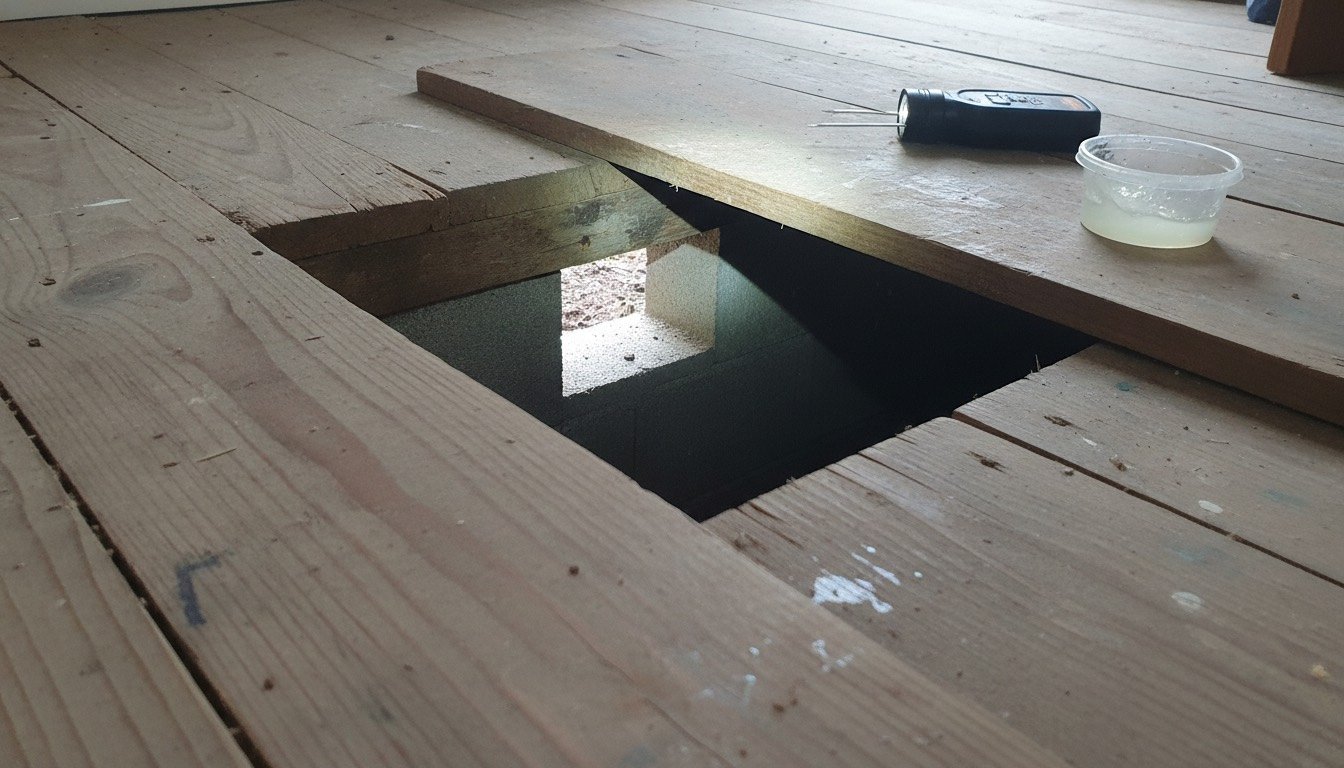
Two quotes land on the same kitchen table most weeks. One is reactive: a spray, a guarantee certificate, a four-figure number. The other barely looks like pest control — an airbrick, a gutter clear, a moisture meter — and costs less than a weekly shop.
Worth saying plainly: there is no established termite population in the UK. The one known colony, at Saunton in North Devon, was eradicated under a government programme. A British "termite" job is really woodworm, deathwatch beetle, wet rot or dry rot, and the treat-or-prevent decision plays out very differently here than in Florida.
What each approach actually buys you
Treatment is a chemical and carpentry response to something already in your timber: a permethrin or boron microemulsion sprayed onto exposed surfaces, paste or injection into affected sections, failed timber cut out, a 20 or 30 year guarantee. Precise, fast, aimed at the organism in front of it.
Prevention is moisture control in work boots. Common furniture beetle larvae need timber above roughly 12 to 14 per cent moisture content; dry rot needs around 20 per cent and wet rot far more. Keep structural timber at the 10 to 12 per cent a ventilated British house naturally sits at and none of them establish, whatever lands on the wood. That is why clearing an airbrick outperforms a can of anything. If you have already seen damage, work through the signs of termites first — misdiagnosis is the costliest part of this subject.
Treatment vs prevention: the side-by-side
- •Trigger — Treatment: live infestation, fresh bore dust, springy timber. Prevention: no evidence, or a historic outbreak that has stopped.
- •Typical outlay — Treatment: £450-£900 for a roof void, £1,200-£2,800 whole-house, £1,500-£4,000 for contained dry rot. Prevention: £0-£400 a year.
- •What it fixes — Treatment: the organism, not the leak, the blocked airbrick or the raised path bridging your damp-proof course. Prevention: the conditions, not anything already active.
- •Disruption — Treatment: one to three days on site, furniture moved, insulation lifted, rooms out of use 24-48 hours. Prevention: an afternoon a year.
- •Guarantee — Treatment: 20-30 years, worth having only if underwritten by an external insurer such as GPI or QANW. Prevention: none, which is the honest position.
- •Failure mode — Treatment: works, then repeats in five years because the moisture source was never traced. Prevention: fails quietly if nobody checks.
Performance: what each genuinely stops
Be realistic about spray. A surface treatment penetrates 1 to 3mm into planed softwood — enough to kill emerging adults and fresh eggs, not enough to reach larvae 15mm inside a joist. That is why professional woodworm work is judged over an emergence cycle of two to four years, and why instant-eradication promises are overselling.
Prevention performs superbly against beetle and wet rot and well against dry rot, but has one blind spot: it cannot undo an outbreak already underway. Dry rot keeps spreading through masonry on moisture it has already banked, and has to be cut out.
The ten-year cost, run both ways
Take a 1930s three-bed semi with suspended timber floors, the commonest at-risk stock in Britain. Prevention route: two blocked airbricks reopened and one added, £220; gutters cleared annually at £110; a pin-type moisture meter, £45; independent surveys at £320 in years one and six; £400 of slipped-slate repairs. Roughly £2,600, most of it maintenance you owe the house anyway.
The reactive route spends nothing until year six, when a weeping waste connection produces a springy board. Then: survey £160, wet rot repair to three joist ends and 5 square metres of boarding £1,600, roof void woodworm spray £700, guarantee £120, reinstatement £600, plus the £220 of airbricks you still need. About £3,400, a fortnight of upheaval, and a floor that never quite matches. Unit rates sit in our termite treatment cost guide.
Prevention wins, but not by the margin the industry implies — in a 2005 house with a concrete ground floor and dry loft, both columns are near zero. The problems typical of 100-year-old houses are a fair guide to who should bother.
How each job gets done, and exactly where DIY stops
Most articles fudge this part. Prevention is almost entirely a competent homeowner's job; treatment mostly is not, for legal and physical reasons rather than snobbery.
- •DIY, confidently: clearing and adding airbricks, lowering soil or paving that has bridged the damp-proof course by 150mm, clearing gutters, fixing dripping wastes, ventilating a cold roof, metering timber, brushing boron gel onto accessible joist ends.
- •DIY, with care: an amateur-use woodworm fluid on a small area of exposed loft timber or on furniture, well ventilated, in FFP3 protection and goggles. Check the label's HSE registration — professional-only products are illegal for you to apply.
- •Stop and call a professional: any dry rot, full stop. Also suspected structural loss in joists, wall plates or lintels, and any subfloor void you would have to enter — a confined space with real oxygen-depletion and gas risk.
- •Stop immediately if you find bats. All UK bats and their roosts are protected under the Wildlife and Countryside Act 1981 and the 2017 Habitats Regulations; treating a roost, even accidentally, is a criminal offence. Ring Natural England, NatureScot, Natural Resources Wales or DAERA first.
- •Stop if the loft predates 2000 and you suspect asbestos insulating board, if the property is listed, or if the wiring is old rubber-sheathed cable that solvent-based fluids attack.
- •Before signing: Property Care Association membership, a surveyor holding CSRT or CSSW, and a survey bought separately from someone who sells no treatment.
Keeping either route working
A treatment certificate is not a maintenance plan. Either way the annual work is identical and takes an afternoon: confirm every airbrick is clear of soil, leaves and decking; check gutters and downpipe joints after leaf fall, which our gutter maintenance guide rates as the cheapest damp prevention going; lift a corner of loft insulation and look at the joist tops; and meter the joist ends nearest the bathroom and any timber against an external wall. Above 18 per cent, investigate. Above 20 per cent for weeks, act.
Condensation raises timber moisture as reliably as a leak, so extractor fans and trickle vents are timber protection too; our guide to damp and mould attacks it from the other end.
Who each suits, and the verdict
Choose prevention if there is no fresh bore dust, no soft timber and no mushroomy smell — which describes most houses that receive a treatment quote. Choose treatment where the evidence is live: gritty pale frass under 1 to 2mm holes, timber that yields to a screwdriver, the rusty spore dust and grey strands of dry rot. Choose both, in that order, when a survey confirms an active outbreak; treating without curing the moisture source books the repeat visit.
The verdict: prevention is the better buy for roughly nine British homes in ten, and treatment is not optional for the tenth. The real mistake is signing a treatment contract on the strength of a free survey by the firm that profits from it. Book an independent timber and damp survey at £250-£500; if it finds nothing live, spend £220 on airbricks, buy a meter, keep the other £2,000.
Found this useful?
There's plenty more — hundreds of guides and honestly-tested product reviews for every corner of your home.
Browse All Guides