Heating & Cooling · 6 min read · 14 August 2026
Conservatory Too Hot? Why It Overheats and the Fixes That Actually Work
A south-facing conservatory can pass 45°C by mid-afternoon. Here's why the heat builds so fast — and the fix ladder that works, from a £40 roll of solar film to a full replacement roof.
By the Nims Casa editorial team — written from professional cleaning experience and checked against our editorial standards.
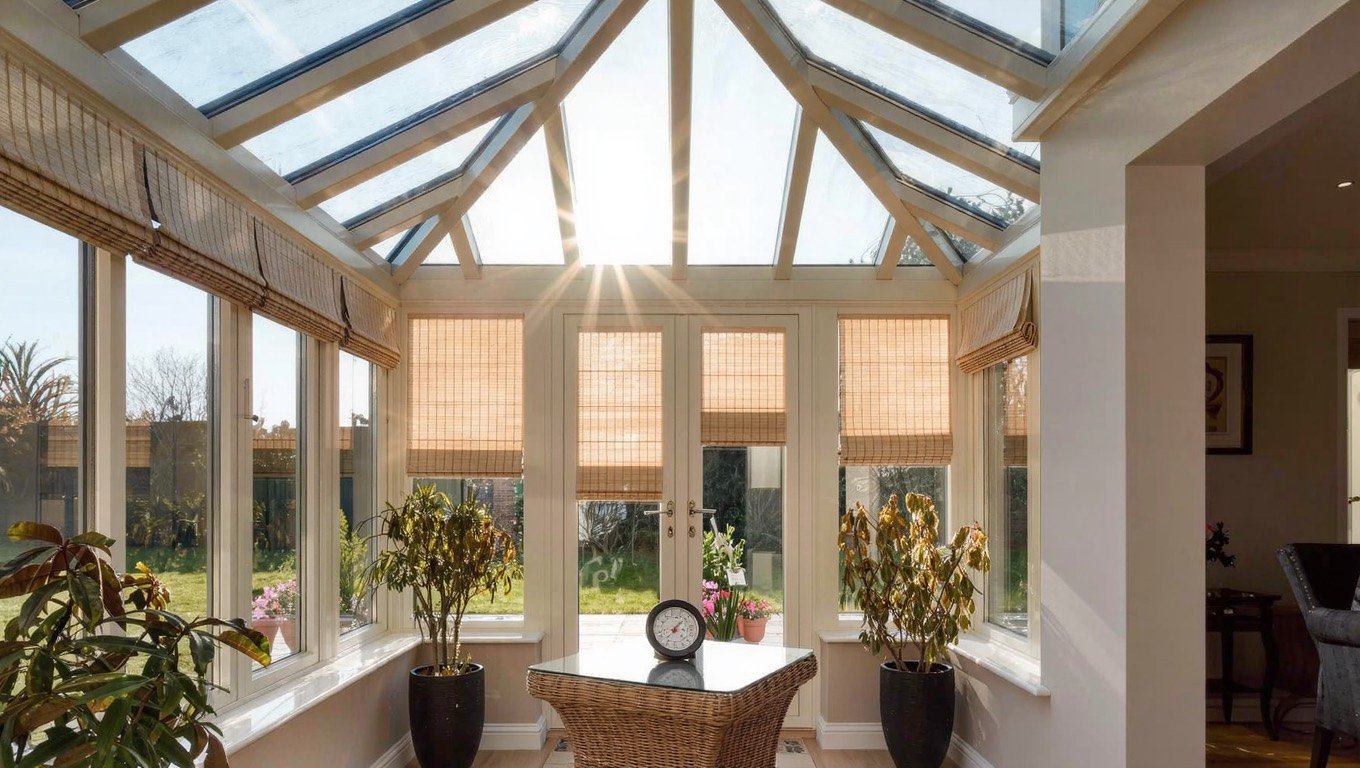
By late morning on a clear July day, an unshaded south-facing conservatory is already past 35°C; by mid-afternoon it can top 45°C — hotter than any other room in the house. The room people buy for summer becomes the one nobody can sit in from June to September.
Overheating is a physics problem with a well-understood ladder of fixes, from a £40 roll of solar film to a £6,000 solid roof. Here is why the heat builds, what each fix genuinely costs in the UK — and what renters can do without a drill going near the landlord's frames.
The Greenhouse Effect, Working Against You
Glass is almost transparent to short-wave solar radiation. Strong summer sun delivers roughly 600–800 watts per square metre, so a modest 3m x 4m glazed roof can be admitting 6–8kW at midday — three fan heaters running flat out. That energy is absorbed by the floor, walls and furniture, then re-radiated as long-wave infrared, which glass largely refuses to let back out. Energy in, nothing out: a greenhouse.
Glazing is rated by g-value — the fraction of solar energy it transmits. Ordinary double glazing sits around 0.7; solar-control glass manages 0.2–0.4. Most conservatories built before the mid-2000s have the worst of everything: high g-value glass on the sides and a polycarbonate roof that diffuses light but blocks very little solar energy, while insulating poorly in both directions — roasting in July, unusable in January. The spec trade-offs mirror those in our guide to double and triple glazing, but in a conservatory it is the roof, not the sides, doing most of the damage.
The Fix Ladder: Cheapest First
Every fix works by one of three principles: reject the sun before it reaches the glass, reject it at the glass, or move the heat out faster than it arrives.
- •Ventilation and night purging — free. Airflow alone is worth roughly 3–5°C. Do it properly, whatever else you buy.
- •Internal blinds — £150 to £3,500. Cut glare and perceived heat, but because they sit inside the glass much of the absorbed energy is already in the room. Expect 4–6°C.
- •Solar window film — from £40 DIY. Rejects 60–80% of solar energy at the glass, before it enters. The best value-per-degree upgrade for a glass roof.
- •External shading — £100 to £2,500. Sails, awnings and planting stop sun before it touches the glazing: the most effective principle, and the hardest to rig over a roof.
- •Roof replacement — £3,500 to £8,000+. Solar-control glass or a solid insulated roof. The only fix that transforms the room in both seasons.
What Each Fix Really Costs
Solar film is the sleeper: DIY rolls run £6–£12 per square metre, professional supply-and-fit £35–£60, so a typical 3m x 4m lean-to roof plus sides lands at £450–£900 fitted. Decent film lasts 10–15 years. Fit it in spring or autumn — in summer heat the mounting solution flashes off before you can squeegee out the bubbles.
Made-to-measure pleated roof blinds commonly cost £120–£250 per roof panel, so a full Victorian-style roof runs £1,200–£3,500 fitted; perfect-fit side blinds add £60–£120 per frame. They are also the biggest dust trap in the house — our guide to cleaning curtains and blinds earns its keep here.
External shading runs from a £30–£150 shade sail through a £250–£800 manual awning to £900–£2,500 for an electric one, fitted. A deciduous tree or a pergola with a climbing vine on the south side is the slow, elegant version — full shade in July, bare stems by December.
Replacement roofs are the endgame: solar-control self-cleaning glass for a typical 3.5m x 3.5m conservatory costs £3,800–£6,500; a lightweight insulated solid roof runs £4,500–£8,000+, needs building regulations sign-off, and requires a structural check that the existing frames can carry the extra weight. Walk away from any installer who skips that check.
Ventilation Patterns That Actually Shift Heat
The classic mistake is throwing every door open at 2pm, importing 30°C air and parking it under glass. Timing and direction matter more than open area. A room that feels stale even in mild weather points to poor home ventilation — conservatories just show it first.
- •Purge early: open everything from 6–9am while outside air is cool, then close up and drop the shading by 10am.
- •Cross-vent, never single-vent: air needs an inlet low on the shaded side and an outlet on the opposite side, or it just eddies.
- •Use the stack effect: heat pools at the ridge, so a roof vent paired with a low-level opening moves far more air than two windows at the same height.
- •Purge again after sunset, once outside falls below inside — usually 8–9pm in a UK heatwave.
- •Point a fan out, not in: one blowing out of a shaded-side door pulls cooler air through the house behind it — and where a solid ridge beam exists, installing a ceiling fan keeps air moving for pennies.
The Renter-Safe Version
Tenants can get most of the benefit with nothing a landlord could object to. Static-cling solar film (£8–£15 per square metre) grips the glass with no adhesive and peels off clean at the end of the tenancy, leaving no residue to argue over at check-out. Perfect-fit blinds clip into the rubber glazing gasket without a screw; tension-rod or suction blinds handle awkward side frames.
Outside, a freestanding cantilever parasol or pot-grown bamboo in planters shades the glass without touching the building, and fans, timed purging and a £10 roll of reflective foil over the worst panels all travel with you when you leave. What crosses the line: screwing awning brackets to the fascia or drilling any frame — deposit territory, and holes in uPVC can void the glazing guarantee.
DIY or Call Someone In?
Film on side glass, sail shades, fans and blind fitting are all sensible DIY. Film on a roof is not: polycarbonate panels will not take a person's weight, and glass roofs need crawl boards and fragile-roof experience. Replacement roofs and wired awnings are professional jobs, full stop.
Be honest about the base case too. If yours is a pre-2000 polycarbonate lean-to with failing seals and misted units, £1,500 of blinds is good money after bad — bank it towards a roof, fix the draughts that make it freezing in winter, and treat the room as three-season until then.
Quick Answers
The questions we hear most on site visits.
- •Does solar film make the room dark? Good spectrally-selective film cuts glare by up to 80% while trimming visible light only 20–40% — the room reads soft, not dim.
- •Will these fixes make winter worse? Film shaves a little useful winter solar gain, a solid roof more than pays it back in insulation, and blinds and shading simply retract from October.
- •Can I just buy a portable air conditioner? In an unshaded glass room a £400 12,000 BTU unit fights 6kW of solar gain and loses; shade first, and the same unit will hold 24°C.
- •Do plants help? A mature grape vine under the ridge is the traditional Victorian fix — worth 1–2°C from shade and transpiration; a supplement, not a cure.
Found this useful?
There's plenty more — hundreds of guides and honestly-tested product reviews for every corner of your home.
Browse All Guides