Energy & Insulation · 6 min read · 20 May 2026
Attic Insulation: R-Values, UK Regional Targets and What It Costs
Most UK lofts hold about half the insulation they should. Here is what R-value means in metric, the depth each UK nation expects, real prices, and the point at which the job stops being DIY.
By the Nims Casa editorial team — written from professional cleaning experience and checked against our editorial standards.
Open almost any loft hatch on a British estate built before 2003 and you find flattened grey mineral wool, 50mm to 150mm deep, laid one way between the joists and untouched since. The target is 270mm, and on a gas-heated three-bed semi that shortfall is worth £250 to £330 a year.
Most advice online is written to American R-values and climate zones, neither of which describes a British roof. Here it is translated: R-value in metric, what each UK nation expects, real prices, and a plain line between DIY and the jobs that need a professional.
R-Values, U-Values and the Metric Translation
R-value is resistance to heat flow: thickness in metres divided by thermal conductivity, the lambda figure on every UK data sheet in W/mK. British R-values use m²K/W, American ones ft²·°F·h/Btu, and the two differ by a factor of 5.678 — so an "R-38 attic" is only R-6.7 here.
UK building control ignores R-values and works in U-values: the inverse figure, measuring heat through the whole ceiling build-up in W/m²K, lower being better. Marketing quotes R; inspectors quote U.
- •Mineral wool quilt, lambda 0.044 W/mK: 270mm gives R = 0.270 ÷ 0.044 = 6.1 m²K/W.
- •Blown cellulose, lambda 0.038–0.040: 250mm reaches 6.3–6.6 m²K/W and fills awkward corners.
- •PIR rigid board, lambda 0.022: 120mm matches 270mm of wool, hence its use at rafter level.
- •US to UK: divide the American figure by 5.678. R-30 = 5.3, R-38 = 6.7, R-49 = 8.6 m²K/W.
- •Result: 270mm of quilt over 12.5mm plasterboard lands at roughly 0.15–0.16 W/m²K.
How Much Do I Need? Targets by UK Nation
Britain has no equivalent of the American climate-zone map, and anyone selling you "more depth because you're up north" is inventing a rule. What varies regionally is heating degree days, which changes the payback, not the target. The signs your home needs more insulation show from inside the house long before you get the ladder out.
- •England and Wales, Approved Document L: 0.16 W/m²K when renovating a ceiling — roughly 270mm of mineral wool.
- •Scotland, Section 6: 0.15 W/m²K, with 15–20% more heating degree days than the south, so the job repays faster in Aberdeen than Exeter.
- •Northern Ireland, Technical Booklet F1: 0.16 W/m²K, in the wettest climate of the four — eaves ventilation matters most here.
- •New build, UK-wide: 0.11–0.13 W/m²K — 400mm of quilt or a warm-roof build-up.
The Materials, and When Each Applies
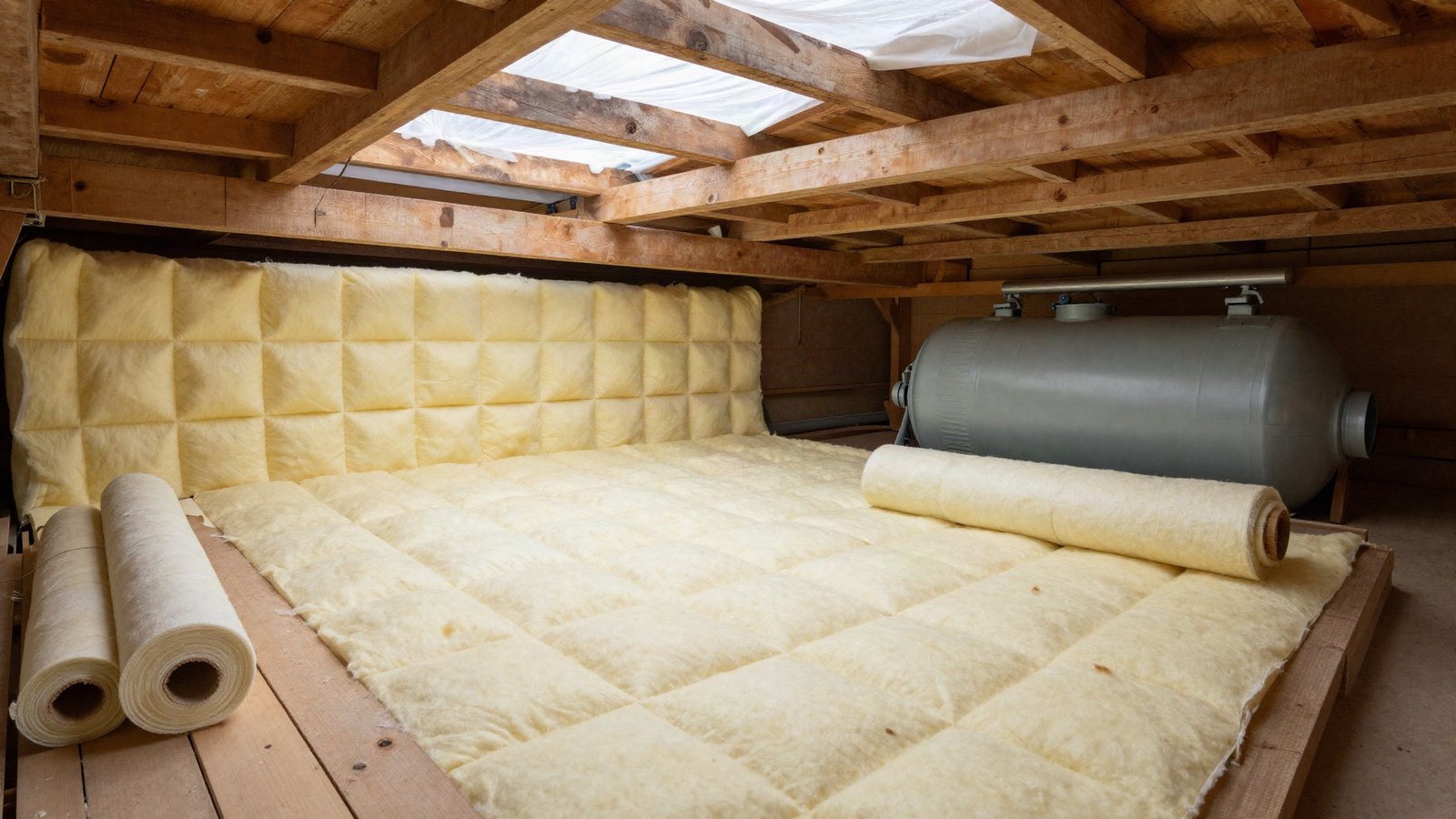
Mineral wool quilt handles nine out of ten UK lofts: 100mm snug between the joists, then 170mm laid at right angles across the tops so the timbers stop cold-bridging. Blown cellulose suits irregular joists and barely crawlable spaces, but needs a hopper and depth checks — installer-only. Rigid PIR between and under rafters is for when you want the loft itself warm — a conversion, or services in the roof space.
Closed-cell spray foam on the underside of the roof deck is the one to avoid. It performs thermally, but it hides the rafters from inspection and many UK lenders and RICS surveyors will now downvalue or refuse a property that has it; we have watched two sales collapse over it. Our comparison of spray foam against mineral wool sets out why.
What It Costs, With Three Worked Examples
Materials cost a fraction of the installed price, because nearly all of the professional charge is labour and access. These are mid-2026 rates; the wider picture sits in our breakdown of what insulation costs across the house.
- •Mineral wool loft roll: 100mm covering 8.01 m² is £22–£28 a pack (~£3 per m²); 170mm covering 6.19 m² is £26–£33 (~£4.50 per m²); a full 270mm from bare joists works out at £8–£11 per m².
- •Installer, fresh lay or top-up: £450–£900 for a typical 40–55 m² loft, one day for two people.
- •Rafter-level PIR warm roof: £70–£130 per m² installed, including vapour control layer and plasterboard.
- •1960s semi, 48 m², bare joists, DIY: £430 of wool plus a £25 hatch kit, two people for one Saturday. Saves around £300 a year — repaid in the first heating season.
- •Same house, existing 120mm topped to 270mm by an installer: £500–£700 for a £35–£45 annual saving. Payback 13–16 years — worth doing while the loft is open, not worth borrowing for.
- •Conversion bedroom, 22 m² of sloping ceiling, 100mm PIR between rafters plus 50mm below, skimmed: £2,300–£3,200. A comfort and compliance job, not an energy investment.
The DIY-or-Pro Line: Where to Stop
This is the part most guides fudge. Laying quilt is easy; everything around it is where people get hurt. Wear an FFP3 mask, goggles, gloves and long sleeves, never stand between joists, and lay crawl boards first. Work from the far corner back to the hatch so you are never stranded on bare plasterboard.
- •Safe DIY: laying or topping up quilt at ceiling-joist level in any accessible loft.
- •Safe DIY: insulating and draught-stripping the hatch — a £25 job, and a natural companion to wider draught-proofing.
- •Safe DIY: lagging the cold tank and exposed pipework above the insulation line, which matters more once the loft runs colder.
- •Call a professional: any suspected asbestos. Grey-brown vermiculite loose fill and boarding around old flues in pre-2000 houses need a survey first: close the hatch and phone a licensed surveyor.
- •Call a professional: rafter-level or warm-roof work. It needs a designed vapour control layer, and getting it wrong rots the roof timbers within a decade.
- •Call a professional: all electrical work. Cables buried in insulation must be derated or rerouted, and downlights need fire-rated loft caps or proper clearance.
- •Call a professional: lofts with no safe access, damp timbers, vermin, or black mould on the roof underside. Insulating over an unresolved problem hides it and makes it worse.
Ventilation and the Mistakes That Cost Most
Adding insulation makes a loft colder, and a colder loft holds less moisture in suspension. Almost every callback follows the same pattern: quilt stuffed tight into the eaves, airflow killed, a dry roof space wet within two winters. Keep a clear 25mm continuous gap at the eaves — or 10mm with dedicated vents — and fit eaves trays if you cannot see daylight along the edges. Settle this before buying anything, using our guide to ventilating a loft properly.
Three errors cause the rest. Never insulate under the cold water tank; it needs warmth rising from below or it freezes. Never compress quilt to fit boards on top — it loses about a third of its value, so use raised loft legs. Keep 60mm clear of flues and chimney breasts.
Common Questions
Can I lay new insulation over old? Yes. Old quilt still works, it has just compressed. Rake it level and run new 170mm rolls across the joists at right angles; do not bin serviceable material because it looks grubby.
Are grants still available? The Great British Insulation Scheme and ECO4 still fund loft insulation for households on qualifying benefits or in lower council tax bands with a poor EPC. Apply through your supplier or council, never a cold caller, and pay no doorstep deposit. For the job itself, our step-by-step on how to insulate an attic covers the sequence.
Found this useful?
There's plenty more — hundreds of guides and honestly-tested product reviews for every corner of your home.
Browse All Guides