Garden & Outdoor · 6 min read · 14 April 2026
Covered Patio Ideas for Real UK Homes and Budgets
An uncovered patio gets used about twelve weekends a year in this country. Here is what cover actually costs, what fails in British weather, and how to do it reversibly if you rent.
By the Nims Casa editorial team — written from professional cleaning experience and checked against our editorial standards.
An uncovered patio in Britain is a fair-weather asset. Between the rain and the hour a table takes to dry after a shower, most people use theirs on a dozen decent afternoons a year. Roofing even part of it changes the maths more than any other garden spend of the same money.
What follows is what we see working on ordinary British houses at 2026 prices, with the failure modes we get called back to fix — plus a fully reversible version for renters.
Start with the brief, not the mood board
Which way the patio faces decides the design before style gets a look-in. South and west-facing patios have a glare problem, so shade beats shelter; north and east-facing ones have a wind and gloom problem, so cover must keep light in. The winter catch: midday sun sits about 15 degrees above the horizon in late December, so a 3m-deep solid roof over south-facing doors takes that light out of your kitchen for four months.
- •Fall: any sheet roof needs at least 5 degrees of pitch, roughly 90mm per metre, or it ponds and grows algae within two winters.
- •Water: 10mm of rain on a 4m x 3m roof is about 120 litres. Gutter it to a water butt or a soakaway 5m from the house, never over a boundary.
- •Wind: free-standing posts want 600mm-deep concrete footings around 300mm square. Gusts of 50mph are routine here, not exceptional.
- •Depth: a 1.4m round table with chairs out needs about 2.6m of cover. A 2.4m awning shelters the table but not the person standing up.
Covered patio ideas under £500
This tier buys shade and light shower cover, not year-round shelter — fine if you only need somewhere to eat in July without squinting. The limitation is wind: everything here either comes down in a gale or is ballasted properly.
- •Cantilever parasol, 3m square: £130–£350, plus a cross base loaded with 60–80kg of slabs at £50–£90. No posts in the seating area and it folds away in October.
- •Shade sail: a 3.6m triangle is £25–£60, plus turnbuckles at £30–£50 and one 100mm post in postcrete. Tension it with a fall so water sheds off a corner.
- •Manual wind-out awning, 3m wide: £180–£350. Fine on brick, useless above about 30mph.
- •Pop-up gazebo, 3m x 3m: £70–£200. Buy steel legs and water-filled weights, and treat it as seasonal kit, not a structure.
The £500 to £5,000 range: verandas, awnings and pergolas
Here a covered patio becomes a space you use in April and October, and the gap between a good installation and a cheap one lies in details invisible in a photo: wall flashing, gutter fall, footings. Starting from bare ground, read what a patio costs to build first — a proper base under a covered area is not optional.
- •Timber pergola with retractable canopy, 3m x 3m: £600–£1,400 in kit form. The fabric is what you replace around year seven.
- •Electric cassette awning, 4m wide, 3m projection: £1,200–£2,600 fitted. Insist on the wind sensor — awnings without one get destroyed.
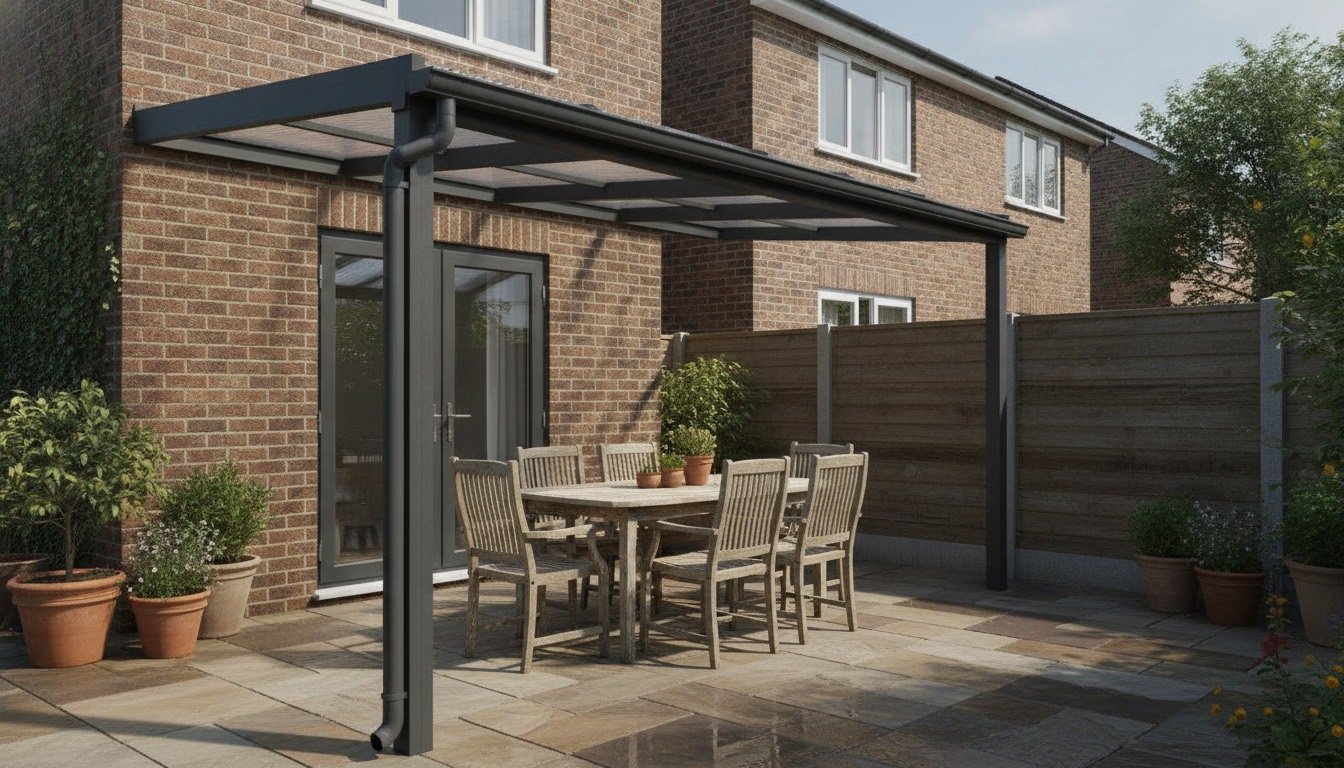
- •Aluminium lean-to veranda, 4m x 3m with 16mm multiwall polycarbonate: £1,600–£3,000 supply-only, £2,600–£4,200 fitted. The default on British semis, rightly: powder-coated aluminium does not rot.
- •Solid-roof lean-to in EPDM with a rooflight: £2,500–£5,000. Warm and quiet in rain, genuinely dark without that rooflight.
- •Louvred aluminium pergola, 3m x 4m: £3,500–£8,000. Superb in July, thunderous in heavy rain, and the blade seals need servicing.
What works in a small UK garden or courtyard
Terraced gardens run 4–6m wide, and the instinct to cover the lot is almost always wrong. Roof 6–9m² nearest the back door and leave the rest open; a fully covered small garden reads as an alley and the planting stops growing. A lean-to also beats a free-standing frame here: you lose two posts and 400mm of floor.
Light is the other constraint. In a courtyard fenced on three sides, use clear rather than opal glazing, paint the return wall a warm off-white, and run the same paving under the cover and out into the open so it reads as one space. If you are relaying anyway, laying a paved patio covers base depths on clay.
- •Corner-mounted shade sails remove posts entirely — anchor to the house wall and fence posts you actually own.
- •Add lighting at build stage: festoon on the frame plus one warm downlight, the same layering logic as lighting a room indoors.
Materials, and where the money actually goes
On a typical £3,000 fitted aluminium veranda, roughly half is frame and glazing, 10% fixings, gutter, downpipe and flashing, 10–15% groundworks, and the rest labour — a two-person team at £400–£600 a day for one to two days. A quote well under that is missing something, usually the footings or the flashing.
Glazing changes the feel most. Sixteen-millimetre multiwall polycarbonate is £45–£70 per m² and loud in rain; 25mm is £70–£120 and better on both counts; toughened self-clean glass is £150–£250, quiet, and still needs washing twice a year. Timber frames cost less up front and more over a decade once re-treating is counted, the same trade-off as composite versus wood decking.
The renter-safe covered patio
Everything above assumes you can drill brick. If you rent, the rule is simple: nothing that leaves a hole in masonry, render, fascia or fence posts, and nothing needing a concrete footing. That still leaves a good covered patio — it just gets ballasted rather than bolted and has to come apart. Ask by email even for reversible work and photograph the patio first, the same thinking behind rental-friendly decor indoors.
- •Free-standing pergola or gazebo ballasted with water-filled feet or 50-litre planters, never concreted in.
- •Shade sail tensioned with soft webbing straps and rubber-lined hooks around existing posts and tree limbs — no pad-eyes screwed into a fence that is probably the neighbour's.
- •Solar or battery festoon lighting only. Never run an indoor extension lead out through a window; a permanent outdoor socket means the landlord's electrician.
- •Pot feet under every planter — iron-rich terracotta stains sandstone within a season, and that gets flagged at check-out. Get the patio properly clean before you hand the keys back.
Permission, upkeep and the questions we get asked most
An attached canopy open on at least two sides and under 30m² is generally exempt from building regulations, and a free-standing structure usually falls under permitted development if it is under 2.5m high within 2m of a boundary and behind the principal elevation. Flats, listed buildings and conservation areas differ, so check with your local authority — when planning permission and building regs apply sets out the lines.
Next step: measure the depth you need with the table in place, work out where the water will run, then get two fixed quotes rather than day-rate estimates. More in the Garden & Outdoor guides.
- •Will it darken the kitchen? A solid roof will; clear 16mm polycarbonate costs only 10–15% of the light.
- •Can I fix to a rendered wall? Only if the fixings reach sound brick behind and you reseal. On external wall insulation, no — that needs thermal brackets.
- •How long does it last? Aluminium 20–25 years, polycarbonate 10–15 before it yellows, softwood 8–12 with annual attention.
Found this useful?
There's plenty more — hundreds of guides and honestly-tested product reviews for every corner of your home.
Browse All Guides