Costs & Hiring · 6 min read · 11 July 2026
Home Inspection Checklist for Buyers: What to Check at Every UK Viewing
Estate agents book 20-minute viewing slots for a reason. Here is how to use them like a surveyor would, plus the certificates that stop a £3,000 surprise arriving in month two.
By the Nims Casa editorial team — written from professional cleaning experience and checked against our editorial standards.
Twenty minutes is long enough to fall for a kitchen island and nowhere near long enough to notice that the rear extension never had building control sign-off. Buyers who avoid five-figure surprises treat a viewing as an inspection rather than a tour, and know which expensive problems hide neatly behind two coats of fresh magnolia.
This checklist follows the way UK sales run: a first viewing, a longer second viewing, a paperwork stage while your solicitor does the searches, then a RICS survey once your offer is accepted. Work in that order and you will either buy with your eyes open or renegotiate with evidence in hand.
What to take with you (roughly £40 of kit)
Turning up empty-handed is why most viewings tell you nothing. None of this is specialist equipment, and every item earns its place.
- •A proper torch, 500 lumens or better. A phone torch is useless in a loft or behind a boiler.
- •A 600mm spirit level. Door heads and floors 10mm out over half a metre are telling you something.
- •A basic moisture meter, £15–£25 from Screwfix or B&Q. Not gospel, but it separates a 12% wall from a 28% one.
- •A tape measure, to check loft insulation against the 270mm current standard.
- •Your phone, to photograph everything and run the postcode through the Environment Agency flood map.
Viewing one: the 20-minute deal-breaker sweep
The first viewing is not about wallpaper. You are hunting the faults that cost more to fix than you could ever claw back on price. If several appear together, walk before you spend a penny on a survey.
- •Stand across the road and sight along the roof ridge and eaves. A dip or wave means rafters or a wall plate are moving.
- •Walk the perimeter. Is the ground higher than the damp proof course? A raised patio bridging the DPC is the commonest cause of ground-level damp.
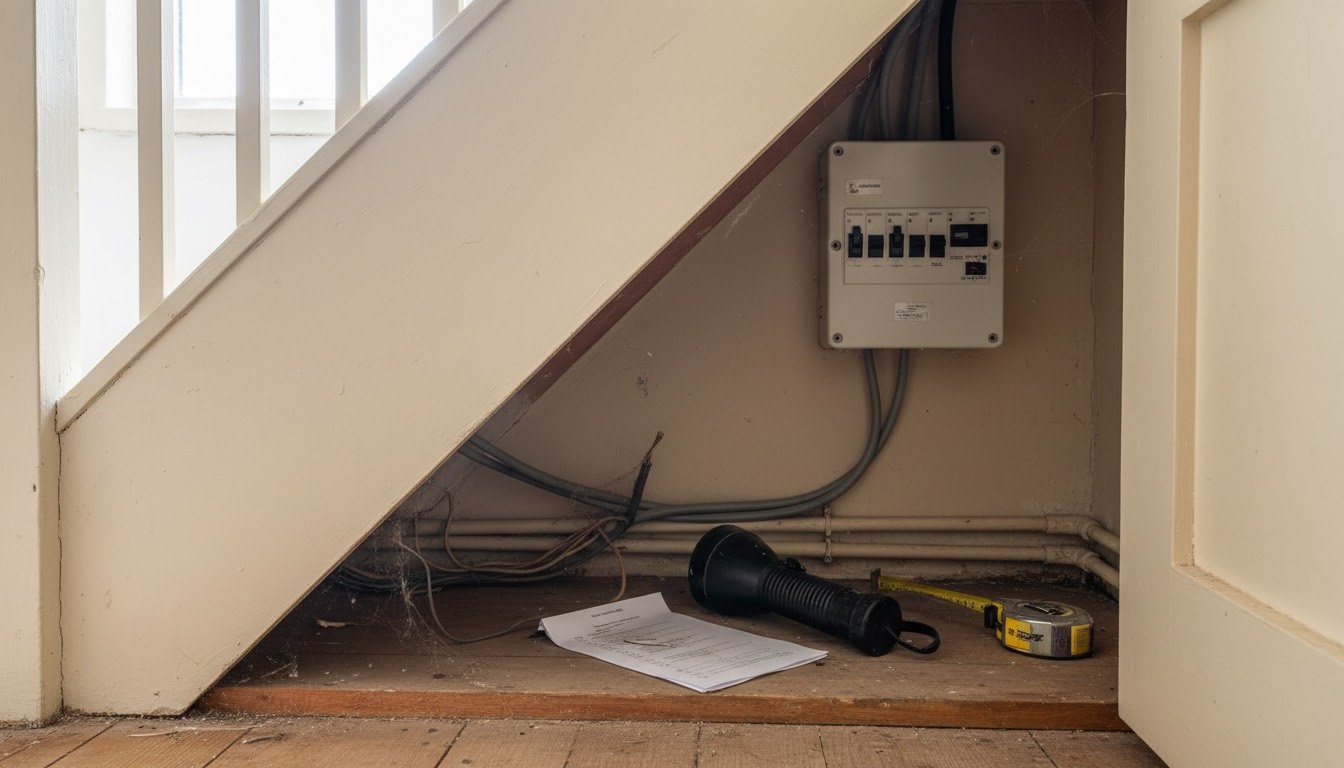
- •Open the under-stairs cupboard. A cast-iron fuse box with rewireable fuses means a rewire is likely, not optional.
- •Sniff each room. Damp has a cellar smell no plug-in air freshener covers.
- •Ask directly: how old is the boiler, when was it last rewired, and has anything been extended?
Viewing two: the 90-minute detailed inspection
Go at a different time of day and take someone who has owned an older house. Vendors expect a second viewing to run long, so use it properly and get into the loft.
Cracking is where most buyers panic unnecessarily and a few should panic more; width, direction and pattern matter far more than length, so learn how to tell if a foundation crack is serious before you negotiate. A damp patch in a bedroom corner is usually condensation, not rising damp, and the two carry very different price tags once you know what actually causes damp and mould.
- •Loft: insulation depth, daylight through the covering, felt condition, water stains on rafters, cut structural timber.
- •Chimney: dark tide marks around the breast in the loft point at flashing failure, a classic early warning before a roof needs replacing.
- •Electrics: consumer unit type and date, RCD protection, socket count, and any non-compliant switching in the bathroom.
- •Heating: boiler manufacture date, system pressure reading, radiator cold spots, and whether the thermostatic valves still turn.
- •Plumbing: run every tap for two minutes, flush every toilet, and look under every sink with the torch.
- •Floors and windows: bounce in the middle of each upstairs room; check for misted glazing and rot at the bottom rail.
- •Drains: lift the inspection chamber cover outside. Standing water means a blockage or collapse downstream.
The paperwork: certificates that cost real money if missing
Condition is only half the job; the other half is proving the work was signed off legally. Missing certificates can block a mortgage, force a retrospective regularisation application, or leave you liable for someone else's unsafe work. Have your solicitor chase every one before exchange, and read up on when planning permission and building regulations apply.
- •Part P: any new circuit, consumer unit swap or bathroom work since 2005 needs a certificate from a NICEIC, NAPIT or ELECSA electrician, or building control sign-off.
- •Gas Safe: boiler installation and gas pipework must be done by a Gas Safe registered engineer. Ask for the certificate and last service record.
- •FENSA or CERTASS for replacement windows fitted since April 2002.
- •Building Regulations completion certificate for extensions, loft conversions, structural openings, new bathrooms and re-roofing.
- •Permitted development is not a substitute for building control. Work can be permitted development and still need a completion certificate.
- •Indemnity policies offered instead of certificates cover legal costs, not the cost of putting bad work right.
After your offer is accepted: which survey, and what it costs
A mortgage valuation is not a survey. It protects the lender and tells you almost nothing. Commission your own RICS surveyor and match the level to the building's age — full figures are in our breakdown of what a home survey costs in the UK.
- •RICS Level 1 Condition Report, £300–£500: only for a modern, conventional house in visibly good order.
- •RICS Level 2 HomeBuyer Report, £450–£900: the default for most 1930s–1990s stock; add a valuation for around £100 more.
- •RICS Level 3 Building Survey, £700–£1,500+: anything pre-1930, timber-framed, previously underpinned, heavily extended or converted.
- •CCTV drain survey, £120–£250: worth it on any house with mature trees or a shared sewer.
- •Independent damp and timber report, £250–£400: pay a neutral surveyor rather than take a free one from the firm selling the treatment.
- •Structural engineer's opinion, £400–£750, and an EICR at £150–£300 if the consumer unit predates 2008.
Time and cost per task — and what to do if you are short on time
Budget £600 to £1,800 of due diligence on a typical £300,000 house. Set against what it costs to rewire a house, that is cheap insurance.
If you genuinely only have twenty minutes, do three things: get your head into the loft, open the consumer unit cupboard, and walk the perimeter checking ground levels against the damp proof course. Those three catch more expensive faults than all the rest combined.
- •First viewing sweep — 20 minutes, free. Second viewing detail — 90 minutes, free.
- •Land Registry title register and plan — 30 minutes, £7 each; the council planning portal is free.
- •Flood risk and radon postcode checks — 10 minutes, free.
- •Certificate chase via your solicitor — around two weeks, included in conveyancing fees.
- •RICS survey — two to four hours on site, report in five to ten working days, £300–£1,500.
Buying to let? Four duties that start on completion day
On an investment purchase the standard rises, because compliance failures become your legal problem the moment tenants move in. Price remedial work into your offer rather than discovering it in month one. Once the keys are yours, the jobs worth doing while the house is empty are covered in what to do before moving into a new house.
- •An EPC rating of E or better. Letting below E without a valid exemption on the PRS Exemptions Register is unlawful.
- •A Gas Safety Record renewed every 12 months by a Gas Safe engineer, issued to tenants within 28 days.
- •An EICR at least every five years, with C1 and C2 remedial work completed within 28 days.
- •A smoke alarm on every storey and a carbon monoxide alarm in every room with a fixed combustion appliance.
Found this useful?
There's plenty more — hundreds of guides and honestly-tested product reviews for every corner of your home.
Browse All Guides