Energy & Insulation · 6 min read · 11 July 2026
How Do Solar Panels Work? The Complete UK Guide (2026)
A solar panel is not a battery and it does not make heat. It is a slab of doped silicon that turns daylight into direct current — here is what happens next, and what it is worth in a British climate.
By the Nims Casa editorial team — written from professional cleaning experience and checked against our editorial standards.
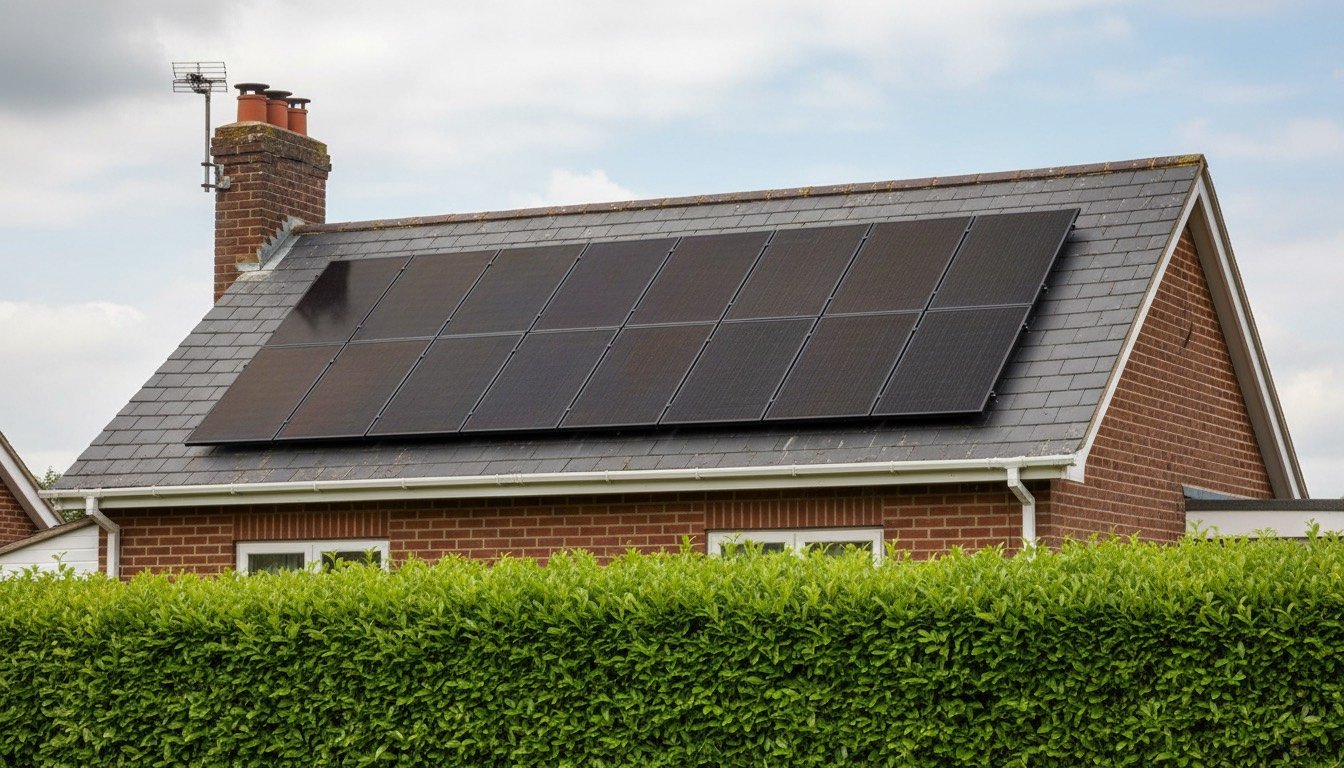
Most explanations stop at "sunlight hits the panel and makes electricity", which is true and useless. What decides whether solar is worth £7,000 is how much of that electricity you use yourself rather than exporting for pennies.
Here is the physics in plain terms, the kit list, 2026 UK costs, where the DIY line legally sits, and a version for renters who cannot put a screw in the roof.
What actually happens inside a solar panel
A photovoltaic cell is a silicon wafer with two deliberately contaminated layers: one doped with phosphorus for spare electrons, one with boron for spare gaps. Where they meet, a permanent electric field forms, so when a photon knocks an electron loose it can only travel one way. Wire the two faces together and you have a current. It runs on light, not warmth.
That matters in Britain. Panels are rated at 25°C and lose 0.3–0.4% of output per degree above it, so a bright cold April morning out-generates a hazy 30°C July afternoon. A 2026 panel is about 1.75 x 1.13m and rated 430–460W; ten to twelve gives a 4.3–5.5 kWp array.
Cells produce direct current, wired in series into strings reaching 300–400V DC. An inverter converts that to 230V, 50Hz AC synchronised with the grid. Generation feeds the house first; surplus flows backwards through the meter. Nothing is stored unless you bought a battery.
The decision tree: is your roof worth it?
Work down in order. Failing the first two steps usually kills the project; the rest just change the numbers.
- •Orientation: south-facing yields 900–1,000 kWh per kWp per year in southern England, 750–850 in Scotland. An east–west split loses about 15% but spreads output across morning and evening. Due north is not worth quoting.
- •Shade: a chimney, conifer or aerial shading one cell drags a whole string down unless you fit optimisers. Stand in the garden at 9am, midday and 4pm in winter and map it.
- •Roof condition: if the covering has under ten years left, re-roof first. Stripping and refitting an array later costs £1,200–£2,000.
- •Daytime occupancy: solar pays through self-consumption, not export. Someone home in the day, an EV or a heat pump matters more than an extra panel.
- •Fabric first: with 100mm of loft insulation and whistling doors, spend £400 on draught-proofing first.
The main types of kit, and when each applies
Panels have converged — monocrystalline, all-black, 21–23% efficient, 25-year warranty. The meaningful choices sit further down the chain.
- •String inverter (£800–£1,400): one box in the loft handling every panel. Cheapest and most reliable, but shade on one panel drags the whole string. Fine on a clean roof.
- •Power optimisers (£50–£80 per panel): DC units under each panel, so shading is isolated and monitoring is per-panel. The default on awkward roofs — dormers, chimneys, hipped ends. Microinverters (£120–£180 per panel) do the same job better and cost more.
- •Hybrid inverter plus battery (£3,500–£6,500 for 5–10 kWh usable): lifts self-consumption from roughly 30% to 60–75% and allows cheap overnight charging on a time-of-use tariff. Check specifications against our home battery backup guide before accepting an installer's default brand.
- •Solar diverter (£350–£550 fitted): pushes surplus into the hot water cylinder instead of exporting at 5p. Cylinder homes only, not combis.
What it costs in the UK, and when it pays back
For a three-bedroom semi in 2026, expect £5,200–£7,500 for a 4–5 kWp array with optimisers, MCS-certified and scaffolded, at 0% VAT; a battery adds £3,500–£6,500. Our solar panel cost breakdown itemises hardware, labour and certification.
A 4.4 kWp system in the Midlands makes around 3,800 kWh a year. Without a battery you use about 30%: 1,140 kWh saved at 26p is £296, and 2,660 kWh exported at a Smart Export Guarantee rate of 5–16p is £130–£425. Call it £430–£720 a year, a 9–14 year payback. A battery lifts self-consumption towards 70% and the benefit to £700–£900, but the capital rises with it.
Budget one inverter replacement at year 11–14 (£900–£1,500) and bird-proofing mesh at £350–£600 if you have gulls or pigeons. Degradation runs 0.45% a year, so year 25 output is still near 87% of new. If an EV charger installation is also planned, quote both together — one visit, one grid application.
The renter-safe version: solar without touching the roof
Tenants get told solar is off the table. Not entirely — you just stay off the roof, out of the fixed wiring, and away from anything that back-feeds the grid. Plug-in "balcony solar" that pushes power into a 13A socket is not BS 7671 compliant here, whatever the German market sells.
What works is a self-contained off-grid island: portable panels charging a battery power station that runs appliances from its own sockets. Nothing drilled, and it leaves with you at the end of the tenancy.
- •Folding 100–200W panels (£120–£350) propped on a balcony, patio or sill on a weighted stand — no fixings, no ladders.
- •A 500–1,500Wh power station (£300–£1,000), charged by those panels and topped up on cheap overnight electricity. It runs a laptop, router, lamps and phone charging; it will not run a kettle. Our portable power station comparison covers runtimes.
- •Clamp mounts on glazing and A-frames on paving — never adhesive pads on painted render or UPVC, which take the finish with them. Solar shed and garden lighting on spikes is the same rental-friendly upgrade logic.
- •If the landlord is interested in a roof array, pitch it as a property upgrade with export income — and agree in writing who keeps the bill savings.
DIY versus professional: where the line sits
You can legally buy panels and mount them yourself. You cannot connect a generating set to fixed wiring without notifying the network operator under G98 (or applying under G99 above 3.68 kW per phase), and the final connection is notifiable under Part P. Without MCS certification you also cannot claim the Smart Export Guarantee — a third of the return, gone.
Self-installing saves perhaps £1,500 of labour and costs you that export income, the insurance-backed warranty and any comeback if a leak appears in year three. Add £450–£900 of scaffolding hire and the gap all but closes. Do it yourself on a shed or off-grid workshop; on a house roof, get three MCS-certified quotes. Stop and call someone the moment you see an inverter that will not restart, an arcing DC isolator or scorching at a connector.
Frequently asked questions
- •Do panels work on a cloudy day? Yes — diffuse light gives 15–30% of clear-sky output. A dull December day yields about 1 kWh from a 4 kWp array; a clear June day gives 25 kWh.
- •Do I need planning permission? Usually not: panels no more than 200mm above the roof plane are permitted development. Listed buildings, conservation areas and flats are the exceptions.
- •Will they keep the lights on in a power cut? Not by default — a grid-tied inverter shuts down for safety. You need a battery with a backup circuit, and even then only one nominated circuit stays live.
- •How much maintenance? An annual visual check, a rinse every two or three years under trees or beside a main road, and an eye on the app. Never jet-wash or clean panels in bright sun.
Found this useful?
There's plenty more — hundreds of guides and honestly-tested product reviews for every corner of your home.
Browse All Guides