Roofing & Exterior · 5 min read · 14 May 2026
How Much Does Crawl Space Encapsulation Cost? 2026 UK Price Guide
Three UK damp firms will price the same underfloor void at £1,600, £4,800 and £11,000 — because they are quoting three different jobs. Here is what each tier actually costs in 2026.
By the Nims Casa editorial team — written from professional cleaning experience and checked against our editorial standards.
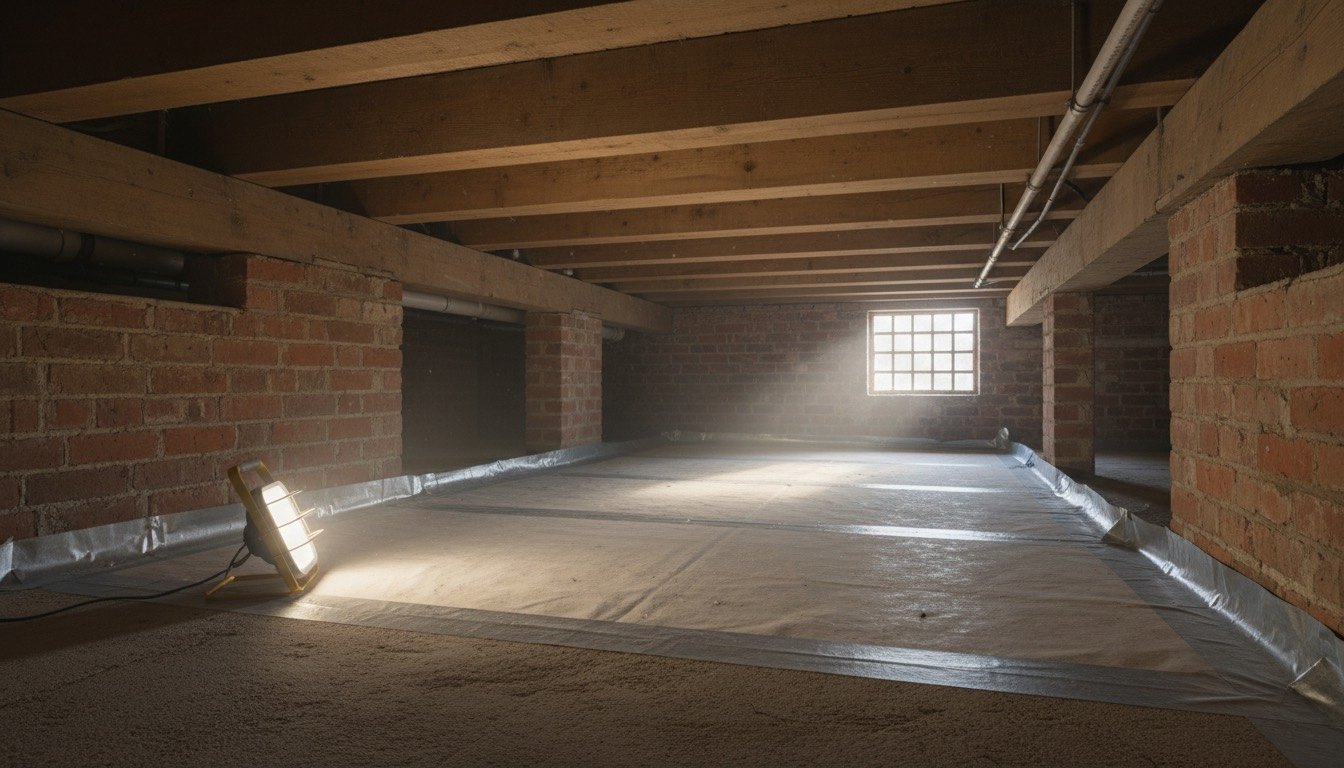
Encapsulation is not one product. It ranges from a taped polythene membrane laid over the oversite to a fully sealed, insulated void with a pumped sump and a ducted dehumidifier running year-round. The gap between those two specifications is roughly £9,000 on an average semi, which is why quotes for the same crawl space land so far apart.
Worth saying before any numbers: British practice has always ventilated suspended timber floors rather than sealing them. Approved Document C expects around 1,500mm² of through-ventilation per metre run of external wall, and closing off airbricks to create a sealed void is the most expensive mistake we see — it turns a dry, breezy space into a mushroom farm within two winters. Most UK homes need a ground membrane plus airbricks that actually work, not the full American-style sealed system. Price the job that matches the fault, not the brochure.
Typical UK Price Range in 2026
Encapsulation is priced per square metre of ground-floor footprint, not per square metre of house. A typical three-bed semi has 55–70m² of suspended floor; a Victorian mid-terrace is usually 40–55m². Work out your footprint first, because every quote you receive is really a rate multiplied by that number.
- •Tier 1 — vented ground membrane: clear the void, repair or replace airbricks, lay and tape 1200-gauge DPM over the oversite. £25–£45/m², so £1,200–£2,600 on most homes.
- •Tier 2 — lined void: reinforced liner to the oversite plus sleeper walls and piers, sealed laps, insulation between joists, ventilation retained or upgraded. £45–£75/m², so £2,800–£5,500.
- •Tier 3 — sealed and conditioned: full liner, drainage channel and sump pump, ducted dehumidifier, sometimes a radon fan. £75–£120/m², so £5,500–£11,000.
- •Emergency or exceptional: sub-350mm headroom, structural timber replacement or a void full of rubble can push a modest terrace past £13,000.
Unit Costs, Line by Line
Ask for the quote itemised against this list. If a firm will not break the price down, you cannot tell whether you are buying a membrane or a maintenance plan. These are 2026 supplied-and-fitted rates including VAT for domestic work.
- •Independent damp and timber survey (not the free one from the company selling the work): £180–£450.
- •Structural engineer's report where joists or wall plates are suspect: £450–£850.
- •Forming a new access hatch through floorboards, with a lockable frame: £250–£550.
- •Clearing spoil, builders' rubble and old plaster from the void, bucketed out by hand: £45–£70 per hour, plus £280–£380 for a 6-yard skip.
- •1200-gauge DPM to the oversite, taped: £22–£35/m² fitted (£1.60–£2.40/m² for the material alone).
- •Reinforced encapsulation liner, 0.4–0.5mm, mechanically fixed to walls: £48–£80/m² fitted.
- •Replacing a cracked or painted-over airbrick: £35–£70 each; telescopic periscope vents where ground level has risen: £70–£130 each.
- •Sub-floor extract fan with humidistat: £420–£900 fitted.
- •Ducted void dehumidifier: £950–£2,100 fitted, plus £80–£170 a year to run.
- •Sump chamber and pump inside the void: £950–£2,000.
- •100mm mineral wool between joists on netting: £20–£32/m²; PIR board cut and sealed: £38–£58/m².
- •Splicing a rotted joist end onto a new bearing: £160–£380 per joist.
Labour vs Materials, and What Moves the Price
On a Tier 2 job the split is roughly 65% labour, 35% materials. Lining 60m² costs about £450–£800 in liner, £120 in jointing tape and mastic and £90 in fixings — under £1,100 of goods. Everything else is two operatives spending three to five days on their backs in a space they cannot sit up in. That is the honest reason the rates look high.
Headroom is the single biggest multiplier. Above 600mm a crew works at normal speed. At 400–500mm expect 30–50% on top. Below 300mm most firms either refuse or move to a day rate of £480–£650 for two people, and the job stops being economic. Standing water changes the sequence entirely: the source has to be fixed before anything is lined, whether that is a leaking supply pipe, a blocked gully or ground levels sitting above the damp-proof course. If you are already seeing bounce, damp skirtings or floors that are visibly sagging, budget for timber repairs before you budget for membrane. The same goes for signs of subfloor damage — lining a void with rotting joists in it just hides the problem.
- •Region: London and the South East run 20–30% above the national rate; the North East and Wales run 10–15% below.
- •Access: a suspended floor reached only through a fitted kitchen adds £300–£700 for lifting and reinstating.
- •Radon-affected areas such as Cornwall, Devon, Derbyshire and Northamptonshire: add £900–£2,200 for a sump and fan, covered in our radon mitigation costs guide.
- •Listed or conservation-area property: breathability constraints can rule out sealed systems entirely.
- •Guarantee: an insurance-backed guarantee typically adds 2–4% to the contract price and is usually worth it.
Three Worked Examples
Real jobs, rounded to the nearest £50, all inclusive of VAT and waste removal.
- •Victorian mid-terrace, Leeds. 46m² footprint, 550mm void, six airbricks rendered over in the 1980s and 40 years of rubble on the oversite. Clear-out and skip £680, six new airbricks £310, 1200-gauge membrane taped £1,150, access hatch £290. Total £2,430 — and the moisture readings in the joists fell from 22% to 15% over the following summer with no dehumidifier at all.
- •1930s semi, Surrey. 68m² footprint, 420mm headroom, standing water each January from a high water table. Reinforced liner to oversite and dwarf walls £4,150, sump and pump £1,480, ducted dehumidifier £1,320, three periscope vents £330. Total £7,280, plus roughly £140 a year to run.
- •1960s bungalow, Fife. 74m² footprint, dry void, cold floors. Owner wanted comfort, not damp control. Membrane £1,850 and 100mm mineral wool between joists £1,920. Total £3,770 — and the heating bill dropped more than the membrane could ever have justified on its own.
The Renter-Safe Version
Tenants cannot encapsulate anything, and should not try. Lifting floorboards, fixing anything to sleeper walls or altering ventilation is alteration of the structure — it will cost you the deposit and, if a gas appliance draws air from that void, it can be genuinely dangerous. What you can do is everything on the outside and above, all of it reversible.
- •Clear the airbricks. Scrape soil, leaf litter, gravel and cobwebs out of the vents around the base of the walls with a screwdriver and a stiff brush. Free, takes twenty minutes, and it is the single most effective thing anyone can do to a damp void.
- •Move planters, bin stores and stacked timber away from the wall base so air can reach the vents.
- •Lay a thick felt underlay and a rug over cold, draughty boards rather than filling the gaps — filler is not reversible, underlay is.
- •Use a temporary draught excluder along the skirting gap, not sealant. Sealant on skirtings is one of the most common deposit deductions we hear about.
- •Run a portable dehumidifier in the room above at 45–55% RH; our dehumidifier picks cover the sensible UK models.
- •Report musty smells, springy boards or damp skirtings to the landlord in writing with photographs and dates. Under the Homes (Fitness for Human Habitation) Act 2018 a sub-floor damp problem causing damp and mould is the landlord's to fix, and a written trail is what makes that enforceable.
How to Sanity-Check a Quote
Convert every quote to a rate per square metre of footprint before comparing anything. A £5,200 quote on 40m² is £130/m² and needs justifying; the same figure on 90m² is £58/m² and looks fair. Then check the specification names the membrane gauge, states whether airbricks are retained, and includes spoil removal — vague quotes almost always mean extras later. Our guide to comparing contractor estimates covers the like-for-like method in more detail.
- •Be wary of any survey that recommends sealing all airbricks without measuring void humidity first.
- •Ask what happens to the water. If there is no answer, the membrane is cosmetic.
- •Check PCA membership and whether the guarantee is insurance-backed by a third party rather than by the trading company itself.
- •Get one quote from a general builder alongside two from damp specialists — Tier 1 work rarely needs a specialist, and this is where the biggest savings sit.
- •If the void is also being sold to you as waterproofing, read our basement waterproofing costs guide first; the two jobs get conflated constantly.
Methodology
Figures are drawn from quotes and completed jobs across England, Scotland and Wales during late 2025 and the first quarter of 2026, cross-checked against merchant pricing for membranes, liners and ventilation components. All prices include VAT at 20% for standard domestic work. Regional multipliers are applied as stated above. Building Regulations guidance on sub-floor ventilation differs between England and Wales, Scotland and Northern Ireland — confirm requirements locally before any work that alters ventilation, and never seal a void serving a room with an open-flued appliance without a competent-person assessment. Prices are reviewed annually.
Found this useful?
There's plenty more — hundreds of guides and honestly-tested product reviews for every corner of your home.
Browse All Guides