Heating & Cooling · 6 min read · 16 May 2026
How Often to Change Your Air Filter (By Filter Type, for UK Homes)
Most filter advice is written for American basements. Here are the intervals we actually work to in British homes, what a year of filters costs, and how to change one without strangling the fan.
By the Nims Casa editorial team — written from professional cleaning experience and checked against our editorial standards.
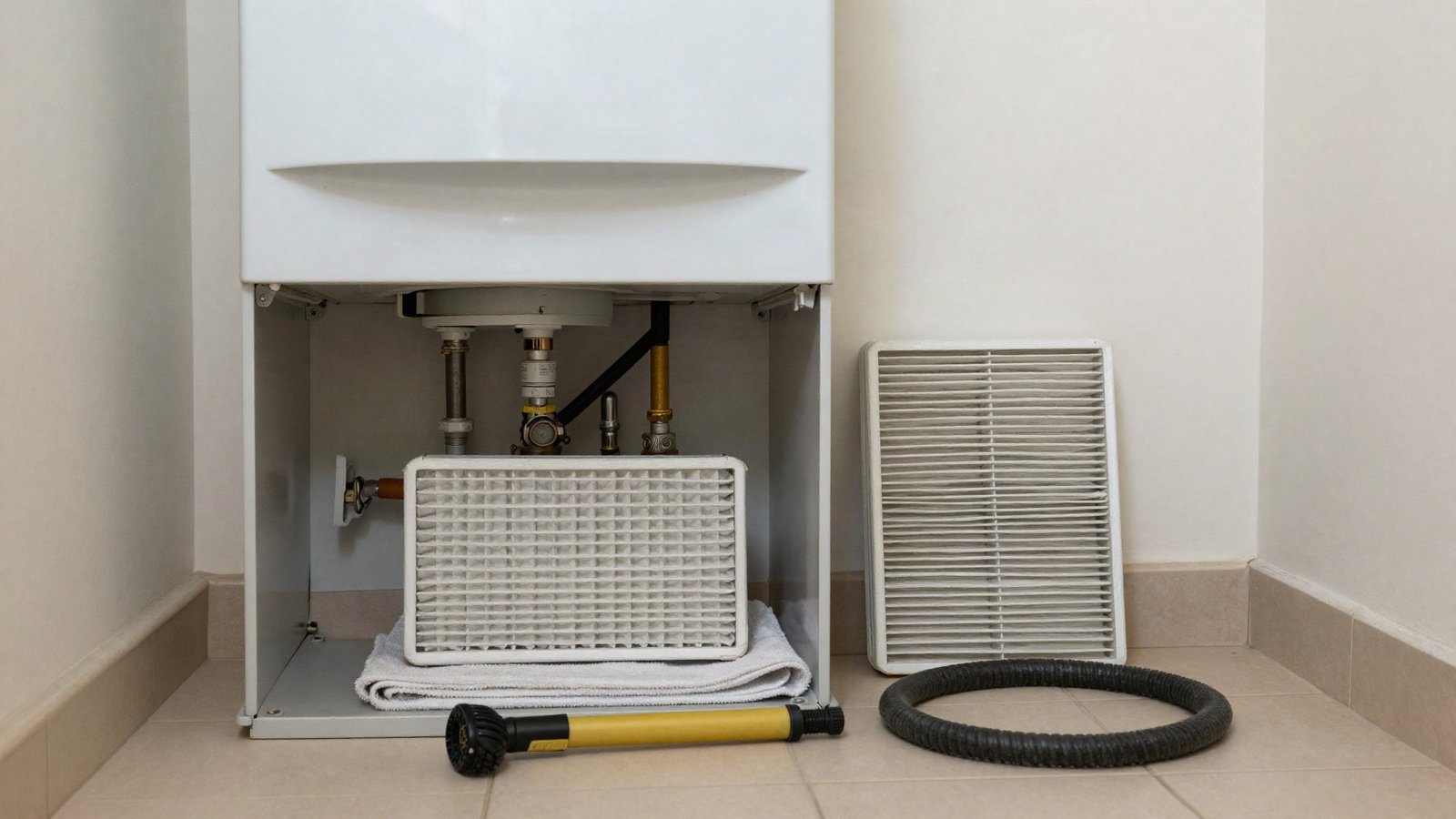
Almost every guide to this assumes a ducted furnace in a basement and a panel filter swapped every 90 days. Barely one UK home in twenty has anything like it. What we have instead is a scattering of filters nobody treats as a system: the heat recovery unit in a new-build airing cupboard, the recirculating cooker hood, the split air conditioner fitted after the 2022 heatwave.
Intervals depend on what a filter catches, not the date on the box. A supply filter thirty metres from a Salford bus route loads twice as fast as the same cartridge in rural Devon. Here are the intervals we work to, the honest annual cost, and what a tenant can do without risking a deposit.
The Intervals That Actually Matter
Work from the filter, not the appliance. A grey filter is halfway through its life; a black one has been costing you airflow and electricity for months.
- •MVHR coarse filters (old G4, now ISO Coarse 60%): every 6 months, or every 3 on a main road or beside a building site.
- •MVHR pollen filter (old F7, now ISO ePM1 55%), supply side only: every 12 months, or 6 for a hay fever household. Fit it in early March, ahead of tree pollen.
- •Air purifier HEPA cartridge: 12 months running continuously, 18-24 if it only runs overnight. The carbon pre-filter goes first, at 3-6 months in a kitchen or pet home.
- •Recirculating cooker hood carbon filter: every 3-6 months. The aluminium grease mesh in front of it: dishwasher, hottest cycle, every 4-6 weeks.
- •Split or portable air conditioner mesh: rinse every 2-4 weeks through the cooling season and dry it fully. Replace any carbon cartridge annually.
- •Ducted warm-air units, still common in 1960s-70s ex-council stock: panel filter every 3 months from October to April.
Safety, Tools and the Time It Takes
Isolate first. MVHR units and extract fans run off a fused spur, so switch it off and check the impeller has stopped. Split air conditioners hold refrigerant under pressure: filters and grilles are fair game, coils and pipework are not. Warm-air heaters are gas appliances, and anything past the filter door is Gas Safe territory. Wear an FFP2 mask: a loaded filter aerosolises six months of dust as it comes out. Allow 10-20 minutes per unit, or an hour for a loft-mounted MVHR.
- •The correct replacement, ordered from a photograph of the old label
- •Vacuum with a brush head and a damp microfibre cloth
- •FFP2 mask, nitrile gloves and a head torch
Changing a Filter Without Choking the Fan
The commonest fault we find is not a dirty filter but a new one fitted backwards or left unseated, quietly halving the airflow.
- •Isolate at the spur or plug, give the fan 30 seconds to stop, then photograph the filter in place.
- •Slide the old one into a bin bag held underneath, rather than shaking it out.
- •Vacuum the housing and wipe it, because grit in the runners abrades the new filter's seal.
- •Check the airflow arrow on the new frame: it points the way air travels, towards the fan or heat exchanger. On MVHR, supply and extract filters are colour-coded and not interchangeable, and the pollen filter belongs on the supply side.
- •Seat it so the frame meets the gasket all round, since air sneaking past the edge has bypassed the filter entirely. Date the frame, refit the cover, then run it on boost: it should sound the same as before, not louder.
MERV Ratings and What They Mean in Britain
MERV is an American scale (ASHRAE 52.2), met here mainly on imported purifiers. British filters ran under EN 779 as G4 to F9, and since 2018 under ISO 16890 as ISO Coarse, ePM10, ePM2.5 and ePM1. Roughly, MERV 8 equals old M5 or ISO ePM10 50%, and MERV 13 equals old F7 or ISO ePM1 55%, the grade specified for the supply side of most domestic MVHR. Our comparison of MERV 8 versus MERV 13 filters covers where the extra resistance earns its keep.
Finer is not automatically better. Every step up adds pressure drop, and a domestic fan has a fixed static pressure budget. Fit ePM1 where the maker specified ISO Coarse and you can lose 20-30% of design airflow, showing up as condensation on bedroom windows. Mirrors that take longer to clear are an airflow problem, not a humidity one, and appear on our list of signs of poor home ventilation.
What a Year of Filters Costs in 2026
This is a materials-heavy, labour-light job, which is why it is worth doing yourself. Consumables run £30-£110 a year for a typical household; the same filters fitted on an engineer visit add £90-£180 in labour. Retail prices, spring 2026, including VAT:
- •MVHR coarse filter pair: £16-£38 genuine, £11-£24 pattern
- •MVHR ePM1 pollen filter: £18-£30 each
- •Air purifier HEPA and carbon set: £25-£75
- •Cooker hood carbon filters £12-£30 a pair; warm-air panel filter £8-£20
- •1930s semi, no mechanical ventilation: two hood filters at £16 plus a £45 purifier HEPA, about £87 a year.
- •2019 flat with MVHR: two coarse pairs at £20 plus a £22 pollen filter, £62 a year.
- •Ex-council warm-air unit: four panel filters at £11 across the season, £44, plus the £90-£140 gas service.
The Renter-Safe Version
Nothing here is a permanent alteration. Filters are consumables and every swap is reversible; the risk for a tenant is being blamed afterwards. Photograph the old filter and its label before removal, keep the new packaging, and never fit a higher grade than specified, because a fan that fails with an off-spec filter in it is an argument you lose at check-out.
Fixed kit, meaning extract fans, MVHR and warm-air units, is the landlord's installation and their repairing obligation under Section 11 of the Landlord and Tenant Act 1985. Report faults by email so there is a date on it. Do not tape over trickle vents or silence a noisy extract fan: black spotting on a bathroom ceiling is a commonly deducted check-out item, and our guide to damp and mould explains how a starved fan causes it. For cleaner air without touching fixed kit, air purifiers for allergies travel with you when the tenancy ends.
Troubleshooting, and When to Call Someone
Louder after a change means the filter is backwards, the wrong grade, or not seated against its gasket, so check all three before blaming the fan. A lingering smell was rarely the filter: look at the condensate drain or the grease trap. Weak airflow with a brand-new filter usually means crushed flexible ducting in the loft. Check any quote line by line: an invoice should name the filter class and part number, give an airflow reading and show labour separately.
Stop when the job crosses into refrigerant, gas or commissioning. Coil cleaning and pipework on a split system needs an F-Gas registered engineer, and cleaning an air conditioner shows where that boundary sits. If MVHR airflow rates were never commissioned, fresh filters will not fix it: the system needs measuring and rebalancing, as in our whole house ventilation guide. Prices above come from UK spares pricing and contractor quotes gathered in spring 2026, London labour 20-30% higher.
Found this useful?
There's plenty more — hundreds of guides and honestly-tested product reviews for every corner of your home.
Browse All Guides