Home Decor · 6 min read · 23 July 2026
How to Choose an Interior Design Style: A UK Decorator's Step-by-Step Method
Most people don't have a style problem, they have a decision problem: forty saved images and a hallway that has been three shades of grey since 2019. Here is the order that resolves it.
By the Nims Casa editorial team — written from professional cleaning experience and checked against our editorial standards.
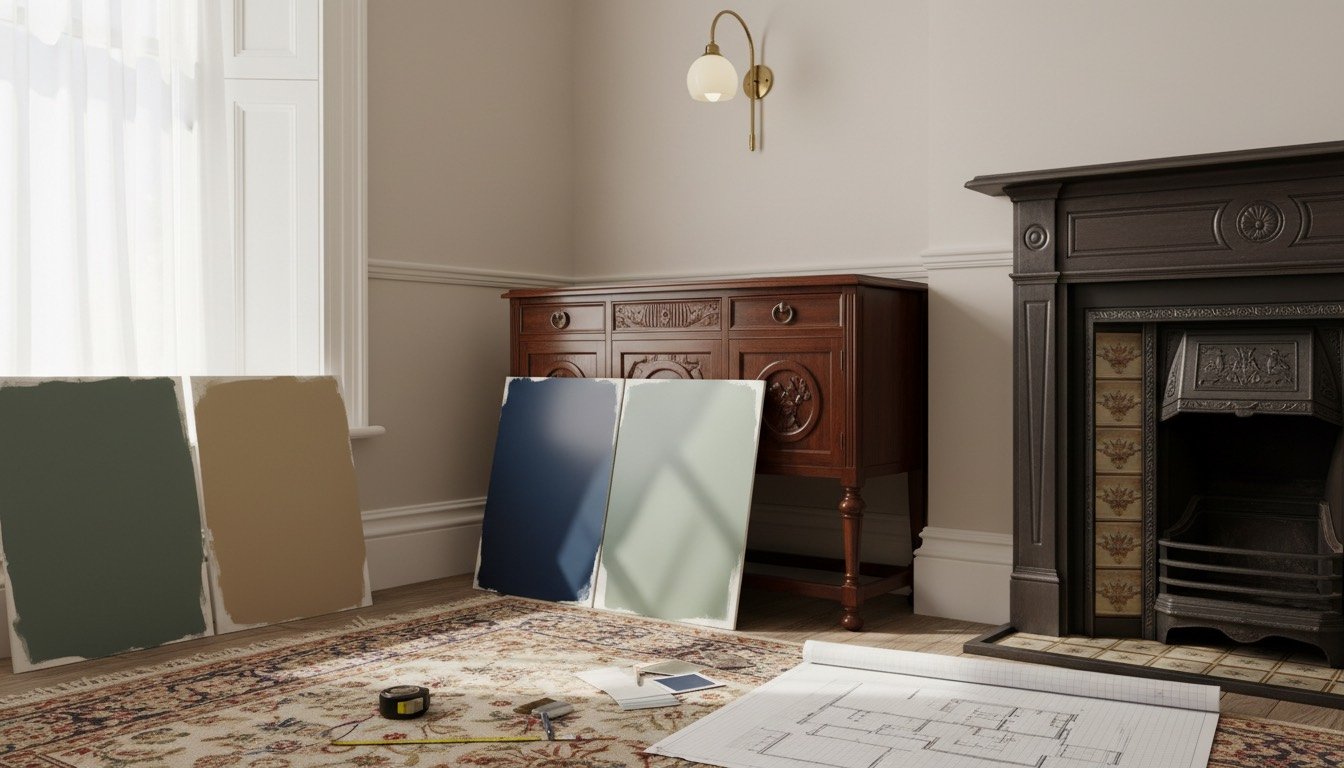
Almost nobody who says they can't find their style is short of taste. They are short of a sequence. Forty saved images, two sample pots gone crusty under the stairs, and a hallway still wearing the previous owner's magnolia. The job is not discovering a hidden aesthetic but narrowing, testing and committing in an order that costs least when you change your mind halfway through.
This is the process we use on real British housing stock: Victorian terraces with 2.6m ceilings and awkward chimney breasts, 1930s semis with bays that eat a third of the wall, new-build flats lit from one direction. It ends with a scheme you can buy, and flags where decorating quietly becomes a building-regulations decision.
Safety and permissions first: what you may actually change
Choosing a style is unregulated. Delivering it often is not. Run these checks before committing to a scheme that needs new lighting, opened-up walls or hard flooring.
- •Listed buildings: internal work needs listed building consent at any grade, including stripping original panelling, replacing cornice or removing a fireplace surround. Unauthorised work is a criminal offence, not a retrospective fee. Conservation area status mostly governs the exterior instead.
- •Electrics: under Part P in England and Wales, a new circuit, a consumer unit change, or new fixed wiring in a room containing a bath or shower is notifiable. Swapping a pendant on an existing point is not. Five new wall lights on a switched five-amp circuit means a registered electrician and a certificate: £450-£900.
- •Renting: nearly every UK tenancy requires written landlord consent to paint, paper or fix into walls. Ask by email, keep the reply, and agree whether you must return it to neutral. Removable schemes solve most of this, as our rental-friendly decor guide covers.
- •Leasehold flats: most leases forbid swapping carpet for hard flooring without consent, under the Part E sound rules. Removing a chimney breast needs building control (£300-£600 in fees) plus structural engineer's calculations at £350-£700.
Skill level, tools and materials
This stage is entirely DIY. The skill needed is restraint, not technique, and the whole kit costs less than one dining chair.
- •5m tape measure, ideally a laser measure (£25-£40)
- •Graph paper at 1:50 or any free floor-plan app
- •Sample pots: £2.50-£4.50 trade, £6-£8 for the heritage brands
- •A3 lining paper or primed MDF offcuts for brushing out properly
- •Peel-and-stick sample sheets (£2-£3) if you rent and cannot paint
- •Masking tape and cardboard to mark furniture footprints
- •Your phone camera in greyscale, which exposes tonal mistakes
Realistic time and cost
The decision phase is cheap and slow; delivery is fast and expensive. Budget them separately, because conflating the two is why schemes get abandoned.
- •References gathered and cut down: 3-5 hours over two weekends. £0.
- •Sampling and living with the colours: £25-£60, plus seven days.
- •Measured plan and furniture layout: 2-3 hours per room.
- •Decorating a 3.5m x 4m room yourself: £120-£180 in materials over a long weekend. A decorator charges £350-£600 across two to three days.
- •A full single-room refresh (paint, layered lighting, curtains, rug, one anchor piece): £900-£2,500 for most UK homes.
- •Whole-house consistency across five rooms: £6,000-£18,000, staged over 12-18 months.
The nine steps, in order
The order matters more than any individual choice, because each step removes options the next would otherwise drown in.
- •1. Audit what stays. List the five things you will not replace: the sofa, the oak floor, the kitchen doors, an inherited dresser. Your style must accommodate them, or you have set a budget you haven't admitted to.
- •2. Collect thirty images without commentary, then leave them a week. Delete anything you like for the room rather than the feeling. Eight survivors is the target.
- •3. Name the three things the survivors share. It is rarely a label; usually it is 'warm wood, matt finishes, no chrome'. Settle the maximalism versus minimalism question early, because it dictates how much storage you need.
- •4. Test the brief against your light. A north-facing UK room gets cool, low daylight most of the year, draining grey-greens and turning cool whites faintly blue by three o'clock in November. Stand there at 9am, 2pm and 7pm before deciding.
- •5. Fix the neutral first, accent second: one wall colour, one woodwork colour, one accent, roughly 60/30/10. Undertone matters more than shade, as our guide to choosing a paint colour explains.
- •6. Brush out samples on lining paper, two coats, cured 24 hours. Move the board round the room, holding it against skirting and sofa. Never dab patches onto the existing wall colour, which distorts everything beside it.
- •7. Draw the layout at 1:50 first. Allow 60cm for a walkway, 90cm to pull out a dining chair, 40cm between sofa and coffee table. In tight rooms the layout carries the style, as our small living room ideas show.
- •8. Buy in order of permanence: flooring, large upholstery, lighting, paint, textiles. Paint is cheapest to change, so choose it to suit the sofa, never the reverse.
- •9. Finish one room and live with it six weeks before rolling the scheme out. What survives a winter evening is the style you actually have.
Troubleshooting: when it isn't landing
Five failures account for nearly every stalled scheme, and none needs starting again.
- •It looks like a showroom and feels cold. Everything arrived at once, from one retailer, in one material. Add two contrasting textures and something old.
- •The colour looks nothing like the sample. Usually the bulbs. A 4000K lamp strips the warmth out of everything; move to 2700K at CRI 90 or better, which also fixes most problems covered in layering lighting.
- •Everything is beige and still chaotic. You have three competing undertones. Sort the pieces against plain white paper into pink-beige, yellow-beige and green-grey, then discard one group.
- •The small room shrank after brilliant white. Sharp white bounces cold light and makes every corner legible; a warm mid-tone taken onto the ceiling often reads larger because the boundaries blur.
- •The furniture doesn't fit the plan. You measured the room, not the route. A Victorian stair turn rarely takes a sofa over 2.1m; check doorway, hall width and turn first.
When to stop and call a professional
Styling is yours. Three categories of work are not, and the boundary is legal rather than a question of confidence. Anything that adds a circuit, alters structure or burns fuel needs a registered trade and a certificate you will be asked for when you sell.
Call a Part P registered electrician for new wall lights, downlights or bathroom wiring. Involve a structural engineer and notify building control before removing a chimney breast or forming an opening. For a wood burner or gas fire, use a HETAS or Gas Safe registered installer and have the flue swept and smoke-tested first: a fireplace opened up for looks is a carbon monoxide risk until proven.
A full designer earns their fee above roughly £15,000 of spend or on awkward layouts, and trade discounts recover part of it. Below that, a two-hour paid consultation to sanity-check palette and layout is better value, catching most common interior design mistakes before you pay for them.
Found this useful?
There's plenty more — hundreds of guides and honestly-tested product reviews for every corner of your home.
Browse All Guides