Garden & Outdoor · 6 min read · 11 August 2026
How to Water Your Garden During a Hosepipe Ban (Legally)
Nine water companies now have hosepipe bans in force, but watering cans, buckets and bath water are all still legal. Here is the routine that keeps a garden alive on a fraction of the water.
By the Nims Casa editorial team — written from professional cleaning experience and checked against our editorial standards.
Nine water companies — Thames Water, South East Water, Southern Water, Anglian Water, South West Water, Affinity Water, Cambridge Water, Welsh Water and Essex & Suffolk Water — currently have hosepipe bans in force. England has been in an official flash drought since 29 July, over 70% of England and Wales is now in drought, and Southern Water has applied for a wider non-essential use ban across Hampshire and the Isle of Wight. With another heatwave forecast, restrictions are likelier to spread than lift; Yorkshire Water, unusually, has none at all.
The ban covers hosepipes and sprinklers, not watering. Cans and buckets are legal, and a garden will come through a dry August on far less water than most owners think. Below: the routine we use on clients' gardens, the grey water rules, and the renter-safe version.
Safety first: what's legal, and the grey water rules
A hosepipe ban — formally a Temporary Use Ban — covers watering, car washing and pool filling with a hose, including filling a can from one. Breaking it is a criminal offence with a fine of up to £1,000. Cans and buckets filled at the tap are legal, and so is grey water from baths, showers and washing-up bowls — provided you follow a few rules.
- •Use grey water within 24 hours. In warm weather bacteria multiply fast — never store a butt full of it.
- •Pour it at the base of ornamentals, shrubs and fruit trees — never over leaves, salad crops or anything eaten raw.
- •Normal soap, shampoo and washing-up liquid at bath water dilutions are harmless; anything with bleach, disinfectant or strong degreaser goes down the drain.
- •Biological laundry detergent carries more sodium and boron than plants like — use washing machine water on ornamentals only occasionally, alternated with tap or rainwater.
- •Carry part-filled buckets — ten litres weighs 10kg, and a wet bathroom floor plus a staircase is a worse hazard than any drought.
Tools and materials
The kit list is short, cheap, and earns its keep every summer from now on. If you are starting from nothing, our guide to collecting rainwater covers butts and diverters in more detail.
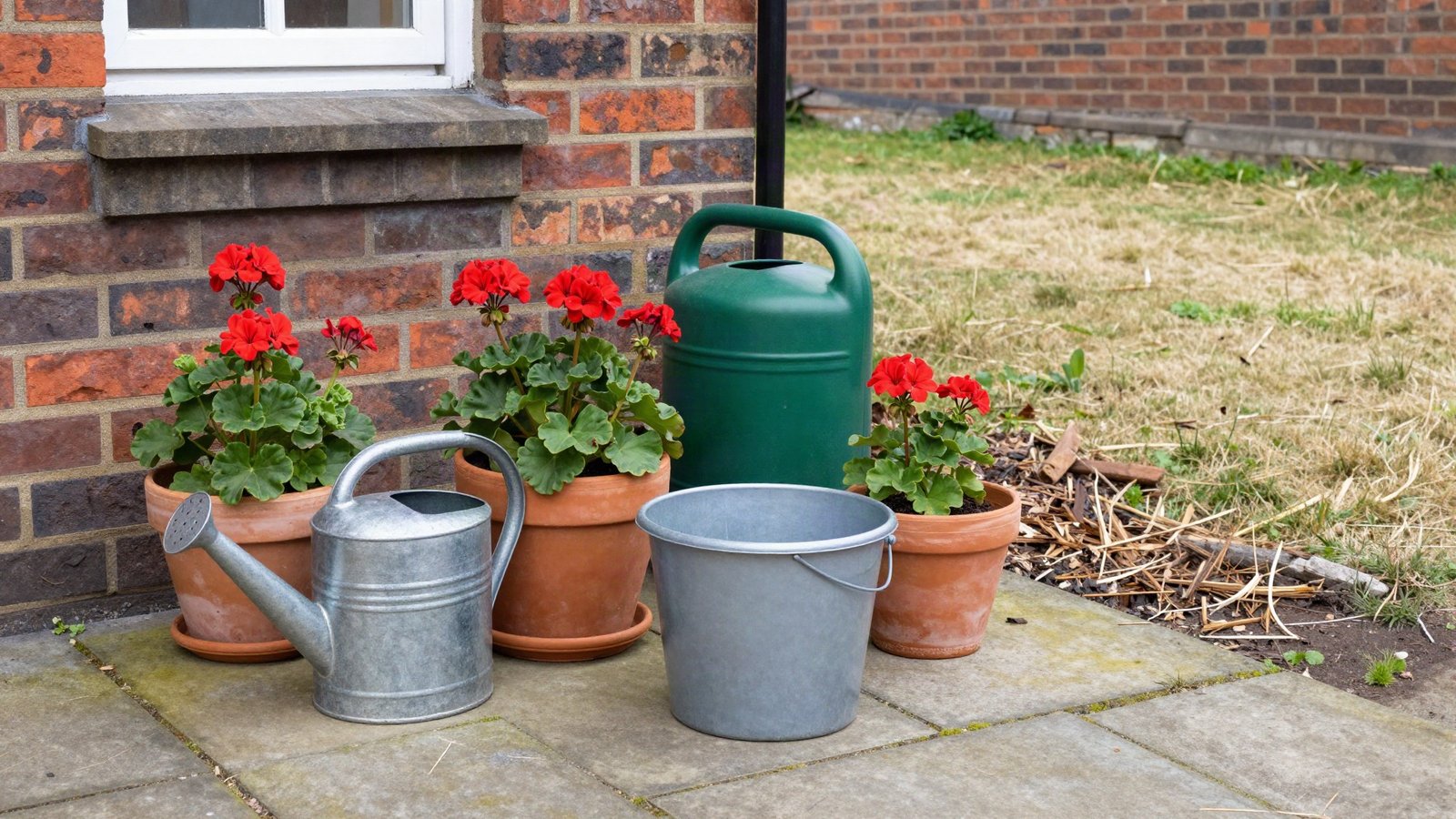
- •Two 10-litre watering cans (£5–£8 each) — one per hand balances the load and halves the trips.
- •A hand syphon pump (£8–£15) to empty the bath into buckets without scooping.
- •Bark or compost mulch — one 100L bag (£6–£9) covers 3–4 m² at 5cm deep.
- •Four to six empty 2-litre bottles for drip watering pots, tomatoes and new plantings.
- •A 100–210 litre water butt (£30–£60) — one decent thunderstorm off an average roof refills it, even mid-drought.
Realistic time and cost
Budget 20–30 minutes per watering evening for a typical 60 m² garden — nearer 15 once beds are mulched, since mulch roughly halves evaporation. One-off setup (mulching, drip bottles, siting a butt) is a two-to-three-hour job and £25–£80 in materials.
Weigh that against replacements: an established shrub is £15–£40, a semi-mature tree ten times that. On a meter the arithmetic works too — grey water is already paid for, and the habit slots into cutting water use across the whole house.
Step by step: a legal watering routine
The aim isn't to keep everything lush — it's to spend a limited water budget where it buys the most survival.
- •1. Triage the garden. Priority one: pots, hanging baskets, this year's plantings and vegetables. Priority two: fruit bushes and trees planted in the last two years. Priority three: nothing — established shrubs, hedges and trees have deep roots and will cope.
- •2. Write off the lawn now. A brown lawn is dormant, not dead — browning grass greens up within two to three weeks of proper rain. Watering turf is the biggest waste of carried water.
- •3. Water at dawn or after 7pm. In midday heat 40–50% of what you pour evaporates before reaching the roots; morning is best because foliage dries fast and slugs get less of a free run.
- •4. Water deeply, twice a week — not a splash daily. A proper soak (a full 10L can per square metre) drives roots downward; a daily sprinkle keeps them at the surface, where they cook.
- •5. Harvest grey water daily. Syphon the bath while warm, keep a washing-up bowl in the sink, and stand a bucket in the shower while it runs hot. A family bath yields 60–80 litres — a full evening's watering.
- •6. Set drip bottles in pots and beside thirsty vegetables. Pierce two or three cap holes, cut off the base, and push the bottle cap-down 10cm into the soil; filled each evening it drips for hours with zero run-off.
- •7. Mulch every bare bed after a good soak. A 5cm layer halves evaporation and keeps roots cooler; our mulch guide covers which type suits which bed.
The renter-safe version
Most tenancy agreements make the tenant responsible for keeping the garden tidy — not green through an official drought. Take dated photos of the browned lawn now and email them to the landlord or agent noting the ban; no adjudicator expects a tenant to defy a Temporary Use Ban.
Everything above is reversible except one: a downpipe diverter means cutting the landlord's downpipe, so get written permission or skip it. Stand a freestanding butt or lidded bin on slabs under a shed roof edge instead — no tools, no alterations, and it moves with you. Drip bottles, mulch and grey watering touch nothing the landlord owns, and mulched beds hand the property back in better condition. For schemes that live entirely in pots and movable planters, see water-saving landscaping ideas.
Troubleshooting
- •Water runs straight off the bed: baked soil forms a crust. Break the surface with a hand fork, then water in two passes ten minutes apart so the second soaks in.
- •Pots dry out the same day: move them out of afternoon sun, group them so they shade each other, and stand each on a saucer to catch run-through.
- •Grey water smells sulphurous: it sat too long. Tip it on the compost heap and collect fresh the same day you use it.
- •Water butt empty and no rain due: switch it to holding grey water for same-day use only, and rinse it before autumn rains return.
- •Shrubs wilt by afternoon but recover overnight: heat stress, not thirst — check the soil 10cm down and water only if it's dry at depth.
When to call a professional — or the water company
If a mature tree is dropping leaves in August, showing crown dieback or shedding bark, a watering can won't fix it — have a qualified arborist assess it early. Mature trees are the one garden asset that is truly expensive to lose.
Check your company's exemption list too. Blue Badge holders and WaterSure customers are typically exempt, and several companies allow fixed drip irrigation systems with a pressure-reducing valve and timer — wording differs, so confirm in writing first. A permanent grey water feed off the bath waste is a plumber's job (with landlord consent in a rental), and report street leaks — during a drought, companies do chase them.
Found this useful?
There's plenty more — hundreds of guides and honestly-tested product reviews for every corner of your home.
Browse All Guides