Heating & Cooling · 6 min read · 17 May 2026
Mini Split Cost UK: Split Air Conditioning Prices, Sizing, Pros and Cons
A wall head, an outdoor condenser and two copper pipes. Here is what a split system actually costs fitted in the UK, how to size it in kW, and the F-Gas, Part P and planning rules nobody mentions in the showroom.
By the Nims Casa editorial team — written from professional cleaning experience and checked against our editorial standards.
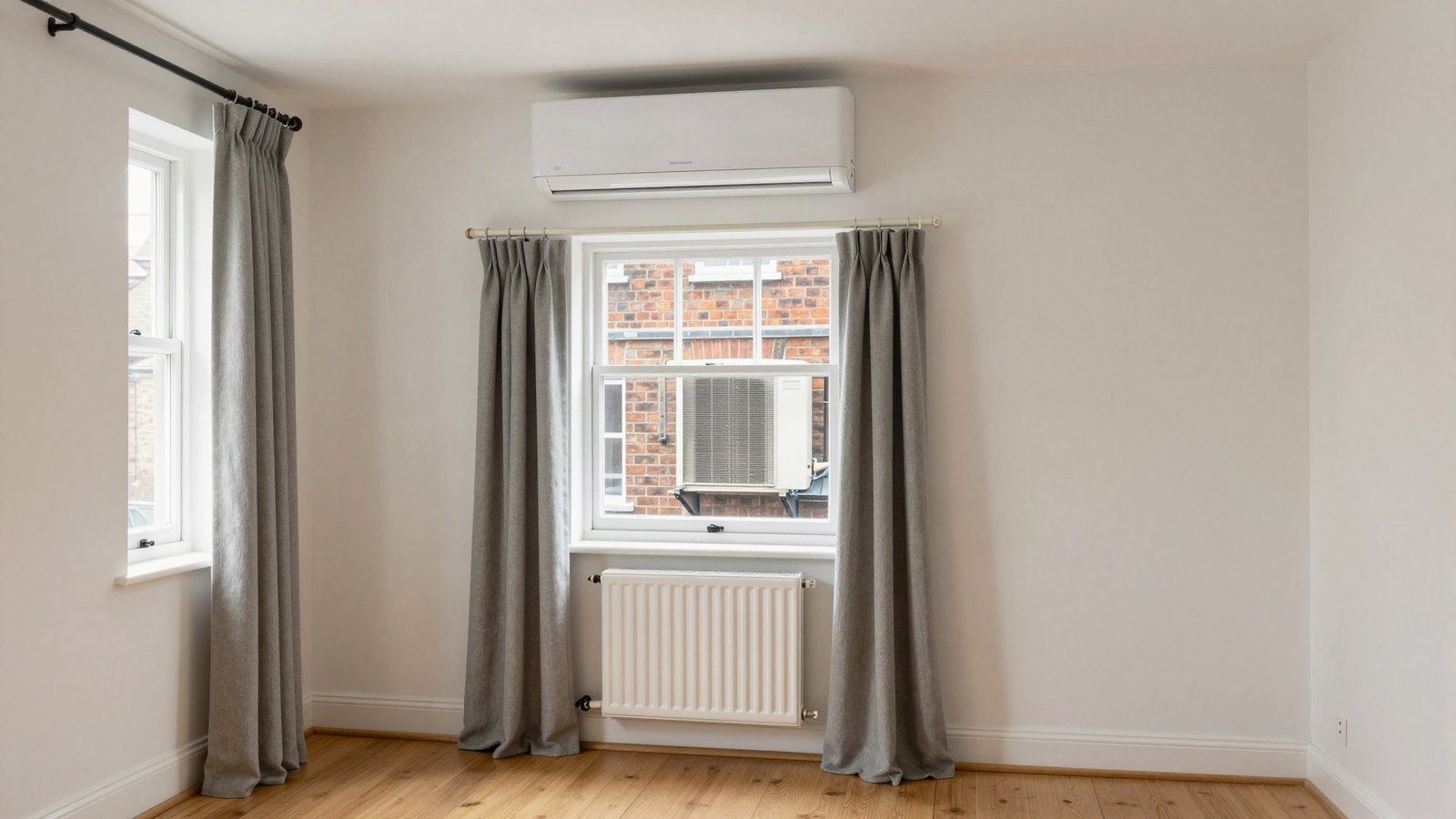
A wall head indoors, a condenser outdoors, two insulated copper pipes and a condensate drain — that is the whole system, and why a single-room install is a one-day job. The box on the wall is rarely the expensive part: kit for a decent 3.5 kW single split runs £900 to £1,400, and the finished job is usually close to double.
In UK terms this is an air-to-air heat pump, a different animal from the air-to-water systems that get the government attention — heat pump vs air conditioner sets out the difference. Everything below is supply-and-fit including VAT: add 20–30% inside the M25, take 10% off in the North East, Wales and the Midlands.
What a split system costs to fit in the UK
Single splits — one head, one condenser — are the predictable end of the market. Multi-splits run two to five heads off one outdoor unit, saving a condenser and brackets but adding pipework and commissioning time, so they rarely beat separate singles until you reach three rooms.
- •2.5 kW (9,000 BTU) single split, bedroom or home office: £1,600–£2,300 fitted
- •3.5 kW (12,000 BTU), average living room: £1,900–£2,600
- •5.0 kW (18,000 BTU), large or south-facing room: £2,300–£3,200
- •Twin multi-split, two heads on one condenser: £3,000–£4,500
- •Three rooms £4,200–£6,000; four rooms covering a whole upstairs £5,500–£8,000
- •Ceiling cassette or ducted instead of a wall head: add £700–£1,500 per indoor unit
Sizing: the number that decides everything else
Oversizing is the classic and costliest mistake. Too big, and the unit satisfies the thermostat in four minutes, shuts down before it has stripped any moisture from the air, and leaves you in a cold, clammy room while the compressor short-cycles towards an early grave. Too small, and it runs flat out on a 32°C afternoon without ever getting there. UK rooms are small and often single-aspect, so the American rules of thumb online overshoot badly — work through the kW and BTU sizing method for UK rooms properly. As a starting point:
- •Bedroom, 10–14 m², standard double glazing: 2.0–2.5 kW
- •Living room, 20–28 m²: 3.5–5.0 kW
- •Kitchen-diner: add 1 kW for the oven, hob and fridge freezer
- •Loft conversion, or large south or west glazing: add 25–30%
- •Each regular occupant 100 W; each desktop PC or large television 120–180 W
- •1 kW = 3,412 BTU/h, so a 9k unit is 2.6 kW, 12k is 3.5 kW and 18k is 5.3 kW
Where the money actually goes
Roughly half the bill is equipment; the rest is getting it onto the wall legally. What pushes a quote up is almost never the unit itself — it is access, pipe length and the state of your consumer unit.
- •Equipment (head, condenser, brackets, refrigerant): 45–55% of the total
- •Labour, two engineers for a day: £600–£900 outside London, £900–£1,300 inside it
- •Dedicated 16 A or 20 A radial circuit from the board: £180–£350
- •No spare way, or an old rewireable fuse box: £550–£900 for a new consumer unit
- •Pipe beyond the standard 3–5 m allowance: £30–£60 per extra metre
- •Tower or scaffold £150–£400; condensate pump £120–£200; decorative trunking £8–£15 per metre
Three real UK jobs, costed
Three complete installations, VAT included, priced in the first half of 2026. Note how quickly access and pipe length outrun the cost of the equipment.
- •1930s semi, Leicester. One 2.6 kW head in a rear bedroom, condenser on ground-level brackets, 4 m run, spare way on the board. Kit £780, labour £700, electrics £210, sundries £160 — £1,850.
- •Victorian terrace with loft conversion, south London. Two 2.5 kW heads, 5.2 kW condenser on the flat roof, 9 m and 13 m runs. Kit £1,950, two days' labour £1,850, electrics £320, pipe and trunking £430, tower £180 — £4,730.
- •2005 detached, Surrey. Four heads on two condensers, 8.0 kW total, plus a consumer unit change. Kit £3,400, three days' labour £2,600, electrics and board £1,150, sundries £520 — £7,670.
Running costs, and the honest case against
Cooling is cheaper than people expect. A 3.5 kW unit at a seasonal efficiency near 7 draws about 0.5 kW — roughly 14p an hour at 27p/kWh, or 85p for a six-hour evening. Heating is the interesting part: at a real-world seasonal COP around 4.0 you make heat at about 6.8p per kWh against 7.2p from a 90% efficient gas boiler. Level pegging, not a saving, which is why air-to-air rarely stands up as a heating strategy beside the systems in our heat pump cost guide. Servicing runs £90–£150 a year, much of it filter and coil cleaning you can do yourself; domestic R32 splits sit below the 5 tonnes CO2e threshold that triggers mandatory F-Gas leak checking.
- •Worth it: a loft bedroom that hits 28°C by 9pm, a home office, a nursery, a south-facing new-build living room
- •Worth it for dehumidification — dry mode pulls litres from a muggy room with no exhaust hose through a window
- •Marginal: a shaded ground-floor room uncomfortable ten nights a year. Blinds and a decent fan do more per pound
- •Against: condensers are seen and heard, typically 45–55 dB(A) at one metre — fine for you, less so for a neighbour
- •Against: no Boiler Upgrade Scheme grant for air-to-air, and the 0% VAT energy-saving rate rarely applies to comfort cooling
F-Gas, Part P and planning: the rules that bite
Two certificates matter and neither is optional. Under the GB F-Gas Regulation, anyone breaking into the refrigerant circuit needs a City & Guilds 2079 Category I qualification, and the business needs an F-Gas company certificate from Refcom, Bureau Veritas or Quidos. Suppliers must verify certification before selling pre-charged equipment — which is why £600 self-install kits arrive with quick-connect pipes and a warranty that dies the moment you touch it.
The electrics fall under Part P. A new dedicated circuit from the consumer unit in England or Wales is notifiable: either the installer is registered with NICEIC, NAPIT or ELECSA and self-certifies, or building control signs it off. Get the certificate at handover — the cost sits inside normal electrician day rates. Landlords, that circuit joins the fixed installation covered by your five-yearly EICR, and no tenant should fit one without written consent.
Planning is what people assume away. England's 2024 permitted development changes scrapped the 0.6 m³ cap and the one-metre boundary rule for air source heat pumps, and most councils treat a reversible air-to-air unit as one. Cooling-only condensers are greyer; flats have no householder rights, listed buildings need consent, conservation areas rule out front elevations. Planners lean on a 42 dB(A) limit at the neighbour's nearest habitable room window, so check whether you need permission or building regs sign-off before the brackets go up.
How to sanity-check a quote
Every figure here comes from installer quotations and merchant list prices gathered across England and Wales between January and May 2026, costed at 27p/kWh electricity and 6.5p/kWh gas, with manufacturer seasonal efficiencies discounted for real installs rather than test rigs. Copper, refrigerant and regional labour move these bands, so use them as a reference point, not a tariff.
Take three quotes and compare them on substance. One that is £400 cheaper because it assumes a 3 m pipe run on an 11 m job is not cheaper. Check for:
- •A kW output per room with the heat gain figures behind it, not 'a 3.5 kW should do it'
- •The F-Gas company certificate number, checkable on the Refcom register in a minute
- •Who notifies the Part P work, and under which competent person scheme
- •Refrigerant: R32 is current, and cheap R410A stock costs you at service time
- •The included pipe run in metres, and the rate per metre beyond it
- •Condensate route, making good of core-drilled holes, and the servicing condition on the warranty
Found this useful?
There's plenty more — hundreds of guides and honestly-tested product reviews for every corner of your home.
Browse All Guides