Garden & Outdoor · 6 min read · 22 April 2026
Pergola vs Gazebo: Differences, Costs and Which Suits a UK Garden
One has a roof and one doesn't, and everything else follows from that: wind loading, foundations, planning permission, and whether you can still eat outside in October.
By the Nims Casa editorial team — written from professional cleaning experience and checked against our editorial standards.
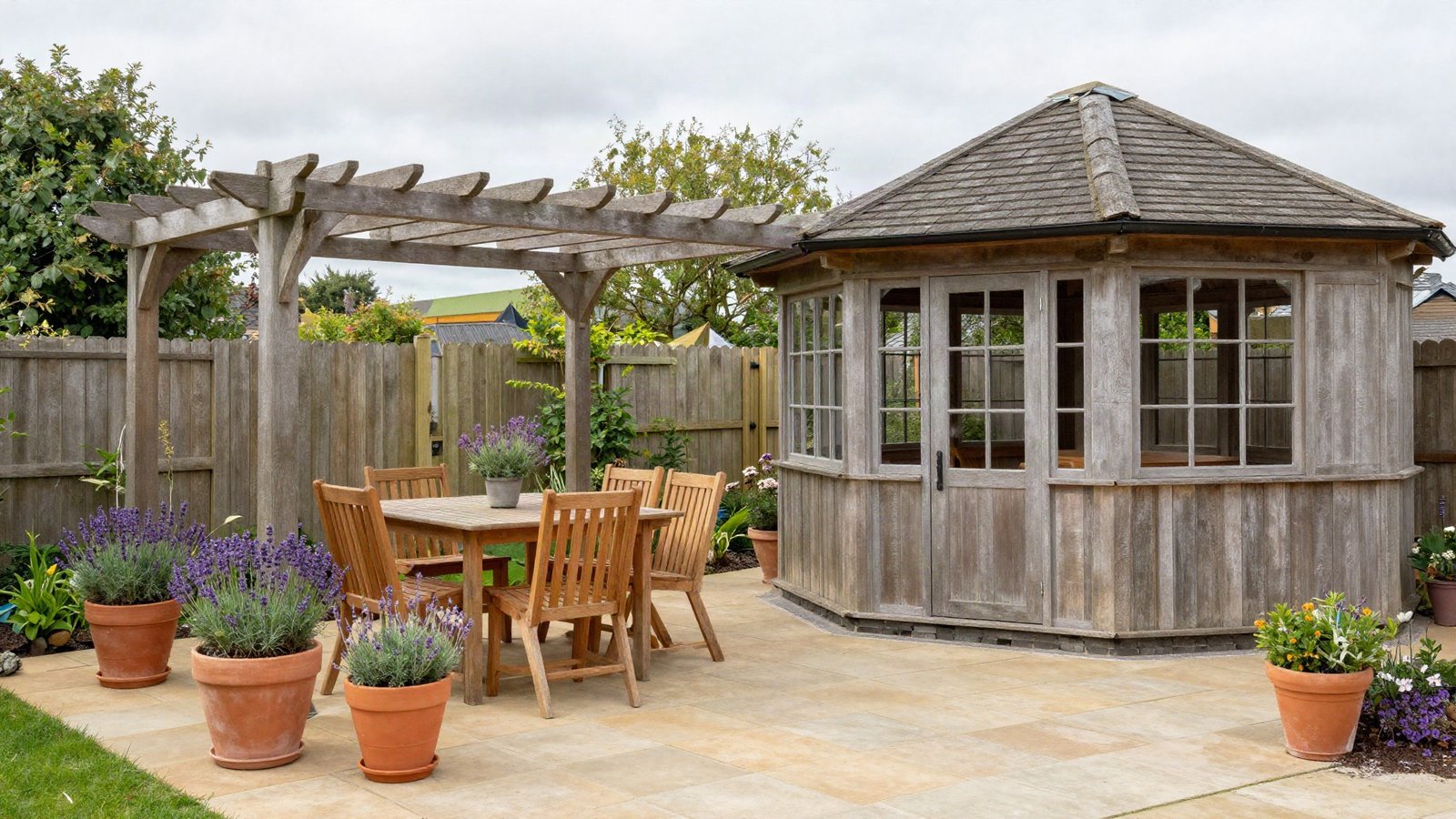
Strip away the marketing and the difference is one thing. A pergola is an open frame — posts, beams and rafters with sky between them. A gazebo has a solid, weatherproof roof and usually a defined floor beneath it. That single distinction drives everything else: how much wind the structure fights, how deep the foundations go, whether you need planning permission, and how many wet weekends a year you spend maintaining it.
What follows is real UK pricing over ten years, how each behaves in a wet climate, and where the line sits between what a competent DIYer can build and what legally has to be done by a registered professional.
Pergola vs Gazebo: The Side-by-Side
Assume a mid-sized structure over a patio: 3m x 4m for a pergola, 3.6m square for a gazebo.
- •Roof: open rafters or adjustable aluminium louvres, versus solid shingles, polycarbonate or powder-coated steel.
- •Rain and shade: a pergola gives dappled, shifting shade and no rain cover; a gazebo gives full shade and a dry table in steady rain.
- •Wind: gusts pass straight through a pergola; a gazebo roof is a 12m² sail needing serious anchoring.
- •Installed cost: timber pergola £1,400–£2,600; aluminium louvred pergola £5,000–£9,000; timber gazebo £3,400–£6,000; hardtop aluminium gazebo £1,200–£2,800.
- •Foundations: a pergola often bolts to existing paving; a gazebo wants a purpose-laid slab or piered base.
- •Build time and height: a weekend for two people versus two to three days plus roofing, and a pergola clears permitted development limits where a pitched gazebo often does not.
How Each Performs in a British Climate
The honest test is not the three good weeks in July — it is whether you use the thing in April and September. A gazebo genuinely extends the season: with a roof and a couple of side panels you can sit out through drizzle, and a patio heater works properly because the heat has something to bounce off. A pergola in that weather is decorative.
Wind flips it. In the gales that hit western and coastal Britain an under-anchored gazebo lifts — we have seen 3m hardtop units cartwheel across a lawn because they sat on paving held down by nothing but their own weight. That is the strongest argument for a pergola on an exposed plot. Damp is the third factor: a solid roof creates a permanently shaded, slow-drying zone, so paving under a gazebo greens up far faster — twice-yearly scrubbing rather than annual, per our patio cleaning guide.
The Ten-Year Cost, Honestly
Purchase prices mislead: the cheap options are the ones that need money spent again. These 2026 figures include materials, a base where needed, and a two-person landscaping team at £350–£450 a day outside London (add 30–40% inside the M25). Our pergola cost guide goes deeper.
- •Timber pergola, 3m x 4m: timber £600–£1,100, post shoes and Postcrete £90–£140, labour £600–£900, penetrating oil every two to three years at £40. Ten-year total: £1,700–£2,400.
- •Aluminium louvred pergola, 3m x 4m: £5,000–£9,000 installed, near-zero upkeep, plus £250–£450 for one actuator failure in a decade. Ten-year total: £5,400–£9,600.
- •Timber gazebo, 3.6m square: structure £2,000–£3,400, base £350–£800, labour £800–£1,500, annual treatment £45, shingles relaid near year twelve for £400–£700. Ten-year total: £3,800–£6,400.
- •Hardtop aluminium gazebo, 3m x 3.6m: unit £700–£1,800, base and anchoring £250–£600, polycarbonate hazing from year seven and a replacement panel set at £150–£300. Ten-year total: £1,200–£2,900.
Installation, Planning Permission and Where DIY Ends
In England both count as outbuildings under permitted development, but height catches people: within two metres of a boundary nothing may exceed 2.5m, rising to 3m elsewhere and 4m for a dual-pitched roof. A pergola at 2.3m to the rafters clears that; a 3.6m gazebo reaching 3.2m at the ridge does not, anywhere near a fence line. Scotland, Wales and Northern Ireland differ — see when you need planning permission and building regs.
On the build the split is clear: a competent DIYer with a mitre saw, an SDS drill and a second pair of hands can put up the shell of either. The services are another matter. In England and Wales any new fixed outdoor wiring — a socket on a pergola post, lights in a gazebo roof — is notifiable under Part P and must be done by a registered electrician (NICEIC, NAPIT or similar). Plug-in lighting from an existing RCD-protected socket you can fit yourself; hard-wired you cannot. Gas is absolute: a fixed supply to a built-in barbecue in an outdoor kitchen may only be connected by a Gas Safe registered engineer.
- •Fine for a competent DIYer: setting 100x100mm posts in 600mm concrete-filled holes or bolt-down shoes; cutting and fixing beams and rafters; assembling a kit gazebo frame; laying a compacted MOT Type 1 base; treating; plug-in lighting.
- •Get a professional: hard-wired outdoor electrics; every fixed gas connection; roofing where the ridge sits above about 2.5m; anything fixed to the house wall, which needs resin anchors and a load check; anything listed or in a conservation area.
- •Get a structural opinion: beams spanning over 3.6m, and any gazebo on an exposed or coastal plot where uplift is the design problem.
Maintenance Through a British Year
Softwood pergolas are the higher-maintenance option people underestimate. Pressure-treated pine wants penetrating oil every two to three years, ideally in a dry spell in May or September with two rain-free days ahead. Skip it and the top faces of the rafters silver, split and harbour rot at the joints within six or seven years. Cedar and oak can be left to weather to grey, which is part of why they cost more.
Gazebo work concentrates in the roof: lifted shingle tabs each spring, gutters and panel joints cleared of leaf litter. Check post bases annually on both — a screwdriver pushed into the ground-contact line tells you more than looking does. Also worth reading: garden furniture care.
Who Each One Suits
Choose a pergola if the garden is exposed, if you want light and sight lines kept through to the house, if the structure sits near a boundary where height is tight, or if you want climbers — wisteria, a rambling rose, grapevine — in the design. For rain cover too, an aluminium louvred version buys it with very low running costs.
Choose a gazebo if the point is using the garden when the weather is against you: a sheltered dining spot, a hot tub cover, deep shade in a plot that bakes. It suits larger gardens where a solid structure sits well clear of boundaries. For the middle ground, see covered patio ideas.
The Verdict
For most UK gardens the pergola is the better buy. It costs less to install, forgives wind, clears permitted development on height, and does not turn the patio beneath into a permanently damp corner. At £1,700–£2,400 over ten years, a timber pergola is the strongest value in outdoor structures.
A gazebo earns its place when genuine shelter is the point and you have the space, the budget and a site calm enough to anchor it properly. If that is you, spend on the base and the fixings rather than the frame — the failures we get called to are almost never the frame. And settle the services question first: the structure is a weekend, but the electrics and gas are somebody else's signature.
Found this useful?
There's plenty more — hundreds of guides and honestly-tested product reviews for every corner of your home.
Browse All Guides