Roofing & Exterior · 6 min read · 1 June 2026
Restore vs Replace Historic Windows: UK Costs, Consents and an Honest Verdict
Original sashes are usually repairable long after a modern window would be scrap. Here is the honest UK cost comparison, the consents that decide it, and where replacement genuinely earns its keep.
By the Nims Casa editorial team — written from professional cleaning experience and checked against our editorial standards.
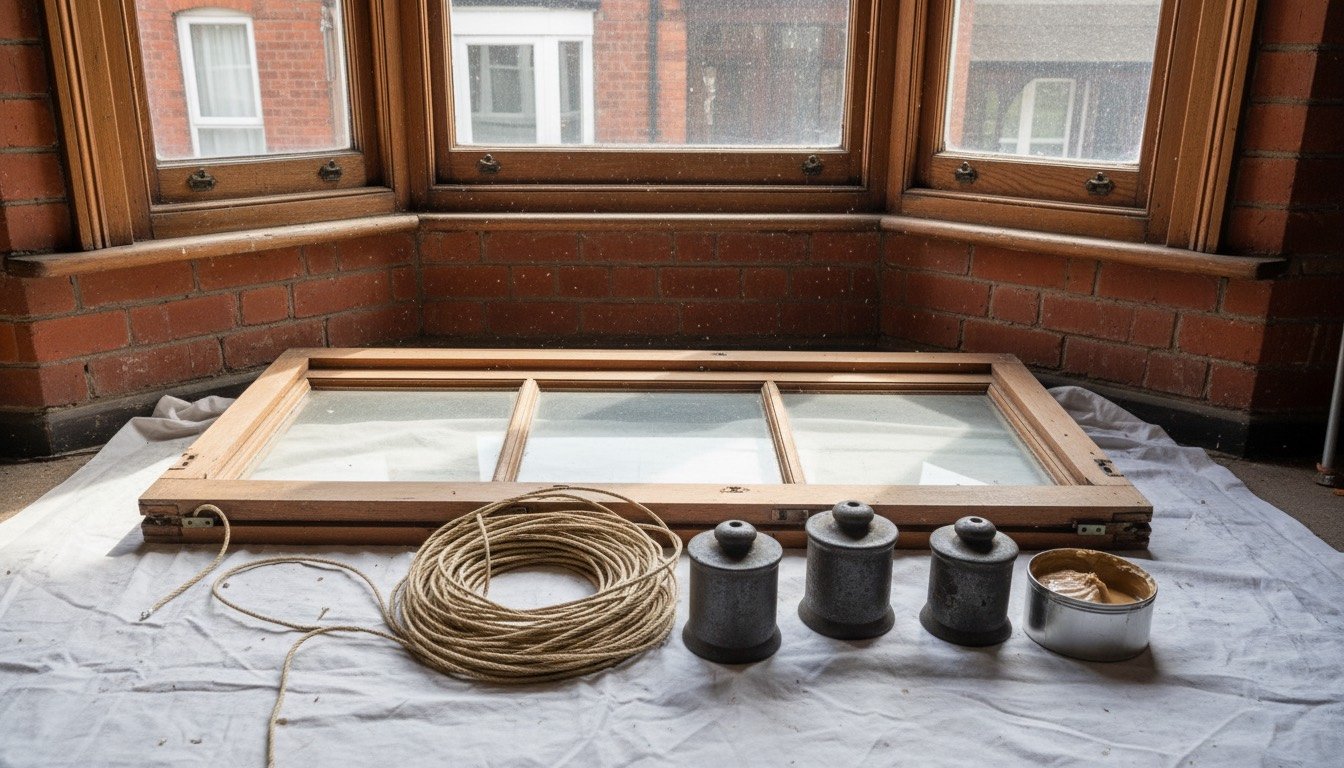
A sash that rattles, sticks and lets the curtains move on a windy night is not necessarily at the end of its life. On a Georgian or Victorian house the frame is usually slow-grown Baltic pine — tighter-grained and more resinous than anything a modern joinery shop can buy — and the parts that fail (cords, putty, bottom rail, cill) are the parts the design intended you to renew.
So the decision is rarely about the timber. It is about money, comfort, and what your council will permit.
The Two Options Side by Side
At 2026 UK prices, for a box sash of roughly 1.2m x 1.5m:
- •Cost per window — overhaul £450–£900; slim double glazing retrofitted into original sashes £900–£1,600 on top; new conservation-grade timber sash £1,400–£2,800 fitted; uPVC sash-style replacement £700–£1,200.
- •Whole-window U-value — original single glazing 4.8–5.4 W/m²K; draught-proofed with secondary glazing 1.7–2.1; slim retrofit units 1.6–2.2; new timber double glazing 1.2–1.5.
- •Lifespan — an overhauled softwood sash runs 30–60 years before the next major intervention; a sealed unit typically fails at 15–25 years; a distorted uPVC frame is not repairable at all.
- •Consent — repair is almost never notifiable; replacement is a controlled fitting under the Building Regulations, and on a listed building needs listed building consent whatever the grade.
- •Reversibility — restoration keeps every option open; replacement is one-way, and the character premium leaves with the skip.
- •Disruption — one to two days per window in situ, frame staying put; half a day to replace, but with the reveal, architrave and often the render opened up.
Performance: What the Numbers Say
Windows shed roughly 10–20% of a typical UK home's heat, and in a period property more of that is air leakage than conduction. Leakage is the cheap half: draught-proofing a box sash properly — brush pile in routed carrier strips, new parting bead, staff bead re-set — transforms the opening for £250–£450 and is the highest-return move on an old window. The same logic runs through our guide to draught-proofing.
Replacement wins on conduction. A timber double-glazed sash at 1.3 W/m²K loses about a quarter of the heat of bare single glazing at 5.0. But slimline secondary glazing takes a single-glazed sash to roughly 1.8–2.1 W/m²K and beats almost any replacement on noise, because a 50–100mm air gap does acoustically what a 16mm sealed unit cannot. On a main road, secondary glazing is the answer.
Slim retrofit units (10–14mm, argon-filled, warm-edge spacer) do fit original sashes, but the rebate must be deepened and each sash gains 8–12kg, so the weights need rebalancing. Skip that and you have paid £1,200 for a window you prop open with a book.
The Consents Nobody Puts in the Quote
Replacement windows are a controlled fitting under Part L: either a building control application, or installation by a FENSA or CERTASS registered firm who self-certify and issue the certificate your conveyancer will want at sale. New windows in an existing dwelling are generally expected to reach 1.4 W/m²K or WER band B. Repair is not notifiable at all.
On a listed building, replacement needs listed building consent whether it is Grade I, II* or II, and unauthorised work is a criminal matter rather than a planning technicality. Conservation officers usually wave through like-for-like repair, often accept internal secondary glazing, and resist wholesale replacement unless the timber has gone — so photograph decay before you strip anything. In conservation areas, replacement on a house is normally permitted development, but an Article 4 direction removes that right and plenty of areas carry one; flats never had it. Check before ordering: our guide to planning permission and building regulations sets out the line.
Three rules catch people out. Approved Document F expects replacement windows to carry trickle vents in most habitable rooms, which conservation officers sometimes refuse. Approved Document B sets the escape-window standard for first-floor habitable rooms — around 0.33m² clear openable area, no dimension under 450mm. And under the Minimum Energy Efficiency Standard a let home must reach EPC E, with listed buildings not automatically exempt, however often that is claimed on site.
The Ten-Year Cost, Worked Through
A three-bedroom Victorian terrace with eight original box sashes, over ten years, scaffolding and making-good included:
- •Restore only — overhaul at £700 per window (£5,600), exterior redecoration in year seven (£850), a broken cord and a cill splice (£350). Around £6,800.
- •Restore plus secondary glazing — the same £5,600, plus slimline aluminium secondary at £550 per window (£4,400) and redecoration (£850). Around £10,850, and the biggest comfort gain of the four.
- •Conservation-grade timber replacement — £2,100 per window fitted (£16,800), scaffolding (£900), making good reveals and architrave (£1,200), redecoration in year eight (£900). Around £19,800.
- •uPVC sash-style replacement — £950 per window (£7,600) plus two failed sealed units by year ten (£420). Cheapest on paper, costliest at resale on a period terrace, and possibly not permitted under Article 4.
Installation, Lead Paint and Making Good
Restoration happens in situ or in a workshop: sashes out, cords and weights rebalanced, decay cut back to sound wood and spliced with matching species, resin repairs kept for small defects, loose putty raked out and renewed in linseed oil putty, original crown or cylinder glass retained wherever possible. One to two days per window, and the frame never leaves the wall — which is why there is no making-good bill. The sequence sits in our guide to restoring original timber windows.
Treat paint applied before about 1970 as leaded until proven otherwise. Dry sanding and hot-air guns above 450°C are what turn a routine job into a health problem; infrared strippers, chemical poultices and wet abrasion are the alternatives, and contractors are bound by the Control of Lead at Work Regulations regardless. Ask how they intend to strip — lead paint safety in old houses explains what a good answer sounds like.
Replacement is faster and far more brutal: the frame is cut out, taking the plaster reveal, architrave and often a section of render. Insist the quote names who makes good, in what material and to what finish — lime plaster on a solid wall, not gypsum, which will blow within two winters. That is where replacement budgets overrun, and it is among the commonest period renovation mistakes we get called in to unpick.
Maintenance Over the Long Run
Restored timber wants a cycle, not constant attention: check the paint film on south and west elevations each spring, touch in breaks before water reaches the putty line, and repaint every five to eight years at £80–£150 per window within a whole-house redecoration. Use a microporous or linseed oil system — impermeable acrylics trap moisture and blister within three winters.
Replacement windows are genuinely lower maintenance: factory-finished timber runs eight to ten years between recoats, uPVC wants a wash and silicone on the hinges. The catch is repairability. A misted unit or a distorted frame has no fix, only another replacement from a supplier who may no longer make that profile — a pattern familiar from other faults in century-old houses.
Who Each Suits — and the Verdict
Match the route to the building, not the brochure.
The verdict: where the originals survive and more than half the timber is sound, restoration wins on cost, embodied carbon, resale value and the point nobody writes into a quote — the replacement will itself need replacing, and the original will not. Replacement earns its keep where the joinery has truly gone, where the openings are already modern, or where a regulation forces the issue.
- •Restore if the house is listed or under Article 4, if most of the original joinery is sound, if the glass is original, or if you will stay long enough to value the character premium.
- •Restore plus secondary glazing if you want warmth and quiet without losing the sashes — the strongest all-round answer for most period terraces.
- •Replace if decay runs through joints and cills on most openings, if 1980s units already replaced the originals, if the opening fails escape rules, or if you are a landlord chasing EPC E on an unlisted property.
- •Replace in uPVC only where there is no period value, no consent constraint, and budget is the binding limit.
Found this useful?
There's plenty more — hundreds of guides and honestly-tested product reviews for every corner of your home.
Browse All Guides