Garden & Outdoor · 6 min read · 5 June 2026
Shed vs Garage: UK Costs, Planning Rules, Pros and Cons
A shed and a garage are not two sizes of the same thing. One is a container you build in a weekend; the other is a building with foundations, and the gap is nearer tenfold than a few hundred pounds.
By the Nims Casa editorial team — written from professional cleaning experience and checked against our editorial standards.
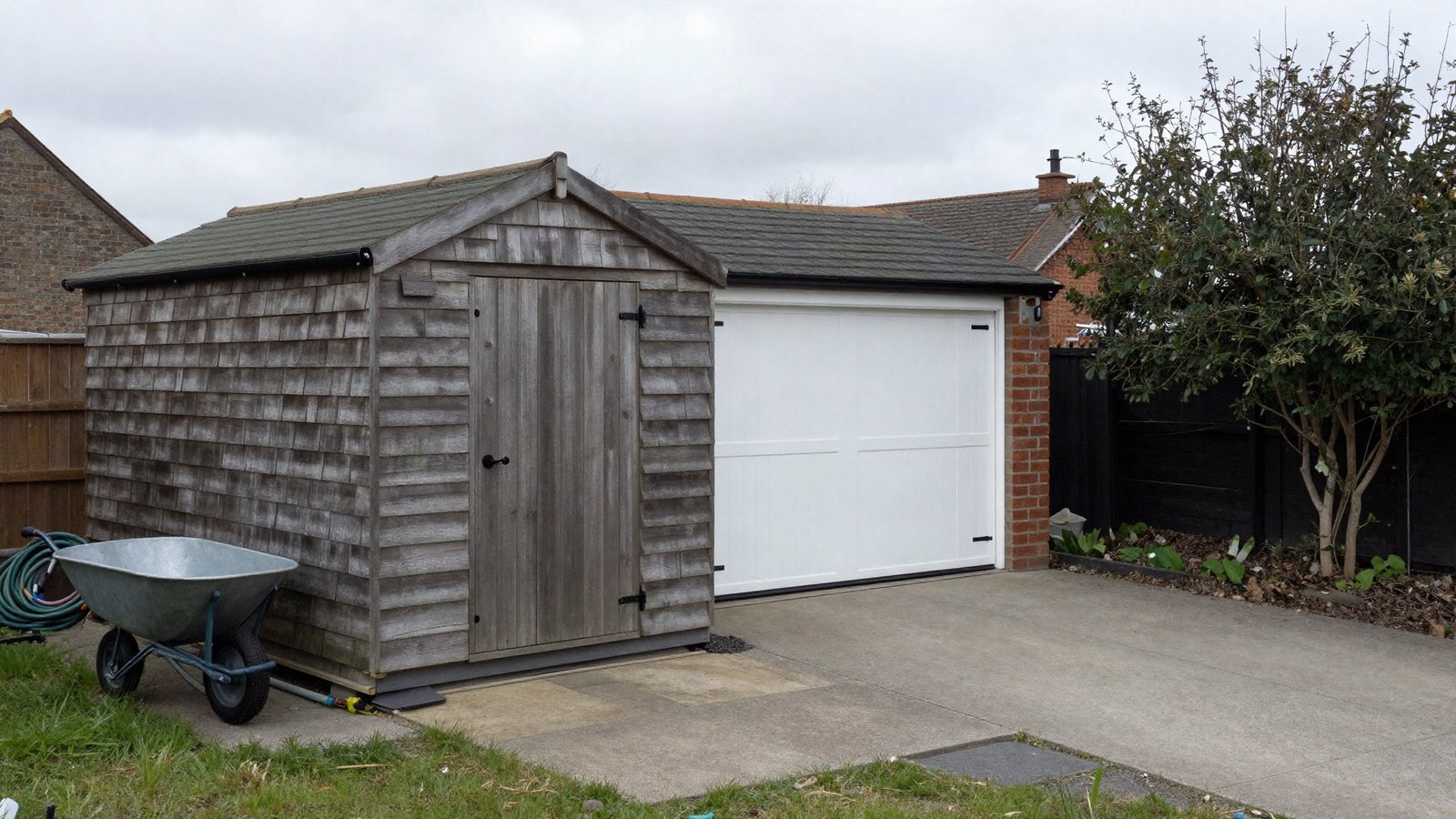
Most people asking this have already outgrown a 6ft x 4ft overlap shed and are deciding whether to go bigger or go permanent. Those are not two points on one scale: a shed is a weatherproof container you assemble over a weekend, a garage is a building on a slab, and at 2026 UK prices the gap is nearer tenfold than a few hundred pounds.
Both are bought for the same reasons — mower, bikes, dry tools, clutter out of the hallway. They diverge from year three, on damp, security and what either does for the value of the house.
Shed vs garage: the side-by-side
Figures are Midlands and North West; London and the South East run 15–25% higher on labour.
- •Usable size: sheds run 1.8m x 1.2m to about 3.6m x 3m. A single garage needs 3m x 5.5m internally before an estate car and an open door coexist.
- •Supplied and fitted, 2026: overlap shed £220–£400; treated shiplap 8x6 £480–£950; 10x8 workshop £1,200–£2,200; concrete sectional garage £7,500–£11,500; brick or block £16,000–£26,000.
- •Base: a shed wants 50mm slabs or a treated timber frame on gravel; a garage needs 100mm of reinforced concrete over 150mm of MOT Type 1, at £110–£160 per m².
- •Power: a shed gets an extension lead and shouldn't. A garage justifies armoured cable and its own consumer unit, £600–£1,400.
- •Lifespan: cheap overlap 7–10 years; treated shiplap 15–25; concrete sectional 40+; masonry 60+.
- •At sale: a shed adds nothing measurable; a garage where parking is contested is worth low single-digit percentages.
Performance: what each is actually good at
A shed is unbeatable value for volume: about £700 buys roughly 12m³ of dry-ish storage, and with the walls doing the work an 8x6 swallows an astonishing amount — our garage and shed storage guide covers the racking layouts that separate a shed you use from one you can't walk into.
What a shed cannot do is hold temperature. Single skin with a felt or steel roof means condensation on cold clear nights, dripping onto whatever sits below. Anything with a motor, battery or blade belongs off the floor in a lidded crate with desiccant tubs — metal sheds are worse than timber, plastic worse again.
A garage stays within a few degrees of outdoors, enough to keep steel tools rust-free, takes a bench you can lean on and a 7kW EV charger, and is the only one of the two you can later convert into habitable space.
Installation and the planning rules that catch people out
Both are usually permitted development in England, but a garage breaches the limits far more easily. Outbuildings must be single storey, eaves under 2.5m, ridge under 4m dual-pitched or 3m otherwise; within 2m of a boundary everything caps at 2.5m, which rules out most pitched garages tight against a fence.
Conservation areas, listed buildings and flats differ, and Scotland, Wales and Northern Ireland set their own thresholds — check our guide to planning permission and building regs before ordering. Outbuildings under 15m² with no sleeping accommodation are usually exempt from building regs, but a new circuit run out to one is notifiable under Part P.
- •Shed build: a day for the base, half a day for the shed, two people — sharp sand over compacted MOT, levelled slabs, 25mm of air under the floor. See how to build a shed foundation.
- •Concrete sectional garage: slab cured seven days, then a crew erects it in a day. Masonry: three to five weeks, plus drainage if water discharges towards a neighbour.
- •New vehicle access from the road needs a dropped kerb: £900–£2,200 plus a council licence.
The ten-year cost, worked through
Purchase price is the smallest honest part of this.
- •Shed, 8x6 treated shiplap: shed £680, base materials £280, treatment every two years at £26 a tin (£130), a felt re-cover around year seven £140, closed-shackle padlock and hasp £45. Ten-year total about £1,275 — £128 a year.
- •Concrete sectional single garage: unit and erection £8,600, slab £2,100, door and gutter servicing £450, repaint or door replacement at year eight £600. Ten-year total about £11,950 — £1,195 a year.
- •Sanity check: against £1,200 a year, a 35 sq ft self-storage unit costs £25–£45 a month and a council lock-up £15–£30 a week. Storage alone rarely justifies a garage; storage plus parking plus workshop plus resale does.
Maintenance: what each asks of you every year
Sheds fail from the bottom up and the top down, never the middle: the floor rots where it sits in a puddle, the felt splits where the sun hits it. Twenty minutes each spring — clear the base of leaf mulch, check the felt nail heads, re-coat the south face — buys another five years.
Garages fail at the door and the roof junction. Up-and-over tracks want white lithium grease annually, and a felt or EPDM roof needs its outlets cleared every autumn or water backs up under the flashing. Black spotting inside is condensation off a cold slab, not a leak; the fix is airflow, as in our damp and mould guide.
The renter-safe version
If you rent, anything bolted to a wall or dug into the ground is a deposit dispute waiting to happen — but it is still solvable reversibly. Get written permission by email first, even for a freestanding store: most tenancies treat garden alterations as landlord's-consent territory, and that thread is what the deposit scheme reads.
- •Choose a plastic or steel store on an interlocking grid base over gravel or existing hard standing: no digging, no concrete, no fixings, and it lifts out with the grid.
- •For bike security without ground anchors, ballast the store with two 25kg slabs in the floor tray — anchors mean resin-bonded bolts and permanent holes.
- •Store on freestanding boltless racking, not wall battens — nothing screwed into fences or garage walls. If there is already a garage, get existing damp staining and door damage into the check-in inventory.
- •On leaving, remove the store, rake the gravel back and re-seed yellowed grass in early autumn. Grass recovers in six weeks; a concrete pad never does.
Who each suits, and the verdict
Buy a shed if the job is storage, the budget is under £2,000, parking is sorted, or you might move within five years. A 10x8 on a proper base with a decent lock does most of what households want, at 8% of the price.
Build a garage if you need secure parking where it is scarce, want a real workshop, are charging an EV, or are improving a house you intend to keep — it is the only version here that comes back at sale. If you actually want a heated room at the end of the garden, neither fits; see garden office options, because insulating a garage afterwards costs more than building right first.
The verdict: for most UK gardens a good shed on a proper base wins, and the money saved belongs in the base and the lock, not a bigger shed. A garage is a house improvement that happens to store things. Decide which you are buying, then price it properly — more comparisons in our garden and outdoor guides.
Found this useful?
There's plenty more — hundreds of guides and honestly-tested product reviews for every corner of your home.
Browse All Guides