Heating & Cooling · 6 min read · 14 July 2026
Signs Your AC Needs Replacing (And the Faults That Are Just a Cheap Fix)
A struggling air conditioner in a July heatwave is usually a blocked coil, not a dying compressor. Here is how to tell the difference in twenty minutes, before anyone quotes you £2,500.
By the Nims Casa editorial team — written from professional cleaning experience and checked against our editorial standards.
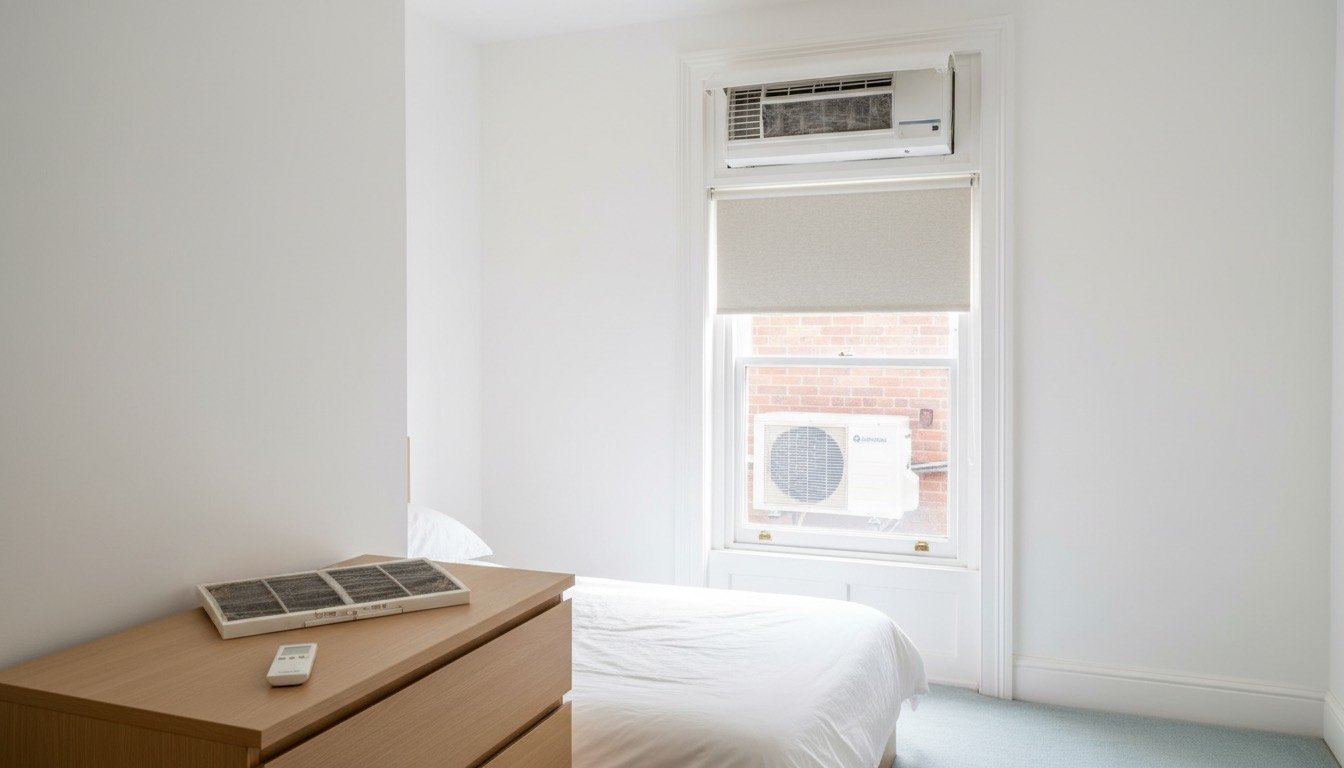
In eight out of ten August call-outs the kit is fine. The filters are choked, the outdoor coil is jammed against a hedge, or the room gains more heat than the system was ever sized to remove. Working out which before you ring anyone is worth several hundred pounds.
UK air conditioning also wears differently from the American kit most online advice describes. A domestic split here runs 300 to 600 hours a year against 1,500-plus in a hot climate, so age alone tells you little — we still service fourteen-year-old units on their original charge. What matters is the refrigerant, the compressor current, and what a repair costs against a new machine.
Start Here: The Twenty-Minute Triage
Before accepting any replacement quote, establish which of three problems you have: a whole-system fault, a single indoor head fault, or a building fault no air conditioner will fix. You need an £8 probe thermometer and twenty minutes.
- •Run cooling at 18°C, fan high, door shut, for fifteen minutes, then measure the air leaving the indoor grille against the air entering the return. A healthy split shows 8-12°C; under 5°C it is not moving heat, over 14°C means restricted airflow.
- •Outside, the condenser should discharge air well above ambient, fan turning steadily. Silence, a humming fan that will not spin, or start-stop cycling inside 90 seconds points at the outdoor half.
- •On a multi-split, run each head alone for ten minutes. One weak head with the others fine is an indoor fault, not grounds for replacing the system.
- •Repeat the test at 8pm with blinds closed. If it holds setpoint in the evening but never at 3pm, the problem is solar heat gain, and a bigger unit is the expensive answer to it.
- •Watch a plug-in energy monitor. A 3.5kW split drawing under 200W while calling for cooling has lost its compressor or its charge; at 1.2kW and still not cooling, heat goes in but never comes out.
Symptom to Cause, Ranked by What We Actually Find
Work down this in order — the cheap causes really are the common ones. If the unit runs but delivers nothing cold, the sequence in why an air conditioner runs but never cools narrows it faster than guesswork.
- •Cool but never cold, worse each season: fouled filters and a furred evaporator. Easily the most common finding, and an hour's work to clean the filters and coils properly.
- •Ice on the pipework or indoor coil: low charge or starved airflow. Run fan-only for 45 minutes to defrost before anyone inspects it.
- •Water down the wall below the indoor unit: blocked condensate drain or a failed pump. A £90-£250 fix, not a system failure.
- •Tripping the RCD: failed start capacitor, moisture in the terminal box, or a degraded compressor winding. Capacitor, £70-£140 fitted; winding, end of life.
- •Metallic rattle or grinding outdoors: fan bearings or perished compressor mounts. Bearings are cheap; a grinding compressor is not.
The Refrigerant Question That Settles Most of It
Find the data plate on the outdoor unit. It gives the refrigerant type and factory charge, and it decides the replace-or-repair question more often than the symptom.
R22 systems — broadly anything fitted before 2004 — are finished the moment they leak: servicing with R22 has been illegal in the UK since January 2015, reclaimed gas included. R407C and R410A remain serviceable, but the F-gas quota phase-down has pushed R410A cylinder prices up sharply, and gassing a leaking system is money into a bucket with a hole in it. R32, standard since around 2018, is cheaper and more efficient.
One legal point catches people out: only an F-Gas certified engineer may open the circuit, and a leak must be found and repaired, not topped up every summer. An installer offering annual regassing without leak detection is breaking the rules and charging you for it. If you are replacing anyway, weigh a reversible unit that heats too — our comparison of a heat pump against a cooling-only air conditioner covers where that pays back.
Fixes, Lowest Risk First
- •Wash the indoor filters in lukewarm water, dry fully, refit. Ten minutes, £0, and it restores most of the lost capacity on a neglected unit.
- •Clear 500mm around the outdoor unit and brush the fins top to bottom, never across.
- •Isolate the system for five minutes and restart — inverter boards latch spurious fault codes.
- •Read the flashing fault code and quote it when you book — it often changes what the engineer brings in the van.
- •Book a £90-£150 service before a £70-£120 diagnostic visit — a clean and a pressure check answer most questions for less.
Repair or Replace: The 2026 Numbers
UK prices this season: diagnostic visit £70-£120; service per indoor unit £90-£150; outdoor fan motor £180-£350; leak detection, repair and recharge £350-£700; indoor coil £500-£900; compressor £750-£1,300. A new 2.5kW split supplied and fitted is £1,600-£2,400, a 3.5kW £1,900-£2,800, and a three-room multi-split £4,500-£7,000.
The rule we use: if the repair exceeds 40-50% of like-for-like replacement, the system is over ten, and it runs R22 or R410A, replace it. Two of three still means repair. A £900 compressor on a twelve-year-old R410A unit fails all three; a £220 fan motor passes comfortably.
Do not let anyone sell replacement on efficiency alone. An old fixed-speed R22 machine sits near SEER 3; a current A+++ R32 inverter reaches SEER 7-9. Across a 400-hour British cooling season that is roughly 240kWh, about £62 a year at 26p/kWh. Real, but not £2,500 of real. When quotes arrive, compare installer estimates line by line.
The Signs That Genuinely Mean Replace
- •R22 in the system and a leak of any size — legally unrepairable.
- •Compressor seized, drawing locked-rotor current, or burned out and left acid in the circuit.
- •A leaking indoor coil on a unit over ten years old: the coil alone costs most of a new head.
- •Two separate leaks in three seasons — the brazed joints are degrading and the third is forming.
- •Control board discontinued with no compatible replacement, common on 2010-2014 ranges.
- •It was never big enough. Replacing like for like repeats the mistake, so work out the load first with our method for sizing an air conditioner for a UK room.
Where DIY Has to Stop
Filters, coil brushing, drain clearing and fault codes are yours. The refrigerant circuit is not: opening it without F-Gas certification is an offence, and liquid refrigerant at pressure causes real frostbite injuries. Leave the outdoor terminal cover alone unless the supply is isolated and locked off — capacitors hold a lethal charge for minutes.
Call an engineer at a burning smell from the outdoor unit, repeated RCD tripping, oily residue on the pipework, ice reforming within an hour of a defrost, or short-cycling. Each gets pricier the longer it runs.
Before a new outdoor unit goes on the wall: leaseholders need freeholder consent, conservation areas and listed buildings restrict siting, a new dedicated circuit is notifiable under Part P, and a condenser sited near a neighbour's window invites a noise complaint you will not win. Then a proper summer maintenance routine keeps the next system out of this article.
Found this useful?
There's plenty more — hundreds of guides and honestly-tested product reviews for every corner of your home.
Browse All Guides