Costs & Hiring · 6 min read · 28 May 2026
Spring Home Maintenance Checklist for UK Homes (Printable)
The three months after the last frost are when a British house tells you what winter did to it. Here is the round we work, month by month, with honest times, prices and a hard line on what to hand over.
By the Nims Casa editorial team — written from professional cleaning experience and checked against our editorial standards.
Slipped slates, a gutter joint weeping down a gable, mortar spalling off a south-west elevation, a fence post gone spongy at ground level: none of it announces itself, and all of it gets dearer between March and October. Winter damage here is rarely dramatic — it is water finding a route and quietly widening it.
This is the round we work on a typical two- or three-bed UK house, split across March, April and May so it fits around the weather. Every task carries a realistic time and a price for handing it over — and because the most useful thing anyone can tell you is where to stop, the next section draws that line first.
The DIY-or-pro line, drawn plainly
Most spring maintenance is genuinely low-risk. The exceptions are consistent, and they are not really about skill — they are about height, gas, electricity and asbestos. Get those four right and the rest is two Saturdays with a ladder and a stiff brush. Our guide to electrical repairs you should never DIY covers the wiring side in detail.
- •DIY: clearing gutters and gully traps at single-storey height, off an EN 131 ladder set at a 1-in-4 angle, footed on firm ground, three points of contact, never side-reaching past your belt buckle.
- •DIY: washing down patios, decking, render and uPVC; renewing bath and shower sealant; testing alarms; bleeding radiators; all fence, shed and garden work at ground level.
- •PRO: anything needing you on a two-storey roof or leaning past the gutter line. A roofer with a tower is £150–£350 for a morning.
- •PRO: the annual boiler service. Gas work is legally restricted to a Gas Safe registered engineer, and £80–£120 buys the certificate your warranty depends on.
- •PRO: consumer unit work, new circuits and anything inside bathroom zones — notifiable under Part P of the Building Regulations in England and Wales. A like-for-like socket faceplate is fine; a new supply to the shed is not.
- •PRO: soffits, garage roofs and textured coatings in homes built before 2000. Cement-bonded asbestos is common in UK stock and only turns dangerous when drilled, cut or broken. Sample it (£40–£60) first.
- •PRO: tree work above roughly 3m, anything near a service cable, and any tree under a Tree Preservation Order or in a conservation area — the council needs six weeks' notice.
March: find out what the winter did
March is inspection, not repair. You are building a list, and doing it early matters because roofers still have diary space before the summer rush. Walk the perimeter first, then the loft, then the boundary.
- •Ground-level roof survey with binoculars — 20 minutes, free. Slipped or cracked slates, lifted ridge tiles, sagging valleys, heavy moss.
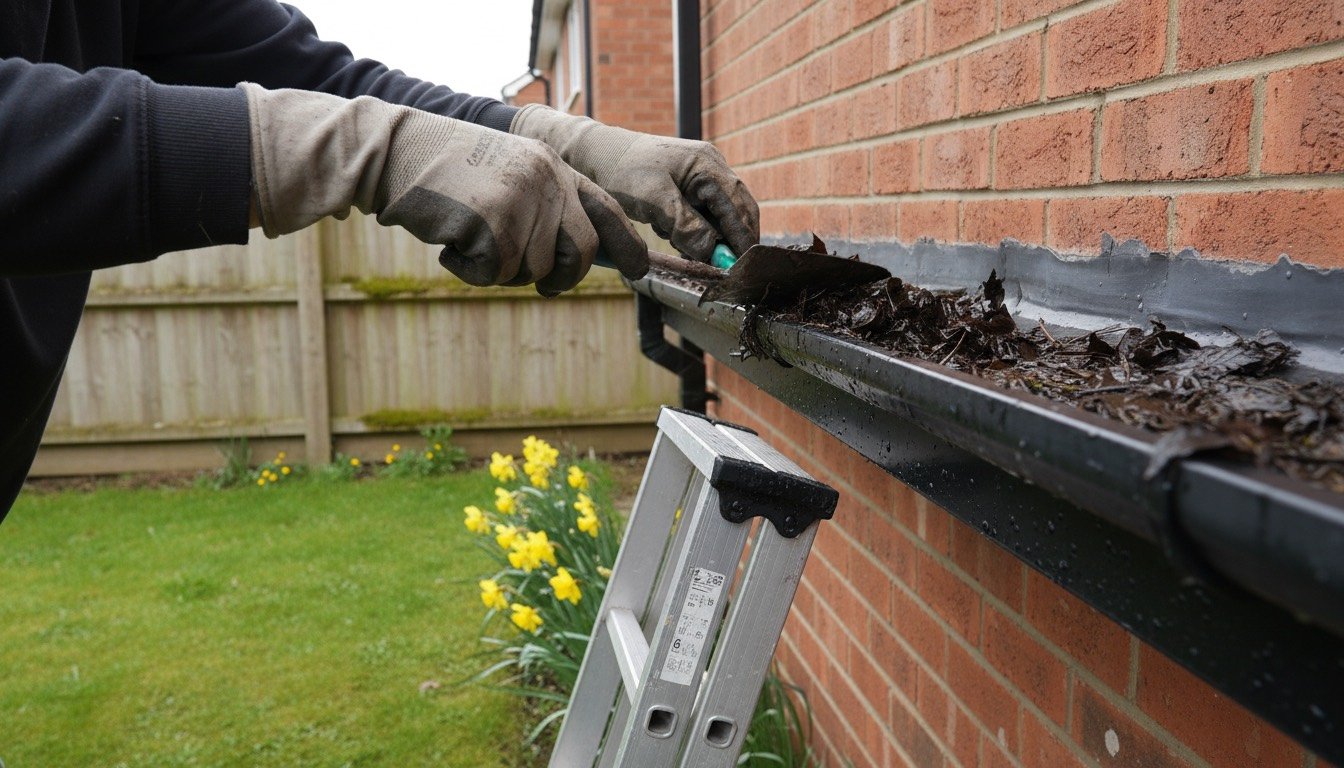
- •Clear gutters, downpipes and gully traps — 90 minutes to 2 hours DIY, or £80–£160 for a vacuum clean on a semi. Blocked gutters cause most of the penetrating damp we see, and gutter maintenance is the cheapest prevention there is.
- •Check pointing and render on the wettest elevation — 30 minutes. Tap suspect render with a knuckle; blown areas sound hollow.
- •Test every smoke and heat alarm and read the manufacture date — 10 minutes. Units expire at 10 years, not just the batteries; sealed lithium replacements are £15–£25.
- •Exercise the internal stop tap and outside tap — 5 minutes. A stop tap that has not turned since last spring is the one that seizes the night you need it.
- •Push-test fence posts at ground level — 15 minutes. Movement now means a £25 repair spur, not a flattened panel in the next gale.
- •Loft check on a bright, dry day — 15 minutes. Daylight through the roof, staining on rafters, insulation depth (270mm of mineral wool).
April: surfaces, drainage and wet-weather damage
April is the working month. Ground temperatures are up enough for coatings to cure and there is usually a dry three-day window somewhere. Do the dirty jobs before the sealing and painting jobs, or you will wash grit over fresh work.
- •Wash down the patio or driveway — 2–4 hours, £30–£45 to hire a pressure washer for a day. Keep a 25-degree fan nozzle 25–30cm off block paving, and stay off lime mortar and soft sandstone; our patio cleaning guide covers the no-pressure method.
- •Clean and re-oil decking — a full day for 20m², £40–£70 in cleaner and oil. A lance furs the boards; use brush and chemistry.
- •Rod and flush external drain gullies — 30 minutes, £15 for a set of rods. A drainage engineer is £90–£180 if it sits deeper than the trap.
- •Wash uPVC frames, sills and soffits — 2 hours, under £10 in cream cleaner.
- •Touch up external woodwork — 2–3 hours plus drying, £25–£40 a tin. Bargeboards, window beads and door bottoms first; full repaints run a 4–6 year cycle in UK weather.
May: heating, ventilation and the forgotten jobs
Nobody wants to think about heating in May, which is exactly why May is the right month. Gas engineers and sweeps are quiet, prices are softer, and you are not queuing behind everyone whose boiler died in the first cold snap. Date every job as you finish it; a written record becomes evidence at sale.
- •Book the annual boiler service — £80–£120, Gas Safe registered, roughly an hour on site.
- •Bleed radiators and check system pressure — 20 minutes, free. Cold tops mean air; cold bottoms mean sludge and a power flush conversation.
- •Clean extractor fans and clear trickle vents — 45 minutes. Poor ventilation drives most of the damp and mould we get called out to.
- •Vacuum the tumble dryer condenser filter or vent hose — 15 minutes. A fire risk and an energy bill in one.
- •Book a chimney sweep for any solid-fuel appliance — £60–£100, and the certificate matters to insurers.
- •Service the mower and sharpen the blade — 1 hour, £10 in oil and a file.
Supplies worth keeping in the shed
Everything above runs off one small kit, bought once.
- •EN 131 double extension ladder, £70–£150 — the single item that decides whether a job is safe.
- •Stiff broom, gutter scoop, drain rods and a bucket on a hook, £35 all in.
- •Decking cleaner, exterior wood oil and a 100mm brush, £45–£70.
- •P3 dust mask, nitrile gloves and safety glasses, £15 — non-negotiable for loft and render work.
If you only get one Saturday
When time is short, prioritise by what water does next. A full DIY spring round costs £120–£200 in materials; handing the lot to trades is nearer £450–£700, inside the 1%-of-property-value rule in our annual home maintenance cost guide. Afterwards, fold these tasks into a month-by-month plan.
- •1. Gutters and downpipes. Water down a wall for six months costs thousands to put right.
- •2. Roof survey from the ground. Two slipped slates are £150; a rotted purlin is £3,000.
- •3. Alarm test and expiry check. The only item here about lives rather than money.
- •4. Stop tap and gully traps. Two five-minute jobs that decide how bad a future emergency gets.
- •5. Boiler service booking. Do it in May and pay less than you would in November.
Found this useful?
There's plenty more — hundreds of guides and honestly-tested product reviews for every corner of your home.
Browse All Guides