Kitchens & Bathrooms · 6 min read · 21 April 2026
Walk In Shower vs Bathtub: Differences, Pros, Cons and Real UK Costs
The choice gets made in a showroom and paid for behind the wall. Here is what each option really costs to fit, run and maintain — and why a pre-1940s house changes the maths completely.
By the Nims Casa editorial team — written from professional cleaning experience and checked against our editorial standards.
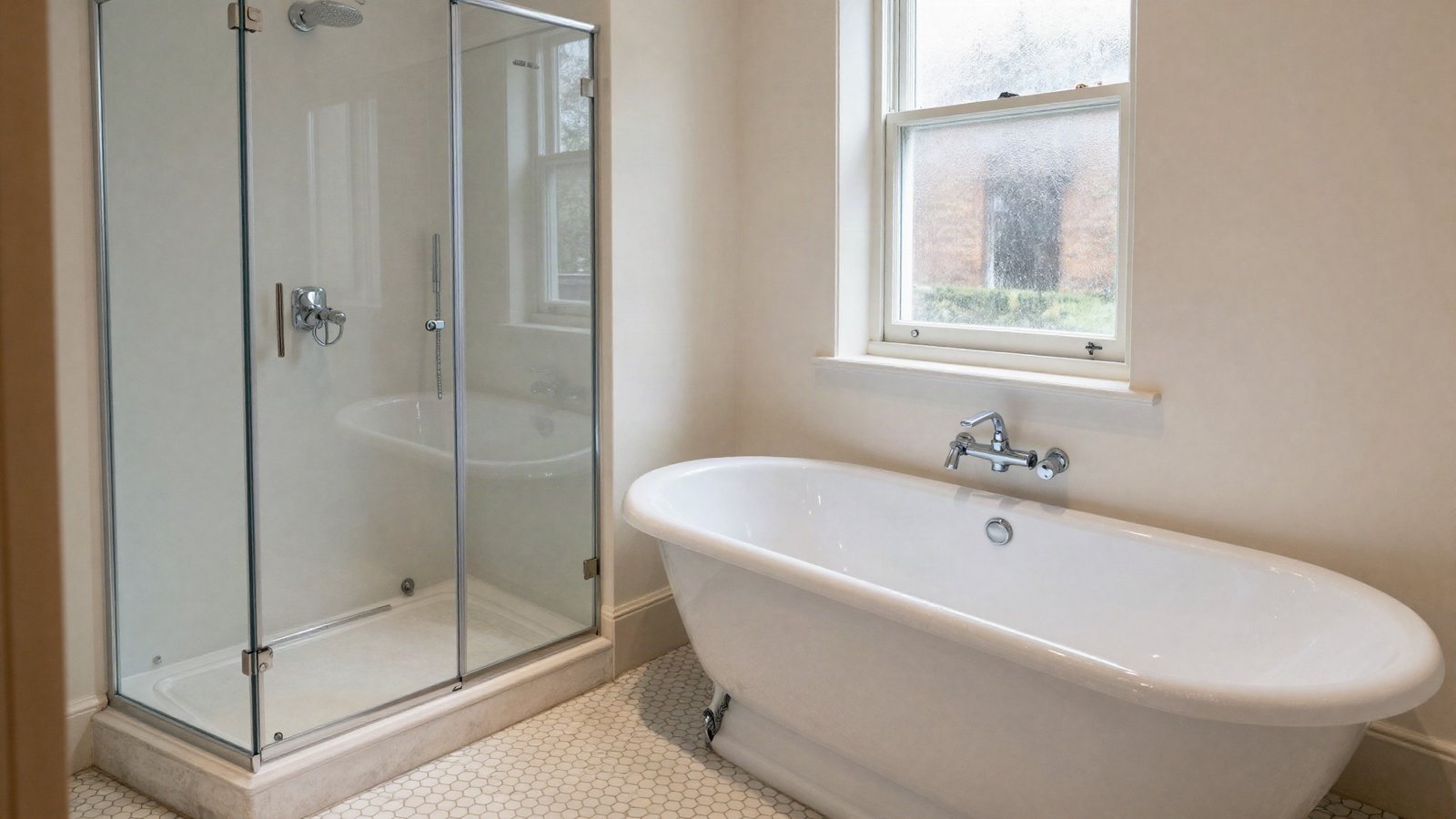
Showroom displays have never had a leak, never been chased into solid brickwork, and never had to drain through a 1900s cast iron stack. The fitting on the plinth is the cheap part. What sits under your floor and behind your plaster decides the cost.
Both work. For a lot of UK homes the honest answer is still a bath with a decent screen over it. Here is the comparison, with the numbers we quote on real jobs.
The short version, side by side
Supply-and-fit figures for an average 2.2m x 1.8m UK bathroom, excluding a full refit.
- •Fitted cost: over-bath shower £1,200–£2,000; walk-in on a low-profile tray £2,400–£4,000; tanked level-access wet room £4,500–£8,000.
- •Footprint: a standard bath is 1700 x 700mm. A walk-in needs 1200 x 900mm to be comfortable; 900 x 900mm is cramped for anyone broad-shouldered.
- •Water: a typical bath fill is 80–100 litres. A 9 litre/minute mixer for eight minutes is about 75. A power shower for ten minutes is 150.
- •Disruption: a like-for-like bath swap is one day. A wet room is three to five, room out of use throughout.
- •Resale: in a one-bathroom family house, removing the only bath narrows your buyer pool. Agents say so bluntly.
- •Lifespan: a steel enamel bath does 25–30 years. A tray and enclosure want replacing at 12–15; the valve sooner.
Performance: water, warmth and what you actually feel
The energy cost of a bath is smaller than people assume. Heating 80 litres from 10°C to 40°C takes about 2.8kWh — roughly 18p on mains gas at 6.3p/kWh, and a 9 litre/minute mixer off the same boiler costs much the same per eight-minute wash. Metered water and sewerage at around £2.30 per cubic metre is what bites, making a long power shower the priciest habit in the room.
Comfort is where they diverge. A walk-in gives a drenching flow and no climbing over a 550mm rim, which matters enormously after a knee replacement — read our guide to making a bathroom accessible before fixing a layout. A bath gives you somewhere to wash a toddler and soak a bad back.
Pressure decides more than either. Thermostatic mixers need 0.5–1 bar to hold temperature; a gravity-fed loft tank two metres above the head gives 0.1–0.2 bar. That is a dribble, and curing it means a twin-impeller pump at £200–£450 plus fitting.
Installation: what the quote is really paying for
Labour is the bulk of it. A plumber runs £250–£350 a day outside London and £350–£450 inside it; a tiler £180–£280. A wet room is dear because it is three trades plus a curing day for the tanking, not because the former costs money.
The bath route is cheap because the pipework exists. A steel enamel bath is £150–£400, acrylic £90–£250, taps £60–£200, a hinged screen £70–£220, and the existing 40mm waste usually stays put.
The walk-in gains cost the moment that waste has to move. A stone resin tray is £180–£400, an 8mm glass panel £150–£450, a thermostatic valve and riser £180–£500, tanking materials £250–£450 on top. Budgets blow up on the drain run: you need a continuous 1:40 fall — 18mm per metre — and in a suspended timber floor that means working around joists, not through them. Our walk-in shower cost guide covers the variants; if the whole room is going, price it against a full bathroom remodel.
The 10-year cost, not the quote
Quotes flatter showers because they ignore consumables and second-round costs. Over a decade, for two adults:
- •Bath with over-bath shower: £1,600 fitted, two reseals at £15 of materials, one replacement valve around year eight. Roughly £1,900 all in.
- •Walk-in with tray and enclosure: £3,000 fitted, reseals, a valve, a seal-strip kit, occasional glass re-coating. Roughly £3,400–£3,900.
- •Wet room: £6,000 fitted, plus the risk line nobody prints — a tanking failure reaching the ceiling below costs £2,000–£5,000 to put right, and is not always covered.
- •Running costs: near identical between a bath and a 9 litre/minute shower. A power shower adds £120–£180 a year on a meter.
The old-house case: solid walls, lath and Victorian drainage
This is where generic advice falls apart. Solid 215mm brickwork has no stud void, so a recessed niche is largely off the table: chasing is capped at a third of wall thickness vertically, a sixth horizontally. That cold, uninsulated wall also grows black mould far faster than a modern one, so a 15 litre/second extractor running 15 minutes after every wash is not optional.
Lime plaster on riven lath will not carry tiles or a tanking membrane. Lime is soft and flexible by design, gypsum adhesives fail on it, and its safe tile loading is under 20kg/m² against 40kg/m² for cement backer board. The wet wall gets hacked back and re-boarded at £20–£30 a sheet; elsewhere leave the lime alone and repair it in kind, as in our notes on fixing cracks in plaster walls.
Floors and services finish it. Victorian first-floor joists run 50 x 175mm at 400mm centres and are often already notched to death; legitimate notches sit in the top, within 0.1–0.25 of the span and no deeper than an eighth. A level-access former wants 30–50mm between them, so the answer is often a pumped waste at £400–£700 or a tray with a 40mm step. Original cast iron stacks with open hopper heads cannot take a shower waste — it needs a trapped connection, which on a conservation-area front elevation becomes a planning conversation. And a 9.5kW electric shower draws 41 amps: a 1960s rewireable board with no RCD will not take it, so add £600–£1,000 for a consumer unit change.
Maintenance: what each one asks of you
A walk-in is the higher-maintenance object, and hard water makes it worse. Across the South East, supply runs 250–350mg/l as calcium carbonate, which etches glass permanently within two years unless squeegeed. Twenty seconds after each use is the whole trick.
Both need silicone renewing every three to five years — sooner if the bead lifts or a grey shadow appears behind it. Done properly rather than smeared over the old, it is 90 minutes and £15 of materials: see replacing the silicone around a bath.
Who each suits, and the verdict
Keep the bath, with a hinged screen and a good mixer over it, if it is the only bathroom in a family house, if you are on a gravity system you will not be changing, or if the room is a first-floor Victorian box with joists you would rather not butcher. Cheapest, easiest to sell on, least likely to leak downstairs.
Choose a walk-in on a low-profile tray if there is a second bath elsewhere, mains pressure at 1 bar or better, and a solid floor or joists that will take the waste run. It is the retrofit sweet spot: most of a wet room's benefit for half the money and a fraction of the risk.
Choose a full tanked wet room only for genuine accessibility need, and only with a fitter who will photograph the tanking before tiling. Above a lath-and-plaster ceiling we would talk most people out of it. Plainly: one bathroom, keep the bath; two bathrooms, put the walk-in in the smaller one. More in the kitchens and bathrooms guides.
Found this useful?
There's plenty more — hundreds of guides and honestly-tested product reviews for every corner of your home.
Browse All Guides