Heating & Cooling · 6 min read · 22 July 2026
Why Is My Furnace Blowing Cold Air? A UK Warm-Air and Boiler Diagnosis
Air moving but no heat in it is a very specific fault, and it narrows down fast. Here is the ten-minute diagnosis we run on UK warm-air units and boilers before anyone touches a gas component.
By the Nims Casa editorial team — written from professional cleaning experience and checked against our editorial standards.
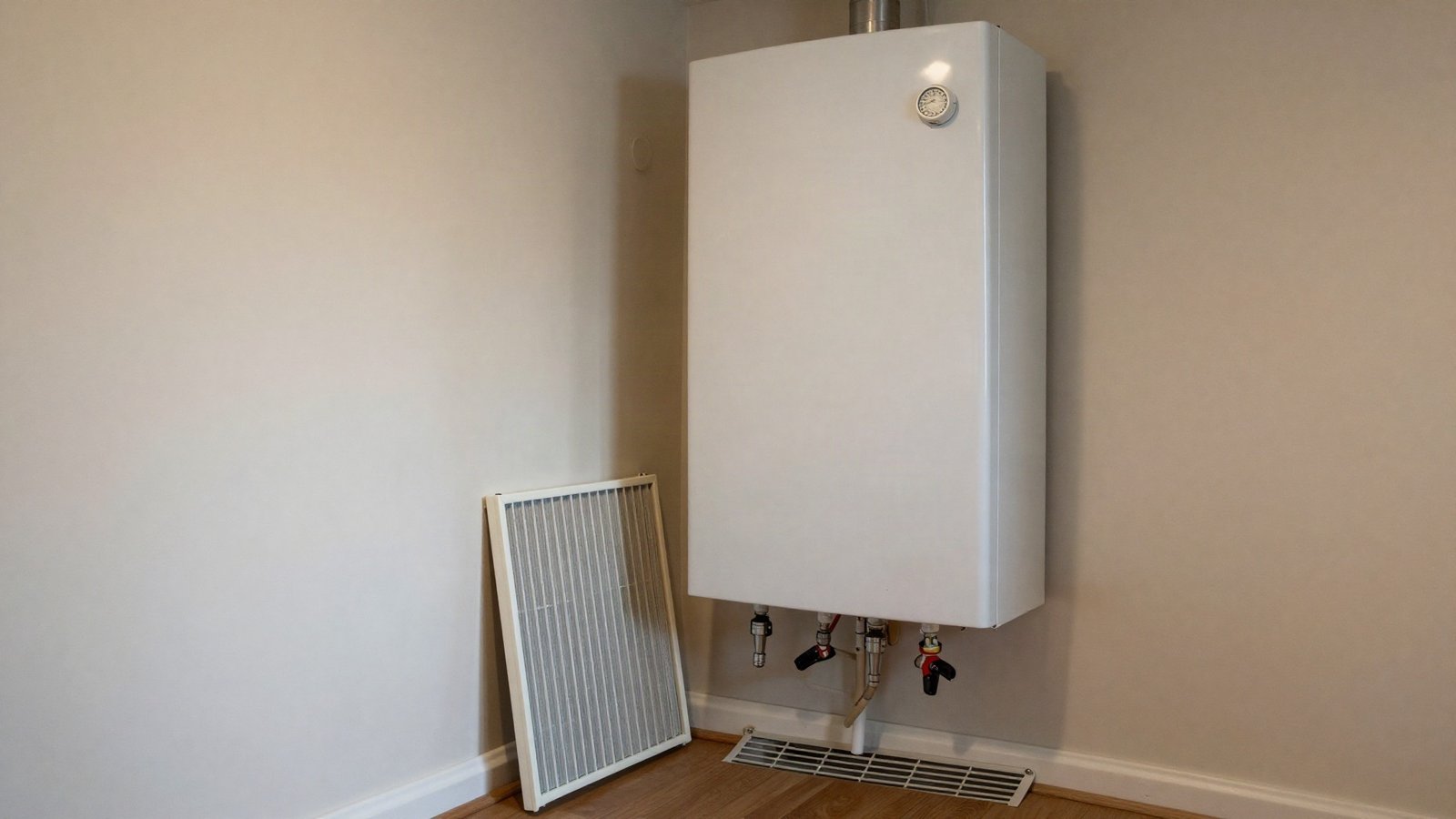
A system that runs but pushes out cool air is telling you something precise: the fan and the electrics work, the heat source does not. That split makes the fault findable in ten minutes with a watch, a torch and your hand.
In Britain the question comes from two households: those with a genuine ducted warm-air unit — Johnson & Starley, Baxi Bermuda and similar, common on 1960s and 70s estates — and the far larger number with a gas boiler, radiators and a fan convector that has gone cold. The logic is identical, and roughly half the time the cure costs nothing.
Start Here: The Ten-Minute Diagnosis
Do not reset anything yet. A fault code is evidence, and reset wipes it. Turn the thermostat up 5°C to force a call for heat, then work through this while a full cycle runs.
- •Time the sequence. The burner should light within 30 seconds, the fan starting 60–90 seconds later once the heat exchanger warms. Fan first with no burner is the fault. Two minutes of cooling air at the end of a cycle is normal overrun.
- •Measure the air: a thermometer in the grille after five minutes should read 30–45°C. Under 25°C, the burner is not firing properly.
- •Check the programmer. It is routinely still on Hot Water Only.
- •Change the thermostat batteries. A wireless stat on tired AA cells drops its radio link and the boiler is never asked to fire.
- •Read the pressure gauge cold: 1.0–1.5 bar. Below about 0.5 bar most modern boilers lock out.
- •Photograph any fault code before pressing reset. Worcester EA, Vaillant F28 and Ideal L2 all mean ignition failure.
- •Outside, check the white 21.5mm condensate pipe. In a cold snap that is usually your answer.
Symptom to Cause: Match What You Are Seeing
- •Fan blows cold, burner never lights, lockout code during frost — frozen condensate pipe.
- •Hot water perfect, radiators and warm air stone cold — diverter valve stuck in the hot water position, or a failed motorised valve actuator on an S-plan or Y-plan system.
- •Radiators hot at the bottom, cold at the top — trapped air.
- •Everything cold, gauge under 0.5 bar — pressure loss from a weeping valve or a discharging pressure relief valve.
- •Heat for two minutes, then cold, then heat again, with a scorched dusty smell — short cycling on a choked filter that keeps tripping the limit stat.
- •One room cold, rest of the house fine — a closed damper, blocked duct branch or seized radiator valve pin. Not a boiler fault.
The Causes, Ordered by How Often We Find Them
Across a British winter, a hundred of these calls break down roughly like this. Note how far down anything expensive appears.
- •Controls and settings — about 30 in 100. Wrong programmer mode, flat stat batteries, holiday mode, or a smart stat off the Wi-Fi. Re-read how to program a thermostat before phoning anyone.
- •Frozen condensate pipe — about 20 in 100 during frost, near zero in mild weather. Any night below roughly -1°C with an external pipe run will do it.
- •Air or low pressure — about 15 in 100, and a fifteen-minute job covered in bleeding radiators and re-pressurising the boiler.
- •Restricted airflow — about 12 in 100. Choked filter, or furniture over a return grille. Changing the filter costs £8–£20.
- •Diverter or motorised valve failure — about 10 in 100.
- •Seized or airlocked pump — about 6 in 100, far likelier after an idle summer.
- •Ignition parts, fan or PCB — about 7 in 100. The genuinely expensive end, and Gas Safe territory.
Fixes in Order of Risk
Work top to bottom and stop the moment heat returns. Nothing here means opening an appliance casing.
For a frozen condensate pipe: pour hand-hot water at 40–50°C slowly along the exposed run from a watering can, concentrating on bends and the outside elbow. Never boiling — it cracks the plastic and scalds on the rebound. Wait five minutes, then reset once. If it locks out again within the hour it is refreezing and needs lagging.
- •No risk: correct the programmer, replace stat batteries, clear rugs and furniture off return grilles.
- •Low risk, £8–£20: fit a new air filter, matching the size on the frame, airflow arrow pointing towards the unit, date pencilled on.
- •Low risk, free: bleed radiators from the ground floor up, then top pressure back to 1.2 bar and close both filling loop valves.
- •Low risk, free: thaw the condensate pipe as above, then reset once and only once.
- •Moderate: free a seized thermostatic radiator valve by pulling the head off and pressing the brass pin with pliers until it springs back. Do not force one that is corroded solid.
- •Moderate: lever a motorised valve to mid position using the lever on its body. That confirms a failed actuator — a diagnostic, not a repair.
- •Stop here. Burners, gas valves, flame sensors, heat exchangers, flues and PCBs are not homeowner jobs in the UK, whatever a video suggests.
Renting? The Reversible Version That Protects Your Deposit
Tenants can do more than they think, provided it is reversible and never involves opening an appliance. Under section 11 of the Landlord and Tenant Act 1985 the landlord must keep space and water heating in repair and proper working order — a duty that cannot be contracted out of, and not your bill.
Report it by email the same day, fault code photographed and dated. Verbal reports vanish; the email is what counts if the repair drags. Ask for the current CP12 gas safety record too.
- •Safe and reversible: stat batteries, programmer settings, thawing the condensate pipe, bleeding radiators, moving furniture off grilles, a plug-in oil-filled radiator as a stopgap.
- •Reversible warmth: thermal-lined curtains on the existing pole, a loose draught excluder at the door, peel-off foam strip on letterboxes and loft hatches. See draught-proofing your home for products that come away cleanly.
- •Ask first: topping up boiler pressure. Most agreements allow it, but one email means a later leak is not pinned on you.
- •Never: remove the casing, adjust gas pressures, add inhibitor, drain the system, or hire your own engineer and deduct the cost without the correct written process.
- •Photograph the thermostat each morning. A flat under 18°C for days is evidence for environmental health.
Where DIY Stops, and What It Costs
The boundary here is legal, not a matter of confidence. Under the Gas Safety (Installation and Use) Regulations 1998, only a Gas Safe registered engineer may work on gas appliances — including removing the casing. Stop and ring 0800 111 999 if you smell gas, see a lazy yellow flame instead of crisp blue, find sooty marks around the casing, or notice headaches arriving with the heating — carbon monoxide is the one part of this you never improvise.
Typical 2026 UK figures: diagnostic call-out £70–£120, diverter valve £150–£300 fitted, circulating pump £250–£400, fan or ignition assembly £250–£400, PCB £350–£550. Past roughly £600 on an appliance over twelve years old, price up a full boiler replacement before authorising the repair. On pre-1990 warm-air units, spares are scarce and a second failure within two winters is common.
Found this useful?
There's plenty more — hundreds of guides and honestly-tested product reviews for every corner of your home.
Browse All Guides