Plumbing · 6 min read · 11 June 2026
Why Is My Water Pressure Low? A UK Plumber's Diagnosis and Fixes
Nine times in ten it isn't pressure at all — it's flow, and the restriction is inside your own house. Here is the order a plumber checks things in, and where you should stop.
By the Nims Casa editorial team — written from professional cleaning experience and checked against our editorial standards.
Most callouts booked as "low pressure" turn out to be low flow, and the two are not the same. Pressure is the push behind the water, measured in bar. Flow is how many litres arrive per minute, set by the narrowest, most furred-up length of pipe between the street main and the tap you are stood at. You can have a healthy 3 bar behind a shower that dribbles.
That distinction is the whole diagnosis. Fifteen minutes with a bucket and a £15 gauge tells you whether this belongs to your water company, your supply pipe, or one scaled aerator.
The Two Tests That Split the Problem in Half
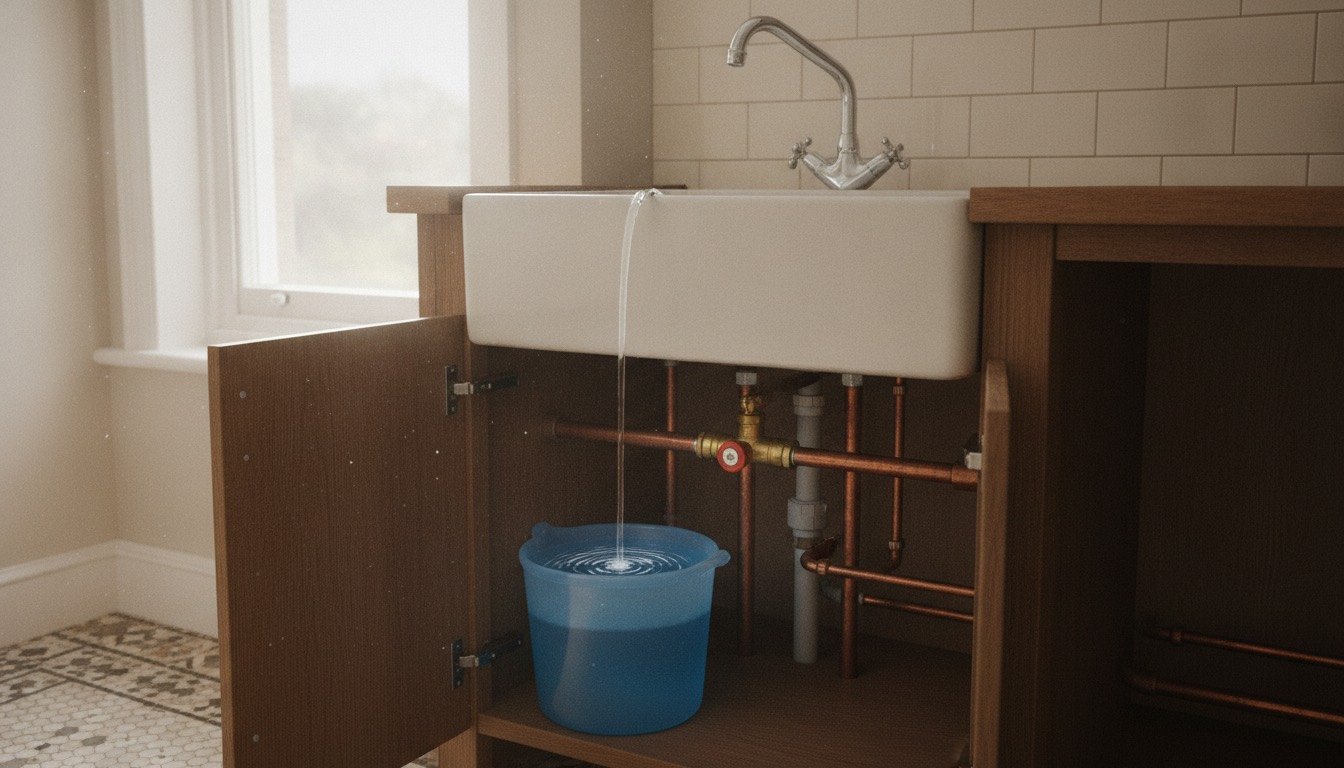
Do these before touching anything. Test at the kitchen cold tap: in almost every UK house it is the only tap fed straight off the incoming main, so it reports honestly.
- •Bucket test: open the kitchen cold tap fully and time a 10-litre bucket. Under 40 seconds is 15 litres per minute or better, which is healthy. 40–60 seconds is workable but tight for a combi. Over 90 seconds is below 7 l/min, under the minimum most suppliers guarantee at the boundary stop tap.
- •Gauge test: a screw-on gauge with a hose fitting costs £12–£18 and fits an outside tap or washing machine valve. Take a static reading with nothing running, then a dynamic one with the kitchen tap open. Typical UK static is 2–3 bar.
- •Read the gap: 3 bar static collapsing below 1 bar as one tap opens means the restriction is inside your pipework. Static already at 1 bar points upstream.
- •Whole house or one outlet? Every tap weak means stopcock, supply pipe or pressure reducing valve. One weak shower means the fault is within a metre of it.
- •Ask two neighbours. On a shared Victorian supply pipe a whole terrace drops together.
Symptom to Cause: Reading Your Own Taps
- •Weak everywhere, hot and cold — stopcock not fully open, seized gate valve, or an undersized, furred supply pipe.
- •Fine at 6am, dreadful at 7.30am and 6pm — peak demand on a marginal supply, typical of shared and 12mm pipes.
- •Cold strong, hot feeble — scaled combi heat exchanger, a part-closed hot isolating valve, or a gravity cylinder with too little head.
- •One weak shower — limescaled head or blocked restrictor. The same limescale removal method that rescues a kettle works here.
- •Pressure gone overnight — a leak, a water company repair, or a stop tap knocked in a cupboard. Sudden loss plus damp or a ticking meter is a leak until proven otherwise.
- •Weak flow plus banging when taps shut — restriction alongside loose pipework, and water hammer eventually splits a joint.
The Causes, in the Order We Actually Find Them
Ranked by how often each turns out to be the answer on a UK callout, not by how dramatic it sounds.
- •1. A stopcock or isolating valve only part open, half-closed during a repair years ago. Free to fix, and an embarrassing share of jobs.
- •2. Limescale on aerators, heads and cartridges — standard from Kent to Cambridgeshire, where supplies run 250–350 mg/l calcium carbonate.
- •3. A furred or undersized supply pipe. Old lead or galvanised steel can lose half its bore.
- •4. A pressure reducing valve set too low, or its strainer blocked with grit after mains work.
- •5. A scaled combi heat exchanger — hot side only, creeping down over two or three years.
- •6. A shared supply pipe serving several houses, still common in pre-1919 terraces.
- •7. A leak on the private supply pipe, which is your responsibility, not the water company's.
- •8. A genuine mains problem. Real, but last for a reason.
Why Older Houses Behave Differently
Anything built before about 1930 plays by its own rules. The original supply is often 12mm lead with its bore already halved by 120 years of scale — it will never deliver combi flow, whatever you fit indoors. Between the wars, galvanised steel rising mains were normal; they rust from the inside, and a 20mm pipe can pass less than a modern 10mm one. Neither is a repair job, and lead is worth raising with your supplier, as many replace their side free.
Access is the other tax. A solid-wall Victorian house has no cavity and no plasterboard: pipes are chased into brick under lime plaster or clipped above a lath-and-plaster ceiling. Lime plaster does not patch like modern skim — cut it carelessly and it lets go from the laths in sheets. That is why the same fix costs three times what it does in a 1990s estate house, and why a good plumber reroutes under a suspended floor instead.
Two more traps. Many pre-1990s homes are still gravity fed from a loft tank, where pressure is only height: each metre of drop gives 0.1 bar, so a two-metre head is 0.2 bar and no stopcock adjustment improves it. Those gate valves seize half open as standard. And if the answer is a shower pump, a pre-1970s rewireable fuseboard with no RCD needs an electrician first.
Fixes, Lowest Risk First
Work down in order and stop when flow returns. We have quoted supply pipes for people whose fault was a £6 aerator.
- •Open the internal stopcock fully, then back it off a quarter turn. Two minutes, free. Check every isolating valve under sinks and at the boiler.
- •Descale aerators and shower heads — soak 2–4 hours in descaler or 1:1 white vinegar. 20 minutes, £3–£8. Replace a perished restrictor rather than binning it.
- •Clean the strainer on the pressure reducing valve or meter and check its setting; 3 bar is normal. 30 minutes, free.
- •Fit new tap cartridges or a shower valve where one outlet stays weak: £15–£60 in parts, an hour's work.
- •Have a combi's plate heat exchanger descaled or replaced for hot-only faults: £180–£350. A scale reducer afterwards is £60–£150.
- •Fit an accumulator or compliant booster set where the mains cannot keep up: £900–£2,000. Pumping straight off the main above 12 l/min is not permitted under the Water Supply (Water Fittings) Regulations 1999 without supplier consent — use a WaterSafe installer.
- •Replace the supply pipe in 25mm MDPE, usually moled rather than trenched: £700–£1,800 for 10–15 metres. Check the signs your pipes need replacing first.
Where DIY Has to Stop
Some of this is off-limits not because it is difficult but because it is restricted or risky. Call someone if there is lead pipework anywhere, because cutting it disturbs drinking water; if the work touches an unvented cylinder, which needs a G3 qualification under Building Regulations; if anything is inside the boiler casing, which is Gas Safe territory; or if the meter turns with every tap shut, which means an underground escape and an acoustic survey.
Stop too if a valve will not move. A seized 60-year-old stopcock is one firm turn from snapping, and a snapped stopcock at 8pm on a Sunday is an uncontrolled flood. Know where your boundary stop tap is and own a key before you try, because the aftermath of a burst pipe costs far more than the fix.
For scale: £60–£110 for a plumber's first hour and £45–£75 after, outside London, roughly double out of hours. Leak detection runs £250–£500. To sanity-check a quote, the breakdown of UK plumber rates by job beats a phone estimate. Diagnose first, spend second.
Found this useful?
There's plenty more — hundreds of guides and honestly-tested product reviews for every corner of your home.
Browse All Guides