Heating & Cooling · 6 min read · 5 June 2026
Winter Heating System Checklist for UK Homes (Printable)
Most winter heating failures are three predictable faults, not bad luck. Diagnose which one you have first, then work the seasonal, monthly and cold-snap jobs in order.
By the Nims Casa editorial team — written from professional cleaning experience and checked against our editorial standards.
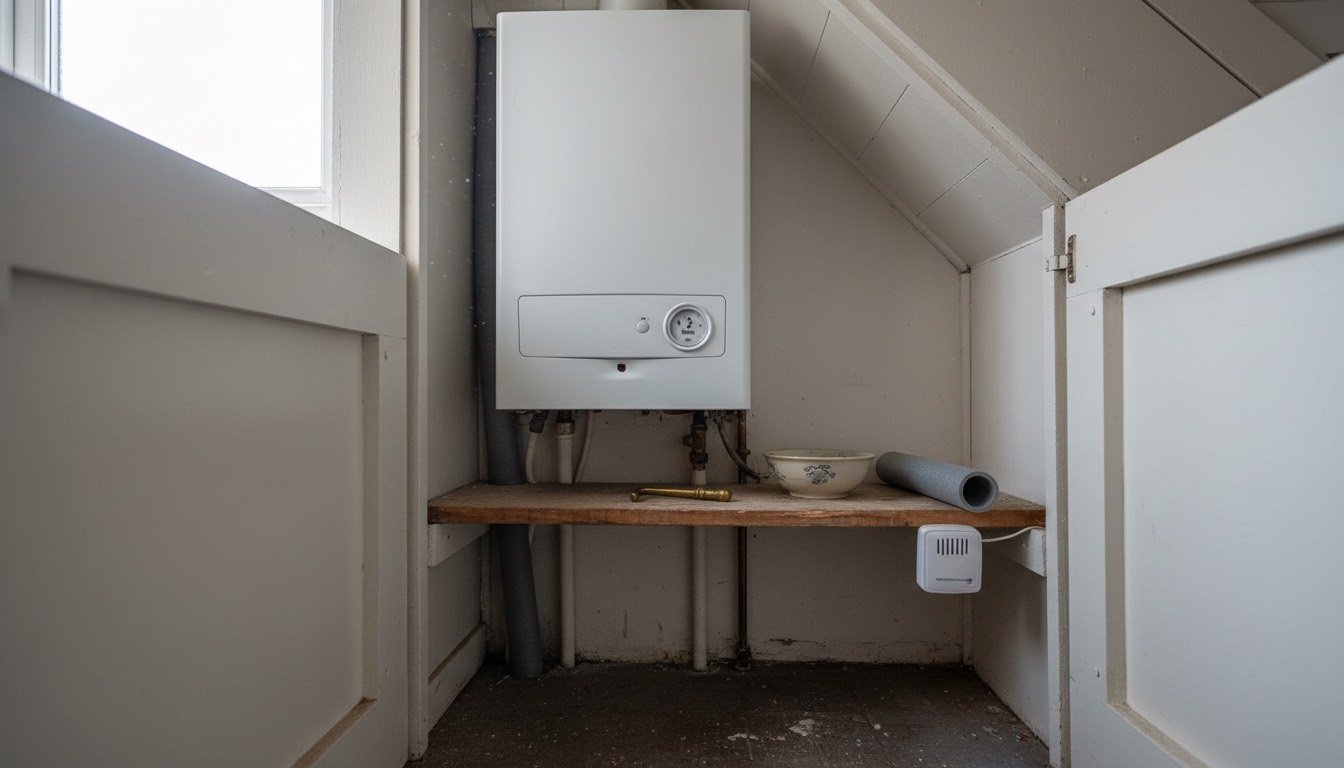
Most December callouts are not breakdowns. They are a boiler that has leaked pressure since October and finally locked out, a condensate pipe frozen at six in the morning, and a radiator half-cold since March because nobody put a bleed key in it. All three are preventable in an afternoon for about £30. If you are starting even earlier — still wondering whether to switch on at all — our guide to when to turn the heating on deals with the timing question first.
This is the winter heating system checklist we work through on our own houses, ordered so the jobs that stop a breakdown come before the ones that shave pennies off a bill. Start with the diagnostic. There is no sense balancing radiators if the real fault is a seized valve pin or sludge in the bottom of every panel.
First, Work Out Which Problem You Actually Have
Fifteen minutes here saves buying the wrong fix. Set the room thermostat 3°C above current room temperature, open every thermostatic radiator valve fully, and after ten minutes go round the house with the back of your hand. If two symptoms apply, deal with low pressure first — a boiler on 0.5 bar locks out mid-job and confuses every other test.
- •Radiator hot at the bottom, cold across the top third: trapped air. Fifteen-minute fix — bleed the radiators and re-pressurise the boiler and expect to lose 0.2–0.3 bar doing it. With the air out, check the boiler flow temperature — most combis leave the factory set hotter than a condensing boiler wants.
- •Radiator hot at the top, cold sludge-line across the bottom: magnetite build-up. Needs a chemical flush (£150–£250) or a power flush (£350–£700) plus a magnetic filter, not bleeding.
- •One radiator stone cold, but the pipe into the valve is hot: seized TRV pin. Pull the head off, free the brass pin with pliers, work it up and down. Costs nothing.
- •Whole house lukewarm and the boiler cycling every few minutes: low pressure, wrong pump speed or a blocked filter. Check the gauge first.
- •Hot water fine, no heating at all on a combi: diverter valve or failed programmer. Engineer territory, £150–£350 fitted.
- •Upstairs roasting, one downstairs room never warms: a balancing problem — see why one room is colder than the rest before you assume the boiler is undersized.
- •Boiler makes a rumbling, kettle-like noise: limescale on the heat exchanger, common in hard-water areas from Kent to Cambridgeshire. Book a service, don't ignore it.
September to October: The Pre-Season Jobs
Do these before the clocks go back. Engineers are bookable in September and rammed by mid-November, and prices reflect it.
- •Book the annual boiler service with a Gas Safe registered engineer — £80–£130 for a combi, 45–60 minutes. Non-negotiable if you want to keep the manufacturer warranty.
- •Check the pressure gauge cold: 1.0–1.5 bar. Top up via the filling loop if low and note the reading — a second drop within a fortnight means a leak, not air.
- •Lag the external condensate pipe (the white 21.5mm plastic one) with foam or Armaflex, £6–£12. This single job prevents the most common UK winter lockout there is.
- •Lag loft and garage pipework and check the stop tap turns — see how to prevent frozen pipes. 30 minutes, £15–£25 of foam sleeve.
- •Clear leaves, ivy and shrub growth from around the boiler flue terminal, minimum 300mm all round. Five minutes.
- •Test every smoke and CO alarm and replace any unit over seven years old. Read how to prevent carbon monoxide poisoning if you have any open-flued appliance.
- •Oil or LPG? Dip the tank and order in October — lead times stretch from three days to three weeks after the first frost.
- •Open fire or wood burner as backup heat? Get it swept before first use: £60–£100 from a HETAS sweep.
Monthly Through the Heating Season
November to March, these take under twenty minutes a month combined. Put a recurring reminder on the first Sunday.
- •Read the boiler pressure gauge cold and write the number down. A slow, repeatable drop means a leak or a failing expansion vessel — £180–£300 if left.
- •Feel every radiator top and bottom, bleed only the ones with cold tops. Two minutes each, bleed key 60p–£2.
- •Vacuum the dust out of radiator fins and the convector fins behind panel rads — dust genuinely costs output, and cleaning radiators properly takes ten minutes a room.
- •Check wireless thermostat batteries. A flat AA is behind a surprising number of "the boiler has died" calls.
- •Look under the boiler for green verdigris or white salt crusting — the earliest sign of a weeping joint.
Weekly Checks and Cold-Snap Actions
When the forecast shows nights below −2°C, add these. Five minutes each, and they save a £180 emergency call-out.
- •Test the CO alarm with its button, weekly, all winter. Ten seconds.
- •On a hard-frost night set the heating to run for 30 minutes at around 3am, or leave the frost-stat active. Movement in the pipework beats a static freeze.
- •If the boiler locks out at dawn and won't reset, suspect the condensate. Pour warm — never boiling — water over the external pipe, then reset. It usually fires within five minutes.
- •Make sure everyone in the house knows where the stop tap is.
Supplies, Kit and What Each Job Costs
Under £60 covers every DIY-safe job above, and the kit lasts years.
Paid jobs sit in a predictable band: annual service £80–£130, magnetic filter fitted £120–£180, chemical flush £150–£250, power flush £350–£700, expansion vessel £180–£300. Once a boiler is past 15 and needing two of those a year, run the numbers against boiler replacement costs.
- •Radiator bleed key and a small jug or tray — £2
- •Foam pipe lagging, 2m lengths, 15mm and 22mm — £15–£25
- •Armaflex or purpose-made condensate insulation — £6–£12
- •500ml corrosion inhibitor (Sentinel X100 or Fernox F1) — £15–£25
- •Adjustable spanner and a 15mm radiator spanner — £12
- •Spare AA batteries for the thermostat — £3
Short on Time? Do These Five, in Order
One hour before the cold arrives? This order returns the most. Everything else can wait until half term.
- •Lag the external condensate pipe — 10 minutes, prevents the single most common winter lockout.
- •Check and correct boiler pressure to 1.2 bar cold — 5 minutes.
- •Test the CO alarm and replace it if it is over seven years old — 5 minutes.
- •Bleed any radiator with a cold top, then re-check pressure — 20 minutes.
- •Draught-proof the letterbox, loft hatch and the worst two doors — 20 minutes and around £20, and draught-proofing remains the cheapest energy upgrade there is.
Where the Checklist Ends and a Gas Safe Engineer Begins
Everything above is homeowner-safe. Beyond it the line is legal, not a matter of confidence: any work on gas pipework, the boiler casing, the flue, the burner or the gas valve must be done by a Gas Safe registered engineer. Taking a case off to "have a look" is an offence, and it voids your buildings insurance.
Call someone the same day if you smell gas (0800 111 999, National Gas Emergency Service), if a CO alarm sounds, if you see sooty staining or lazy yellow flames, if the boiler locks out again after two resets, or if pressure falls below 1 bar within days of topping up. Persistent low pressure with no visible leak is usually the expansion vessel or the pressure relief valve — neither is another top-up job.
Found this useful?
There's plenty more — hundreds of guides and honestly-tested product reviews for every corner of your home.
Browse All Guides