Cleaning Guides · 6 min read · 14 May 2026
How to Clean Radiators (Inside the Fins — Where the Heat Lives)
The dust inside your radiator's fins is an insulating blanket you're paying to heat through. The ten-minute per-radiator clean that pays for itself.
By the Nims Casa editorial team — written from professional cleaning experience and checked against our editorial standards.
Radiators heat a room by convection: cold air is drawn in at the bottom, pushed up through the metal fins, and pushed back out of the top grille warm. It's a simple system, which is exactly why a decade of dust and pet hair packed between those fins is such a problem — you've effectively fitted an insulating blanket right where the heat is supposed to escape. The efficiency loss from a genuinely clogged radiator runs into several per cent, and across a UK heating season that adds up to real money leaving as grey fluff rather than warmth in the room.
This guide covers the proper method for cleaning inside the fins, including the hairdryer trick for what a brush can't reach, the different approach convector and column radiators need, fixing yellowed paint and rust without making it worse, and the point where a radiator that still won't heat up stops being a cleaning job. Budget ten minutes per radiator, once before the heating season and again midwinter if you have pets.
Tools and materials for cleaning radiator fins
You'll already own most of this — the one dedicated tool worth buying is cheap.
- •Radiator brush (long, slim, flexible bristles) — £4 to £9
- •A hairdryer on the cool setting — no need to buy one specially
- •An old towel or dust sheet, laid underneath and behind the radiator
- •A vacuum with a crevice nozzle, for the fallout and the floor beneath
- •A microfibre cloth and warm water with washing-up liquid, for the outer panels
- •Fine sandpaper or wire wool (£2 to £3) if treating rust spots
- •Radiator enamel or heat-resistant touch-up paint (£10 to £16 per 750ml) if the finish needs restoring
- •A radiator bleed key (under £3), in case bleeding turns out to be the real issue
How to clean inside radiator fins step by step
This is the part that restores lost efficiency — dusting the outer casing does almost nothing for airflow through the fins.
- •Turn the heating off and let the radiator cool fully — warm dust turns to paste, and a hot radiator isn't safe to work on.
- •Lay a towel underneath and, if the radiator sits close to the wall, tuck a strip behind it too.
- •On panel radiators, unclip the top grille if there is one to open full access to the fins.
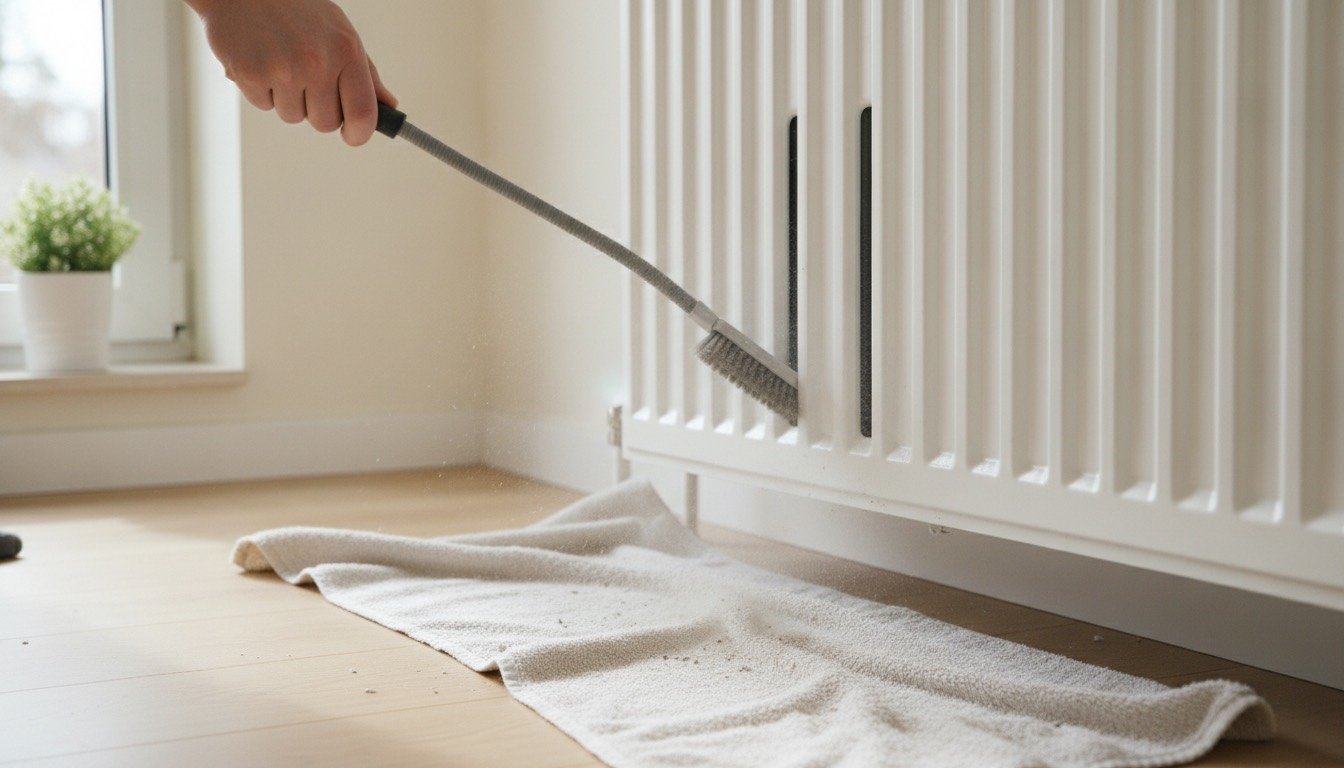
- •Sweep the radiator brush down through every fin channel, top to bottom, across the full width.
- •Point a hairdryer on cool down through the fins from the top for the dust the brush missed — the towel catches what falls, and it's always more than expected.
- •Vacuum the fallout, the floor, and the wall behind — the dust shadow on the wall marks the convection path and collects there again if left.
- •Wipe the outer panels with a microfibre cloth and warm soapy water — nothing abrasive on painted finishes, which scratches and invites rust.
- •Let everything dry, reattach the grille, and turn the heating back on, checking the valve and joints for drips.
Convector, column and cast iron radiators
Double or triple convector panels have thin fins sealed between front and back panels, often with no grille to unclip — the hairdryer-and-brush combination through the top slots is usually the only way in without lifting the radiator off its brackets.
Column and cast iron radiators, common in Victorian and Edwardian houses, have wide gaps that collect dust constantly, one of several reasons a room can feel dusty even when the rest of the house is clean (our guide to why a house gets dusty covers the others). A long soft brush or a vacuum with a narrow head, run down each gap, clears these far faster than wiping by hand.
Fixing yellowed paint, rust spots and chips
White radiator paint gone cream at the edges has heat-aged, not just got dirty, and no washing brings it back. The fix is radiator enamel applied cold, heating off for 24 hours either side. If you've never painted metalwork, the prep and cutting-in technique in our how to paint a room guide translates directly, even though it's written for walls.
Rust spots need treating before they spread, not painting straight over — that only buys a few months. Sand back to bare metal, wipe away dust, apply metal primer, then radiator topcoat once cured. Deep pitting or rust around a valve joint is past a touch-up and worth a proper look before it becomes a leak.
Common radiator cleaning mistakes to avoid
- •Using a scouring pad on painted panels — it scratches the finish and creates bare metal spots rust needs to start.
- •Wiping only the outer casing and skipping the fins, where most of the trapped dust actually sits.
- •Cleaning a radiator while it's still warm — bristles mat, and a hot edge easily burns a knuckle.
- •Painting over active rust instead of treating it first — it keeps working under the new coat.
- •Ignoring dust around the thermostatic valve head, which can affect how accurately it reads room temperature — see our cheap heating tweaks guide for getting TRVs working properly.
- •Skipping the annual clean because 'it's just dust' — over several winters that layer thickens enough to measurably slow how quickly a room heats.
When a clean radiator still won't heat properly
A radiator cold at the top but warm at the bottom has trapped air — bleeding it is a five-minute job; our radiator bleeding guide covers it along with re-pressurising the boiler afterwards. Cold at the bottom, or cold in patches, points to sludge rather than air, which needs a plumber and a powerflush, not a bleed key.
If one room stays cold after bleeding while the rest of the house is fine, the system may be out of balance, sending too much hot water to radiators nearer the boiler — our balancing radiators guide covers the lockshield adjustment that fixes it. If several radiators are underperforming as the season starts, work through our winter heating system checklist — an overdue boiler service is a common hidden cause.
Frequently asked questions
How often should I clean inside my radiators? Once a year, just before the heating season starts, is enough for most households. Homes with pets or dust allergies benefit from a second pass midwinter.
Does a dusty radiator really affect my heating bill? Yes, modestly per radiator — blocked fins restrict the convection airflow that does the actual heating, so it runs longer to reach the same temperature. Across a whole house it's a noticeable slice of a bill for a job costing under a tenner in tools.
Can I use a wet cloth inside the fins? Best avoided. Water dripping into narrow steel channels encourages corrosion you can't see until it's a problem. Keep the fin cleaning dry with a brush and hairdryer, and save the damp cloth for the outer panels.
Is it safe to lift a radiator off its brackets to clean behind it? Usually, but the pipes are still connected below, so lift straight up rather than pulling it away from the wall. If you're not confident, cleaning in place with a long brush works just as well with no risk to a pipe joint.
What's the difference between radiator paint and normal gloss? Radiator paint resists yellowing under sustained heat, which standard gloss doesn't — ordinary white paint goes cream within a couple of winters, while radiator enamel holds its colour for years. It costs a little more per tin but makes the real difference on something that heats up daily.
Found this useful?
There's plenty more — hundreds of guides and honestly-tested product reviews for every corner of your home.
Browse All Guides