Heating & Cooling · 6 min read · 11 August 2026
Do Fans Actually Cool a Room? Fan Placement Tricks That Work
A fan never lowers the temperature of a room — but pointed the right way, at the right time of day, it can drop a bedroom by several degrees. Here's the physics and the placement.
By the Nims Casa editorial team — written from professional cleaning experience and checked against our editorial standards.
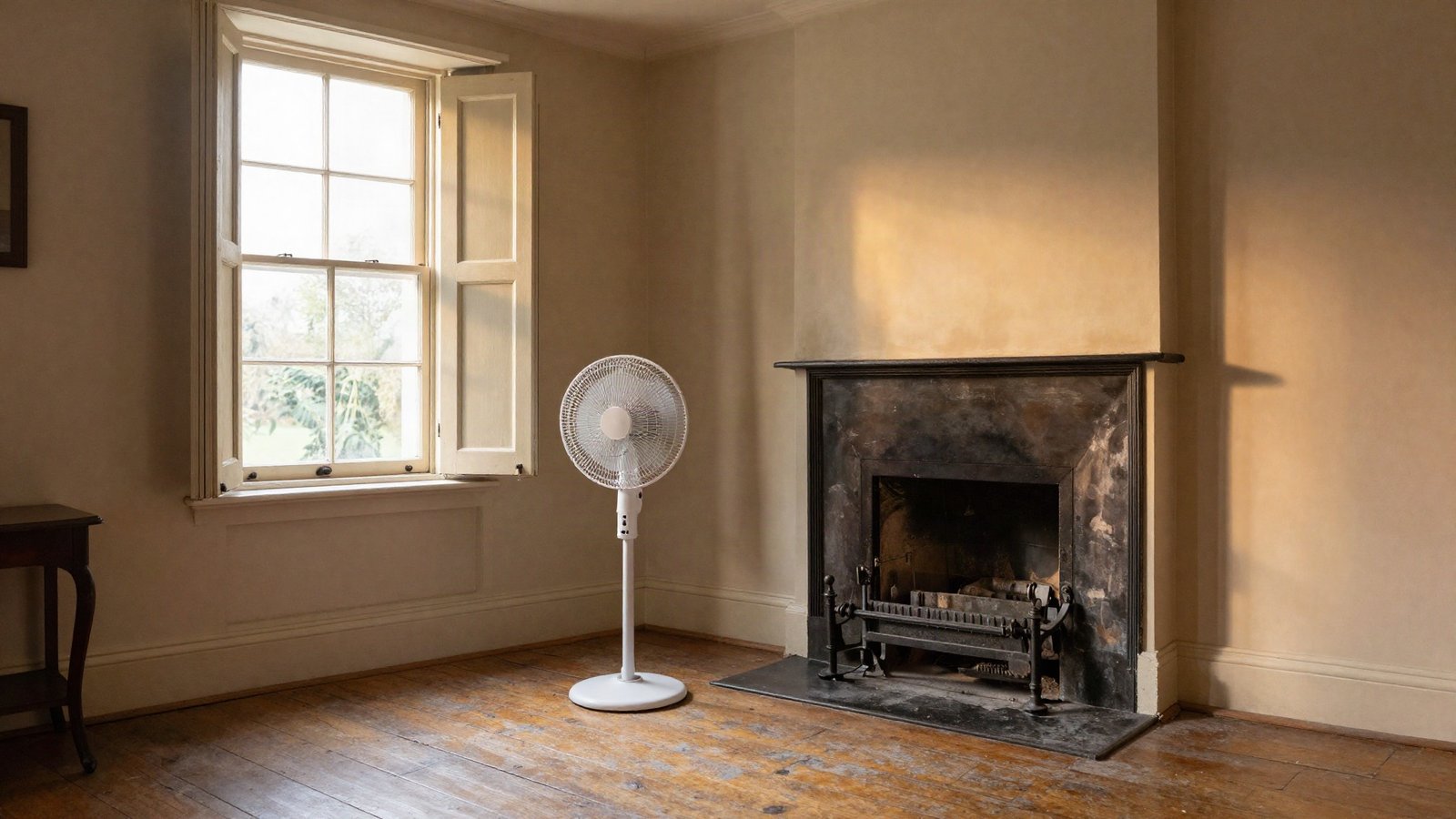
Every heatwave the same argument breaks out: leave the fan running to "cool the room down", or is that a waste of electricity? The honest answer, after twenty summers fitting ventilation in UK homes: a fan on its own does not lower a room's temperature by a single degree — the motor actually adds around 40 watts of heat. Yet pointed the right way, at the right window, at the right time of day, a fan is the cheapest room-cooling tool you own. The difference is entirely placement.
Fans Cool People, Not Rooms: The 30-Second Physics
In still air, a thin blanket of warm, humid air builds up against your skin and slows the evaporation of sweat. A fan strips that boundary layer away, so evaporation speeds up and you feel 3 to 4 degrees cooler than the thermometer says. It is wind chill, nothing more.
Two consequences follow. A fan blowing into an empty room achieves nothing except warming it slightly, so switch it off when you leave. And past about 35°C — hotter than your skin — a fan starts blowing heat onto you rather than carrying it away. UK rooms rarely get there, but a south-facing loft room in late afternoon can.
The One Setup That Genuinely Cools the Room
Exactly one arrangement lowers the actual temperature: pointing the fan out of the window once the outside air is cooler than the inside — typically from 8pm on a British summer evening. The fan exhausts the day's trapped heat, creating gentle negative pressure that pulls cool evening air in through every other opening.
Set the fan on the sill or a chair, blades facing the garden, and open a second window as far away as possible, ideally on the opposite, shaded side of the house. Run it for two to three hours: a bedroom that has sat at 28°C all day will reliably reach 23–24°C by 11pm. Two fans? Put the second at the intake window facing inwards for a push-pull system moving roughly double the air.
Cross-Ventilation Setups for Real UK Layouts
The exhaust trick works best when air has a clear path through the house:
- •Terraced house: one front and one rear window open, fan exhausting at the rear (usually the shaded side by evening). Prop internal doors fully open — a door ajar chokes the flow.
- •Two-storey house: exhaust upstairs, draw in downstairs on the shaded side. Warm air rises anyway, so you are working with the stack effect.
- •Single-aspect flat: with windows on one wall only, run two fans in the same opening — one half exhausting, one drawing in.
- •Bedroom-only: fan exhausting at the bedroom window, door open, landing window cracked. Thirty minutes before bed often does it.
- •Daytime rule: while it is hotter outside than in (roughly 11am to 7pm), do the opposite — windows shut, curtains closed on the sunny side. Midday ventilation just imports heat.
Old Houses Play by Different Rules
Victorian and Edwardian homes have advantages a 1990s estate box does not. Nine-inch solid brick walls carry huge thermal mass: they take two or three days to warm through, then dump that stored heat back at night. The strategy is the night purge — shut the house up all day, then ventilate hard with exhaust fans from 9pm until the walls have given up their heat, often past midnight in the second week of a heatwave.
Original sash windows were designed for this job. Open the top sash 100–150mm and the bottom the same, and you get a convection loop in a single frame — warm air out of the top gap, cooler air in at the bottom, no fan required. If your sashes are painted shut, as about half the ones I meet are, our guide to restoring original timber sash windows covers freeing and re-cording them. The same draught-proofing work that saves money in January makes summer ventilation controllable — air then only moves through openings you choose.
Two cautions. Lath-and-plaster ceilings will not hold a ceiling fan screwed into the laths — it must fix to a joist or a spreader board, as covered in our ceiling fan installation guide. And if the ceiling rose is still fed by pre-1970s rubber-insulated cable, have an electrician look first; that insulation crumbles when disturbed.
The Bowl of Ice and Other Tricks, Ranked Honestly
Every August the same hacks do the rounds. Ranked by how much they actually help:
- •Ceiling fan spinning anticlockwise (downdraught): best of the lot for occupied rooms — a steady 2–3°C of perceived cooling over the whole bed for about 20W. Check yours with our guide to ceiling fan direction in summer vs winter.
- •Fan exhausting out the window after 8pm: the only trick that lowers the thermometer reading. Do it every hot evening.
- •Bowl of ice or frozen bottles in front of the fan: real but modest — a cooler breeze for one person within a metre, for 20–30 minutes, while adding humidity. Fine for a desk, pointless for a room.
- •Damp sheet over an open window: evaporative cooling that suits dry continental heat but not a muggy UK heatwave — saturated air cannot absorb much more moisture.
- •Fan running all day in a sealed, empty room: worse than useless. You have built a very slow 40-watt heater.
Running Costs, and When a Fan Isn't Enough
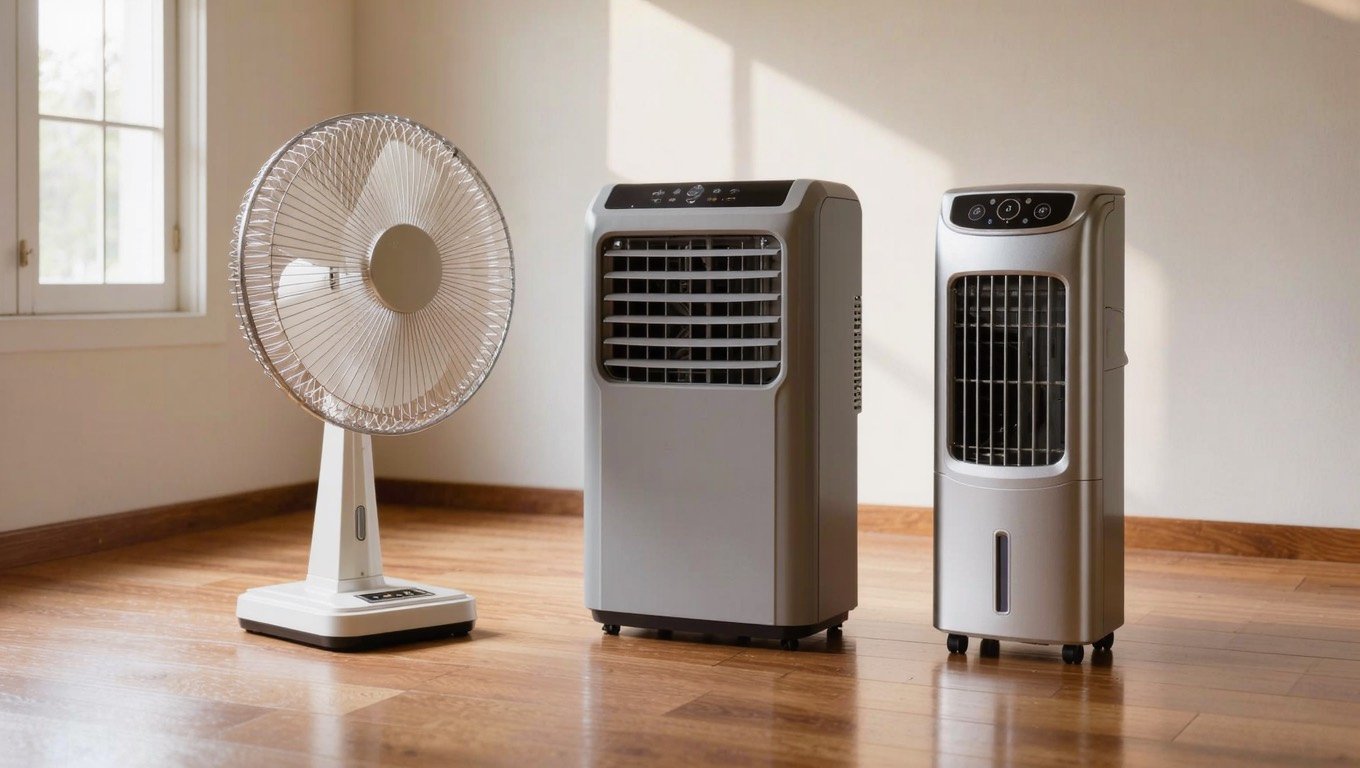
At around 26p per kWh, a 45W pedestal fan costs just over 1p an hour — a full night's sleep for about 10p. A DC tower fan halves that; a ceiling fan on low draws less than a phone charger. This is why every summer comfort problem should start with fans.
Muggy nights are the exception. Once indoor humidity passes about 70 per cent, sweat stops evaporating efficiently and a fan loses most of its power; on close, sticky nights a dehumidifier run for an hour before bed often does more for sleep than the fan itself. And if a bedroom still sits above 26°C at midnight after a proper night purge — common in loft conversions and flats over shops — airflow has hit its limit. Air conditioning costs 25–30p an hour, so treat it as a single-room tool and size it with our air conditioner sizing guide before spending anything.
Fan FAQs
- •Window open or closed? Cooler outside than in: open, fan exhausting. Hotter outside (most of the daytime): closed, curtains drawn, fan pointed at people.
- •Is sleeping with a fan on bad? For most people no. If you wake with a dry throat, aim it across the bed rather than at your face, or use the timer.
- •Does a fan in a doorway help? Yes — about a metre back from the opening, pushing air through it. Right in the doorway it fights its own turbulence.
- •Do bigger fans work better? A large blade moving slowly beats a small blade at full speed: more air, far less noise at 2am.
- •Should the fan point at the ceiling? In a closed daytime room, angling it up mixes the hot layer at ceiling height — useful in tall Victorian rooms, where the top metre of air runs 4°C warmer than head height.
Found this useful?
There's plenty more — hundreds of guides and honestly-tested product reviews for every corner of your home.
Browse All Guides