Tools & Workshop · 6 min read · 19 May 2026
Pocket Holes vs Dowels: Strength, Cost and Which to Use in a UK Workshop
Both joints hold a bookcase together for decades, but they fail in completely different ways. Here is what each really costs, which one survives being moved, and what a tenant can safely build.
By the Nims Casa editorial team — written from professional cleaning experience and checked against our editorial standards.
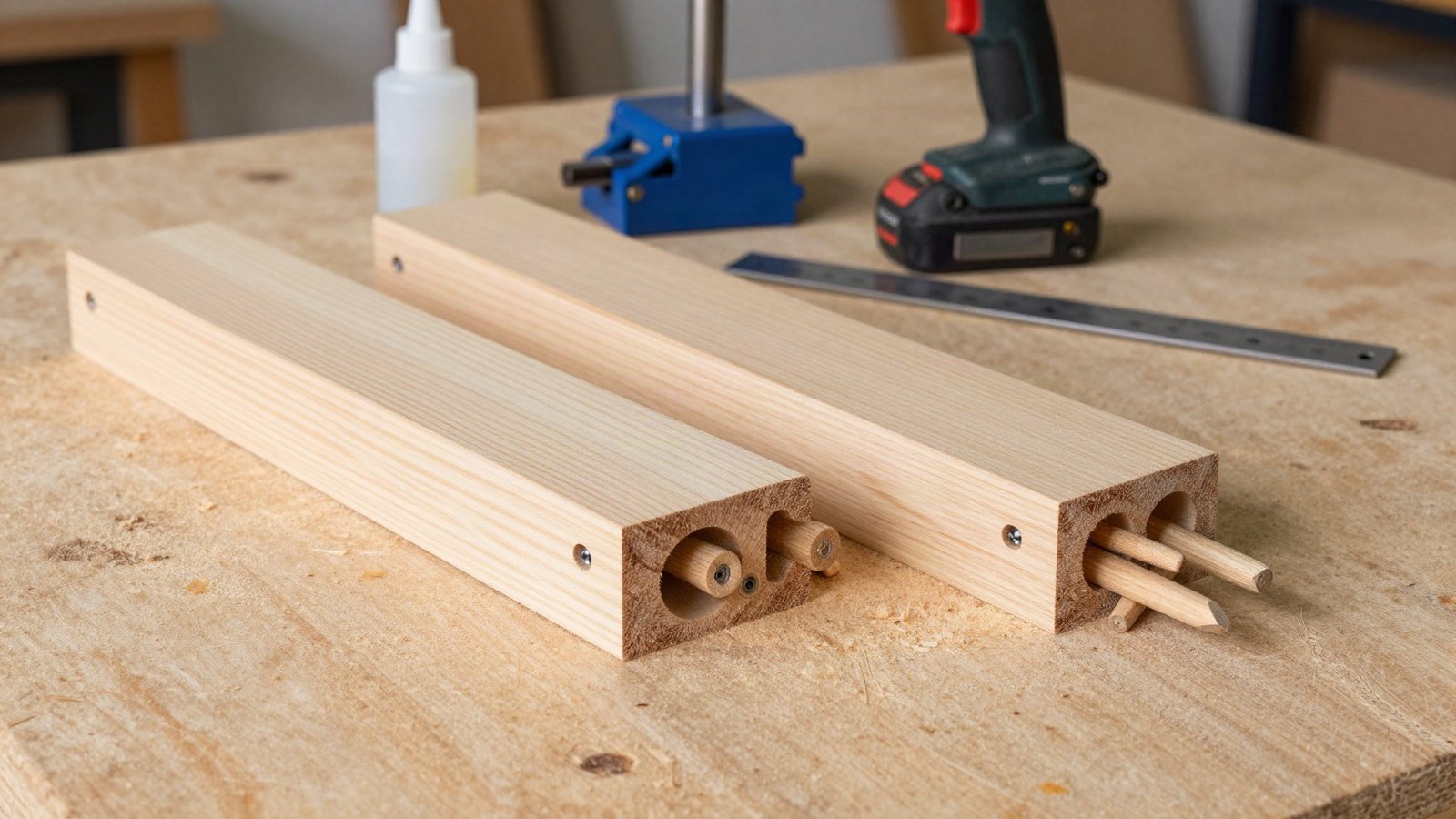
Two boards, one right angle, two very different philosophies. A pocket hole is a mechanical fastener driven at roughly 15 degrees through one board into the face of another. A dowel joint is a glue joint, with wooden pins doing the alignment and the shear work.
We build the same carcases both ways every year, and neither is universally better. What differs is where the load goes, what happens in year eight when the joint loosens, and whether you can ever take the thing apart again. That last point matters more than most guides admit, particularly if you rent.
The 60-second comparison
Figures are UK retail, 2026, for 18mm stock.
- •Kit cost: pocket holes £40–£220 for a jig plus £12–£25 a box of screws. Dowels £30–£60 for a self-centring jig plus about £8 per 100 beech dowels.
- •Time per joint: pocket holes 60–90 seconds with one face clamp. Dowels 3–5 minutes, then 30–60 minutes in sash clamps (£20–£25 per 900mm) before the assembly can be moved.
- •Accuracy: dowels self-align and pull square. Pocket screws creep sideways as they bite, so the joint slips unless the faces are clamped flush.
- •Racking resistance, the twist that kills bookcases: dowels clearly ahead. Two 8mm dowels resist rotation; a screw line pivots.
- •Visibility: dowels are invisible. Pocket holes leave a 10mm oval on the hidden face — fine inside a cabinet, ugly on an exposed back.
- •Reversible: pocket holes yes, if you skip the glue. Dowels no, once PVA has cured. Both are weak into the raw edge of MDF.
Strength: what actually fails, and how
Load a pocket-screwed T-joint sideways and the failure is predictable: the screw acts as a pivot, the timber around the shank crushes, the hole elongates, and a wobble appears long before anything snaps. A dowelled joint loaded the same way holds until the glue line or the timber splits, because the load spreads across two glued cylinders and a far larger bonded area.
The nuance most guides skip: a pocket hole joint with a bead of PVA on the mating face is a different animal to one relying on screws alone. The screws become clamps, holding the surfaces tight while the adhesive cures, which closes most of the racking gap for nothing. Use a D3-rated PVA, for the reasons in our notes on the best wood glue.
Pocket holes win on straight tension along the screw axis: face frames, cleats, anything pulled apart rather than twisted. Dowels win on panel glue-ups and any carcase carrying books, tools or a television. For how both sit against mortise and tenon, biscuits and dominos, start with our basic woodworking joints guide.
Cutting and assembly: where each one goes wrong
Both jigs are simple. Both have one setting beginners get wrong, then blame the method for.
- •Pocket holes: set the jig collar and the drill stop collar to the same stock thickness. Mismatch them and the screw breaks through the show face or stops short of grabbing.
- •Pocket holes: coarse thread for softwood, ply and MDF; fine thread for oak and beech. Coarse screws in oak split the receiving board about one time in five.
- •Pocket holes: 32mm screws for 18mm stock, 38mm for 22mm. Set the clutch to about 6 of 20 on an 18V drill and finish by feel.
- •Dowels: 8mm fluted beech dowels 30mm long in 18mm stock, drilled 17mm into each half. Fluted, not smooth — the grooves let trapped glue escape instead of hydraulically splitting the board.
- •Dowels: two per joint minimum, 40mm in from each edge. One dowel is a hinge, not a joint. Dry-fit the whole carcase first; once PVA is on you have about 8 minutes to slide it square.
The 10-year cost, worked through
Per joint the consumables are nearly identical — about 15p for a pocket screw, 8p for a dowel plus glue. The real cost sits in the jig and the clamps.
Ten years of pocket holes, casual use: mid-range jig £85, five boxes of screws at £18 each (£90), one face clamp £25, and a replacement stepped bit around year six at £18. Total roughly £218.
Ten years of dowelling: self-centring jig £45, 500 beech dowels £40, four bottles of D3 PVA (£28), four 900mm sash clamps at £22 each (£88). Total roughly £201 — though those clamps earn their keep elsewhere, so the joinery-only figure is nearer £113.
Worked example, an 1800mm bookcase in 18mm ply, 24 joints: pocket holes cost about £3.60 in screws and 40 minutes; dowels about £2.20 and roughly two hours including clamping waits. Pocket holes win the single-project maths; dowels win on the finished object.
Repair, movement and living with the joint
UK homes swing between roughly 35% and 60% relative humidity over a year and timber moves with it. A pocket-screwed joint absorbs that by loosening — nip the screws up once, sometimes twice, before the threads strip in softwood. The fix is a 6mm dowel glued into the stripped hole, left overnight, then re-drilled. A dowelled joint either holds indefinitely or opens as a hairline you must cut out and re-pin.
Repairability favours pocket holes heavily. A wobbly dowelled carcase means a mallet, snapped dowels and cured glue in blind holes — the grim process covered in our guide to repairing wood furniture. The pocket-hole equivalent is a screwdriver and five minutes.
The renter-safe version
In a tenancy, the joint matters less than whether the piece is freestanding and demountable. Anything drilled into a wall is a deposit conversation. The renter's play is pocket holes with no glue on the carcase joints: unscrew, stack flat, move, reassemble. Glue only the face frame. A 1.8m dowelled bookcase cannot be flat-packed, and often will not turn the half-landing of a Victorian terrace.
- •Build freestanding. Deep units get an anti-tip strap, not four screws through the plasterboard.
- •If you must fix to a wall, use a French cleat — two fixings into studs rather than a full run, and easy to make good.
- •Avoid wall-hung designs in rented flats; the load path of floating shelves needs heavy plasterboard or masonry fixings landlords rarely welcome.
- •Photograph the walls first, keep leftover filler, and patch and touch in before check-out.
- •Pick materials that survive two moves — 18mm birch ply over MDF, for the reasons in our plywood vs MDF comparison.
Who each suits, and the verdict
Pocket holes suit cabinets, face frames, garage shelving, workbenches and jigs — anywhere speed matters and the joint is hidden. They suit renters, anyone without a clamp collection, and anyone expecting to move the piece. Dowels suit visible furniture, panel glue-ups, chairs and tables, and anything twisted in use.
The verdict: pocket holes for boxes, dowels for furniture. If you buy one jig this year, buy the pocket hole jig — it builds the shelving that lets you build everything else, and glue closes most of the strength gap. Add a dowel jig when you start making things people sit on. First, though, spend twenty minutes on the woodworking mistakes beginners make: wrong screw length and unclamped faces cause most early failures.
Found this useful?
There's plenty more — hundreds of guides and honestly-tested product reviews for every corner of your home.
Browse All Guides