Electrical · 5 min read · 27 May 2026
Signs Your Electrical Panel Needs an Upgrade: Reading a UK Consumer Unit Before It Fails
Most fuse boards get replaced only after something has already gone wrong. Here is how to read yours from the outside, in the order a surveying electrician does it.
By the Nims Casa editorial team — written from professional cleaning experience and checked against our editorial standards.
Most consumer units get replaced for one of two reasons: something has already burned, or a buyer's survey finally wrote it down. Both are late. The board in the hall cupboard decides whether a fault on the kitchen ring ends as a tripped breaker or a call to the fire service, and almost every board fitted before 2000 was designed for a house with a 3kW immersion heater, not an induction hob and a car on charge overnight.
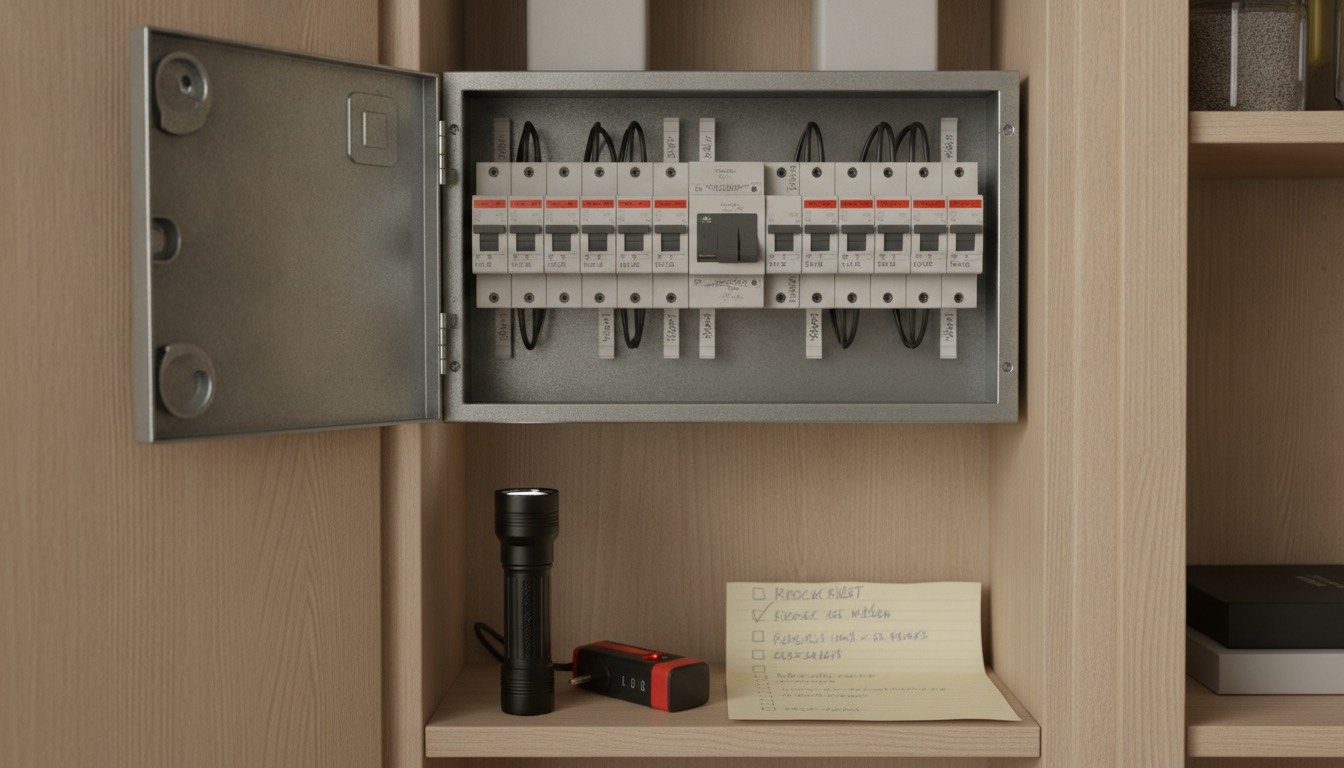
The useful thing is that a fuse board tells you most of what you need to know from the outside. Every check below is done with the cover on and a phone torch, in survey order.
The ten-minute diagnosis, cover on
Photograph as you go. Nothing here needs a screwdriver. If the cupboard smells hot before you open the door, skip to the last section.
- •Identify the type. Ceramic carriers you pull out by hand mean a BS 3036 rewireable board, usually 1960s to early 1980s. Small switches that flick down are miniature circuit breakers.
- •Hunt for a test button. RCDs and RCBOs carry a button marked T or Test. None anywhere means no residual current protection at all, the single biggest safety gap in UK housing stock.
- •Press each test button, having warned the household and shut down computers. It should trip instantly and firmly; a sluggish trip, or one needing a second press, is a failed device.
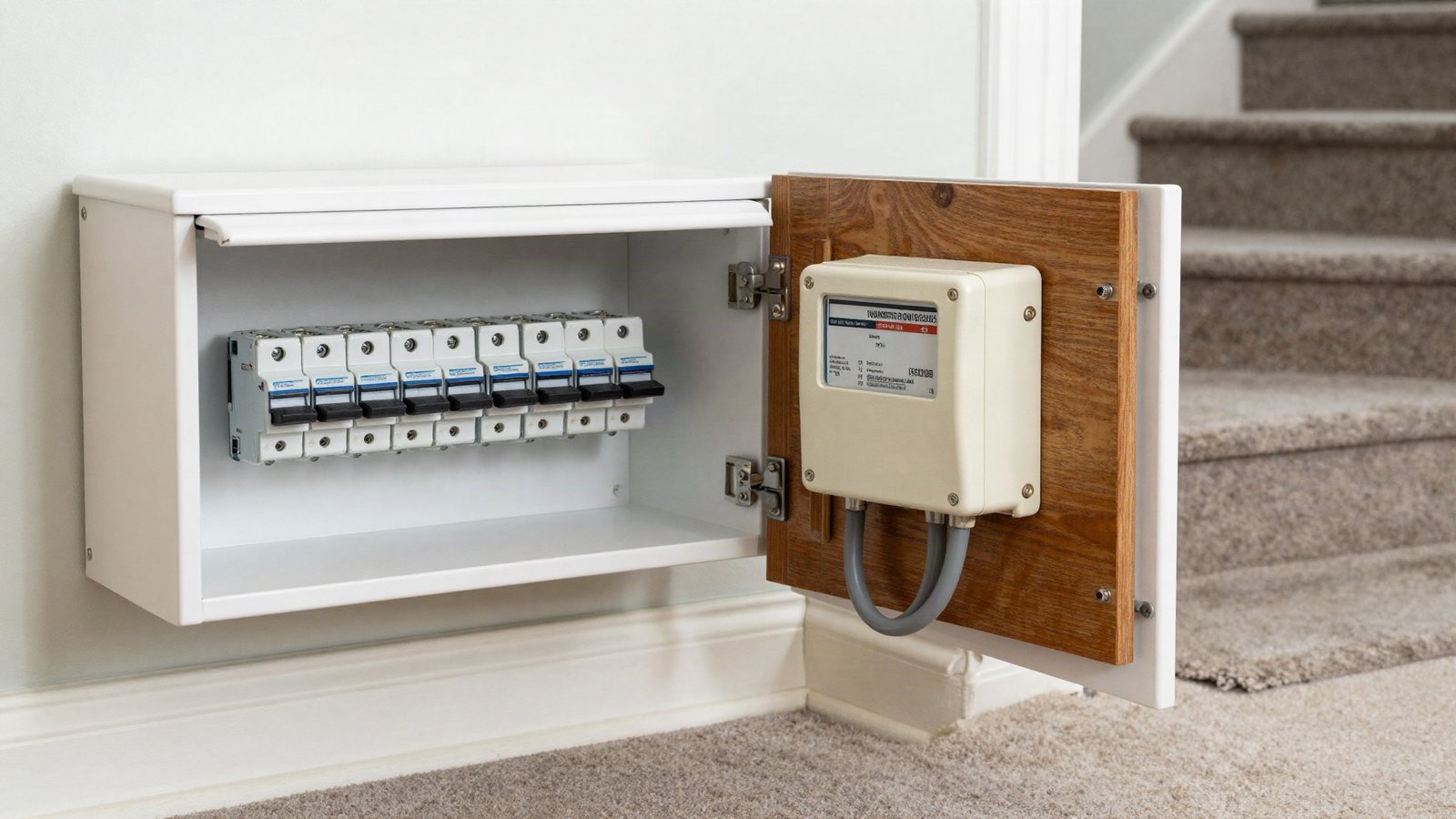
- •Check the enclosure. Since January 2016 domestic consumer units have had to be non-combustible, in practice steel. Plastic screwed to a wooden backboard under a timber staircase is a real fire-spread concern.
- •Count spare ways. Fewer than two free slots means any future shower, garden supply or charge point forces a board change anyway.
- •Look and sniff. Amber staining around a breaker, a fishy or bakelite smell, faint buzzing, or warmth through the cover are stop-now findings.
- •Read the main fuse, the sealed unit with the supplier's tag. A 60A cut-out caps the house at roughly 13.8kW; the network operator upgrades it to 100A, not your electrician.
Symptom to cause: what each sign means
Symptoms rarely point where people assume. A tripping breaker is usually doing its job; the quiet faults are the ones that matter.
- •Lights dim when the electric shower starts: voltage drop from undersized meter tails or a 60A cut-out, not a board fault.
- •One breaker trips only on the washing machine's heater cycle: a failing element, confirmed by moving the machine to another circuit.
- •The whole house goes dark when one appliance faults: a split-load board where a single 30mA RCD covers far too many circuits. The usual trigger for an upgrade.
- •A breaker warm to the touch, or buzzing: a loose termination, or a breaker no longer gripping the busbar. This gets worse, never better.
- •Burning smell with nothing tripping: high-resistance arcing that never draws enough current to operate a fuse. The most dangerous entry here.
- •Switch plates yellowing across several rooms at once: rubber or lead-sheathed cable perishing with age. A new board will simply trip on it constantly.
Causes, ordered by how often we find them
Across a run of UK surveys the reasons for recommending a new board fall out in roughly this order, and most concern protection and capacity rather than a broken unit. Missing or partial RCD protection leads by a wide margin, typically a 1990s board where sockets were protected and the lighting and cooker left bare. Second is capacity: no spare ways, which bites the moment anyone wants an EV charge point fitted at home. Third is shared-RCD nuisance tripping, what most people are really describing when a circuit breaker keeps tripping across unrelated appliances.
Further down come combustible enclosures on timber backboards, obsolete breakers nobody manufactures, 16mm² tails on a 100A supply, and perished cable. That last one matters most: with 1950s rubber wiring you are pricing a rewire, not a consumer unit change.
Fixes, ordered from lowest risk to highest
Work down this list, not up it. The cheap steps often make the expensive ones unnecessary, or prove they are needed.
- •Free: read the existing Electrical Installation Condition Report. C1 means danger present, C2 potentially dangerous and remedy required, C3 improvement recommended and can wait.
- •£150 to £300: commission an EICR on a two- or three-bed home. Three to four hours, and the only honest basis for the decisions below.
- •£12 to £25: a plug-in RCD adaptor for outdoor tools on an unprotected board. A stopgap only.
- •£70 to £140 per way: retrofitting RCBOs where a compatible range is still made. Cheaper than a full change if only three or four circuits are bare.
- •£450 to £900: full consumer unit replacement including circuit testing and Part P notification. Add £150 to £300 for London rates or a relocation.
- •£3,500 to £6,500: rewiring a three-bedroom semi with a new board, making-good excluded. Our rewiring cost breakdown covers what pushes that towards five figures.
The renter-safe version: what a tenant can do reversibly
Tenants have more leverage here than almost anywhere else in the home, and none of it involves tools. In England, private landlords have had to hold a valid EICR since April 2021, renewed every five years, and must supply a copy within 28 days of a written request. Ask in writing, keep the email, read the codes not the summary line. Scotland has a parallel five-yearly duty under its repairing standard.
Everything else is reversible and leaves no mark: photograph the board on day one alongside the meter reading, buy a £15 plug-in socket tester, use an RCD adaptor for garden tools, and keep high-draw appliances off shared extension leads. Report any C1 or C2 finding, or any warmth, buzzing or scorching, in writing rather than by phone. If nothing happens in a fortnight, environmental health can serve a remedial notice.
What a tenant must not do is add circuits, swap the board, drill for new sockets or fit anything hardwired. The reversible-only logic behind rental-friendly decor applies with far higher stakes here: the deposit is the smallest thing at risk.
Where DIY stops, and the legal boundary
Replacing a consumer unit is notifiable work under Part P of the Building Regulations in England and Wales. It must be certified by a registered competent person through NICEIC, NAPIT or ELECSA, or notified to building control beforehand at a cost that usually exceeds the saving. Scotland and Northern Ireland impose equivalent duties. Doing it quietly surfaces at conveyancing and hands an insurer a reason to argue after a fire.
The practical line: you may identify the board, press an RCD test button, label circuits and reset a tripped breaker once. Anything involving the cover, the tails, the main switch or the meter is out of bounds, because the supply side stays live even with the main switch off. Our list of electrical jobs that should never be DIY draws the same boundary from the other side.
Call an electrician on the emergency rate, £90 to £160 for call-out and first hour, if you find scorching, a burning smell, a breaker too hot to touch, an RCD that will not reset, or water near the board.
Found this useful?
There's plenty more — hundreds of guides and honestly-tested product reviews for every corner of your home.
Browse All Guides