Heating & Cooling · 6 min read · 17 July 2026
Signs Your Furnace Needs Replacing: The UK Boiler and Warm-Air Diagnosis
Almost no British home has a furnace in the American sense, but boilers and ducted warm-air units fail in the same predictable order. Here is how engineers choose between one more repair and a replacement.
By the Nims Casa editorial team — written from professional cleaning experience and checked against our editorial standards.
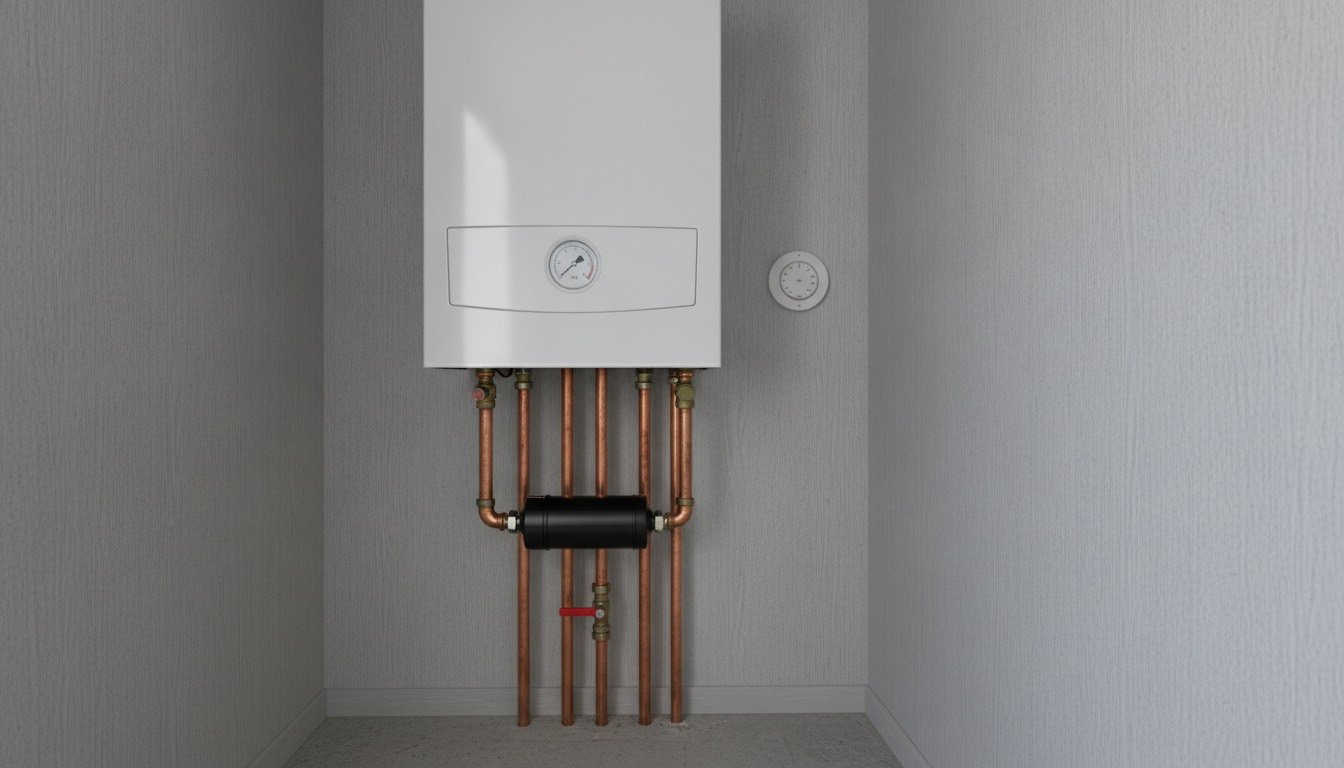
Roughly nine in ten British homes heat water in a boiler and push it round radiators. Genuine ducted warm-air units — Johnson & Starley WarmCair machines, old Lennox installs — survive mainly in 1960s and 70s estate housing where nobody ripped the ductwork out. Both wear out, both warn you the same ways, and both sit under the same law: if it burns gas, you cannot legally open the combustion side yourself.
The real question is whether another £400 repair buys a winter or five years. What follows is the order an engineer works through it — from minute-long checks to the ones ending with a warning label cable-tied to the gas cock.
The 60-second diagnosis
Before reading a single fault code, test the appliance against these six triggers. Two or more and replacement beats repair.
- •Over 15 years old and out of warranty. Combis last 10-15 years, heat-only boilers 18-20; warm-air units run 25 but are long parts-orphaned.
- •The repair quote exceeds 40-50% of a straight swap — above roughly £900 against a £2,000-£2,600 combi exchange.
- •Two or more unrelated faults in one heating season — a system problem, not a part.
- •Spares on back-order — manufacturers typically commit to parts for about ten years after a model is withdrawn.
- •A cracked primary heat exchanger or weeping gas valve — no decision to make; that appliance is finished.
- •Sooty staining, a lazy yellow flame on an open-flued appliance, or a CO alarm sounding. Turn it off, open windows, ring 0800 111 999.
Symptom to cause: what it is telling you
Faults announce themselves months before they strand you, and the pattern matters more than the noise. If yours will not fire at all, work through the step-by-step heating troubleshooter first; this list is for appliances that still run, badly.
- •Pressure falls below 1 bar every few days — a leak, a failed expansion vessel, or a relief valve weeping from the copper pipe outside.
- •Banging or kettling on start-up — limescale and magnetite baked onto the heat exchanger. Endemic across the hard-water belt from Cambridgeshire to Kent.
- •Short cycling: fires for 60-90 seconds then drops out — an oversized boiler against a small load, or a dying flow sensor.
- •Repeating lockouts (Worcester EA, Vaillant F28, Ideal L2) — ignition or flame-sensing faults a reset only masks.
- •Gas use up 15-20% with no change in habits and a clean service history — combustion efficiency is falling away.
- •Warm-air only: a hot-dust smell that never clears, or heat discolouration at the plenum. Treat as a cracked exchanger until proven otherwise.
Causes, ranked by how often we find them
Order matters: it stops you spending £700 on a control board when the culprit is suspended iron oxide.
- •1. Sludge and scale — the most common cause by a distance, and behind most kettling, cold-bottomed radiators and pump failures.
- •2. Wear parts at design life: diverter valves, fans, pumps, three-port actuators, PCBs, usually 8-12 years in.
- •3. Bad original specification. Oversized combis in two-bed flats short-cycle themselves to death in a decade.
- •4. No system protection — no magnetic filter, no inhibitor since installation, hard water and no scale reducer.
- •5. End-of-life corrosion of the heat exchanger, or of the exchanger casing on warm-air units.
- •6. Controls, last — cheap and quick to swap, which is why they get blamed for everything else.
Fixes in order of risk
Work down; stop where your competence stops. If one room is cold rather than the whole house, the fault is distribution, not the appliance — see why one room runs colder than the rest.
- •Free, 10 minutes: check programmer times, thermostat batteries, the fused spur and meter credit. One call-out in eight is one of these.
- •£0-£15: bleed the radiators and re-pressurise to 1.0-1.5 bar cold. Needing this more than twice a year means a leak, not a habit.
- •£8-£15 quarterly: on warm-air units, change the EU4 panel filter; a blocked one overheats and cracks the exchanger.
- •One reset only. Lock out twice in a week and you are re-igniting an appliance that has decided not to.
- •£120-£250 fitted: magnetic filter on the return, chemical clean, fresh inhibitor — the best-value job here. A full powerflush is £350-£600.
- •Behind the case — gas valve, burner, heat exchanger, flue, combustion analysis: Gas Safe registered engineers only, by law.
Where DIY stops — that is law, not opinion
Under the Gas Safety (Installation and Use) Regulations 1998, only a Gas Safe registered person may work on a gas appliance or its fittings; oil is OFTEC, solid fuel HETAS. Check the back of the engineer's card: it lists the appliance types they hold, and warm-air is a separate competency from boilers.
If an engineer applies the Gas Industry Unsafe Situations Procedure, take it seriously. "At Risk" means labelled and switched off until corrected; "Immediately Dangerous" means they will ask to disconnect on the spot and notify the emergency service provider if you refuse. On an old unit that ends the repair conversation. Any suspected combustion fault should also send you to the basics of preventing carbon monoxide poisoning — a BS EN 50291 alarm costs under £25 and lasts five to seven years.
Landlords carry harder duties: an annual gas safety check, the record to tenants within 28 days, and a CO alarm in any room with a fixed combustion appliance other than a gas cooker. Nursing one through another winter is not an option in a let property.
Replacement costs, and what the regulations force you to buy
Replacing a boiler is notifiable under Part L of the Building Regulations; the engineer self-certifies and a compliance certificate follows from Gas Safe within weeks. Keep it, because a conveyancing solicitor will ask. Boiler Plus rules in England set the minimum spec too: at least 92% ErP efficiency, time and temperature control, plus one of load compensation, weather compensation, flue gas heat recovery or a smart control with automation and optimisation. That is the standard, not an upsell.
As a 2026 guide, a like-for-like combi swap runs £1,900-£2,800; with a flush, filter and new controls, £2,600-£3,400; relocating the boiler or stripping an old back-boiler adds £500-£1,200; a system boiler with unvented cylinder lands at £3,200-£4,800. Warm-air like-for-like is £3,500-£5,500, converting to wet radiators £6,000-£9,500. The fuller boiler replacement cost breakdown splits labour from materials; if you are considering leaving gas, start with air source heat pump costs after the Boiler Upgrade Scheme grant.
Two checks before signing: insist every quote states output in kW, not just a model name — a 30kW combi in a two-bed terrace short-cycles from day one — and ask what happens to the existing pipework before the new appliance goes on it.
When one more winter is the right call
Replacement is not automatic: a twelve-year-old system boiler with a good service history, clean flue gas analysis and one failed pump is worth £180 and a few more years. But boilers rarely fail gracefully in February, so on three or four triggers, book the swap for late spring when quotes run 10-15% keener. Fix the fabric first — draught-proofing and honest loft insulation can cut the heat load enough to justify a smaller, better-modulating appliance.
Found this useful?
There's plenty more — hundreds of guides and honestly-tested product reviews for every corner of your home.
Browse All Guides